Friday, January 16, 2009

Bee-eaters: just my b..... luck


Seldom have much luck getting close to Rainbow Bee-eaters (Merops ornatus) when I've a camera in hand. Large flocks close up against blue skies are memories of non-photographic yesteryears. 

But there have been a few pirripping here and there in paperbarks and launching out after dragonflies and other insects - almost certainly not bees. (At risk of repeating myself, Rainbows rarely show any interest in Tyto honeybees, which four years ago swarmed in to a large tree hollow and took over from a pair of Masked Owls.)


Two of the birds this week proved a little less wary than the rest. The light was ever changing as clouds white and grey rushed west, now and then leaving frustratingly small blue holes and some sunlight. 


Just my luck, though, to find the one bird that stayed low and let me walk up to it looked as if it recently went through a car wash - backwards! It seemed healthy, without any sign of parasites. Just moulting, I suppose. The other bird let me even closer, without ever presenting itself in good light or at good height. B..... bee-eaters! 

Wednesday, January 14, 2009

Trickle of birds as Tyto floods


Plenty of rain, but Tyto wasn't looking too wet today. A bit of water running over a track, some paperbarks and razor grass sitting in deeper water, unwanted rampant lotuses going under, a few trees with limbs shattered by weight of water and gusting winds. In fact, surprisingly little flooding, given more than 300mm in 24 hours on Monday and heavy showers yesterday.

Improved culverts on the highway allowed much swifter outflow of floodwater than in previous years. Newly completed rock-lined lagoons overtopped yesterday by 700mm-800mm of surging brown water were today back to merely brimming.

But few birds were on any of the water or its edges, though there was plenty of activity in the trees. Best sighting on my morning cycle was a Black Bittern. Also showing out briefy: Buff-banded Rail, Pale-vented Bush-hen, White-browed Crake, Black-necked Stork, Comb-crested Jacanas, and Magpie Geese. No ducks, pigmy geese, egrets, cormorants.


Didn't feel like risking the new camera and lens, so pressed the old Panasonic FZ30 back into service. Pictures not quite so sharp, but came across a Long-necked Turtle and a White-bellied Cuckoo Shrike to get some wildlife into the morning's ride.


A tail piece about the 'nannyism' threatening all sorts of outdoor recreation. Note the water flowing across the track (above). Be aware there's a crocodile warning near Tyto's lookout (one croc seen in five years, but ever a possibility). I've been told that the track doesn't conform with safety guidelines even when most of the year it stands 300mm-500mm clear of the main lagoon (left in picture).

Such guidelines, enforced rigidly, would close much of Kakadu, many other northern national parks and nature reserves, and huge numbers of boat ramps. Informed and sensible caution, yes; mollycoddling for all, NO! And don't get me started on croc and shark hysteria... 

Monday, January 12, 2009

Wildlife charms: wild life harms


Agile Wallabies (Macropus agilis) often adopt poses sure to bring a smile to most watchers. There's no intention on their part to amuse. The heads-up quizzicality usually denotes uncertainty and general wariness. Yet such knowledge cannot stop a grin every time I see two such as those above, pictured near Tyto's first lagoon a few mornings ago. Equally charming is the natural 'grin' of a wallaby as (below) its mouth opens while chewing.
 
But no wallaby would today have been looking so photogenic. On the edge of the weakening Cyclone Charlotte, Tyto has copped a day of downpour and gusts with the probability of another night and day or two of the same.

I have a new false roof on my caravan and so can sit comfortably dry writing about the charms of wallabies. They, however, must find such shelter as drenched flooded grass and woodland offers. No agility exists that can escape the truth of life in the wild.  

Saturday, January 10, 2009

Beating the grey skies

Rain. Showers. Threat of rain. Well, it is the Wet season. But the real rain has been falling well to the west or north of Ingham and it's been frustratingly hard to read the morning sky. I don't mind the rain, but the camera's not so keen. Even when there's no rain, the grey skies make bird photography something of a washout without plenty of flash power (which I lack).


One or two chances have offered themselves however. There's this Brown-backed Honeyeater from a sunnier moment a few days ago. And the juvenile Crimson Finch (below) with its spot of coming breast colour.
   

The stop-start weather has made short-term nonsense of my predicted inflow of birds chasing small fish as they thrash upstream into flooded grasslands. But all will come to pass!

In the meantime, looking for more birding stuff? Try I And The Bird 91  Lots of interesting bits - and an amusing false link that makes Kiwis Australian!

Friday, January 9, 2009

Cannon Ball (Tree) run

Since first seeing a Cannon Ball Tree (Couroupita guanensis) a few years ago I've been unable to pass one by without taking a deep sniff of the heady scent and checking the flowers for insects on them.


So far as I know there's just the one rather stunted specimen of C. guanensis in Ingham. It stands somewhat forlornly with a lone poinsettia (in which the headstone-adorning Magpie Larks of an earlier post nested) at the entrance to the historic cemetery.

So, a wee tribute to the tree, including a totally overdone and luridly coloured picture in the style of movie posters and pulp science fiction magazine covers of the 50s and 60s. The unnamed insects are mere bit players! 

Thursday, January 8, 2009

A year of Tyto moments

Gulp! Tagged by Duncan as part of a chain meme to list 10 memorable nature moments in 2008, I've scrabbled through my tatty sweat-stained daily notebooks praying that in my absence they'd miraculously grown magical details of marvellous sights. They haven't!

What's worse, it turns out that my most stirring moments failed to present themselves as photo opportunities. And when they did, my camera skills were not often up to the task. That's got rid of the excuses-in-advance, time to knuckle down and get the 10 off the fingertips.

First must be the Tyto morning  a Common Tree Snake slides slowly over my shoulder and coils about my hat as I sit paused on my bicycle.  Blurred getaway.
Second, enraged female Pacific Black Duck stands tall, wings flailing and furiously fights off a Little Eagle after it targets her and two ducklings ... and same day, same post ...
Third, after years of failure, a Little Bittern hunting almost out in the open. Get pictures, grainy but graphic. 
Fourth, first Tyto sighting of a Red-capped Robin. Made memorable by my misidentifying it and joining later photo to a dummy spit.
Fifth, witness Black Kite learn new fishing trick, but fail to resnatch catch.
Sixth, find Lovely Fairy-wrens and nest after years of searching.
Seventh, play time with wallabies and wagtail.
Eighth, bit of nonsense with a snarky Carpet Python.
Ninth, see a small Agile Wallaby hurtle from nowhere to boot a large Amethystine Python's head. 
Tenth. At least 10 times in 2008 hear a sweet high song. No sight of bird. No idea of species. Good to have a challenge for 2009!  

Tuesday, January 6, 2009

Dekko at 'smiling' gecko

Asian House Gecko (Hemidactylus frenatus) looks rather pleased with this night capture of unidentified prey. Hard to dislike anything so attractive, though they have taken over from native geckos throughout all Queensland coastal suburbia, and the Northern Territory. Makes one wonder if Cane Toads would be so detested had they been blessed with some natural beauty.


Blessed with great good looks, yet often the victims of irrational fear, Carpet Pythons (in this case Morelia spilota mcdowelli) often make an appearance after rain. Found this feisty one-metre snake sprawled along a guava branch in Tyto yesterday. 

Alarm calls from Yellow, Brown and Brown-backed Honeyeaters led me to the python. It always pays to check on any noisy gathering of more than two species of bird. There's usually a predator of some sort hanging around. Literally, in the case of pythons, which like to hang poised above pathways used by animal prey.


Change of pace and space with a Bluedragonfly (? species) on a lotus leaf unusually curled to show its underside colour and patterning. Intended to try for a series of insects using this leaf but 30 hours of rain and showers had by yesterday morning lifted Tyto's lagoons to gentle fullness and trickling outflow. The leaf went under early on.

The outflow through a meandering creek - and, more swiftly, by way of a northern bypass channel - brings a rush of small fish swimming against the tide. They strive to reach flooded grasslands through temporary creeklets and also plastic culverts which feed water into the lagoon system.

In turn, the fish draw egrets, herons and bitterns to the shallow flows where the fish are most vulnerable. The limited numbers of fish here and there yesterday were lucky. Apparently the birds hadn't caught up with the latest fishing reports. Not even a Black Bittern I caught distant sight of three days back. But they'll all be here soon, trust me!
    

Sunday, January 4, 2009

Wings on the headstones

Female Magpie Lark (Grallina cycanoleuca) brings vibrant life to old headstones at the Ingham Historic Cemetery. Chanced upon the bird's mud bowl nest and two near fledglings in a poinsettia as I cycled by the other day. 


The parents gave the game away with their alarm calls and half-hearted swooping at me. Too dark within the tree for worthwhile shots of the youngsters after they left the nest. But the noisy posing of the female offered dramatic possibilities. 


Unfortunately, she wouldn't let me close enough and wouldn't stay still long enough for any first-rate pictures. And the male was content to let his mate do most of the squawking!

Saturday, January 3, 2009

Yellow hello not so mellow


Bright and breezy start to 2009 and life outside the nest for this new-fledged Yellow Honeyeater (Lichenostomus flavus) on bush in front of Tyto hide. Parent bird not keen on having people around and letting everyone know it.

The Yellows thus join pairs of Brown-backed Honeyeaters, Willie Wagtails and Crimson Finches in successfully producing young from nests in the three paperbarks that ring the hide. White-breasted Woodswallows used the main vertical fork (as usual) in another paperbark just 10 metres away across a narrow and shallow channel.


But Red-browed Finches (formerly Firetails) (Neochmia temporalis) have not returned to the heights of the trees, which they have used in the past. The pictured bird is building the typical bulky oval nest within twiggy growth on an exposed branch close to a nearby track and a mere two metres above the mown grass.

The site is an odd choice for a bird that normally shows remarkable caution when approaching the nest. The nest tree is seldom reached directly. Most often, the birds carry nest material (and - after hatching - food) into an adjoining tree before sneaking across to their true destination. Makes it easier for me to watch, if all goes well.


Also easier to watch than is commonly the case, this Yellow Oriole (Oriolus flavocinctus) hunting close to the water's edge at the first lagoon. Yellow Orioles will occasionally forage for prey close to the ground in open habitat if it offers low growth with bushy stems stiff enough to carry their weight. Olive-backed Orioles stick more to the trees.      

Thursday, January 1, 2009

Colourful start to 2009

2009 looks gloomy in prospect, so a bit of colour might help give us a lift!


How about a pollen-laden honeybee (Apis mellifera) visiting a Tyto blue lotus today?


Or a Carpenter bee (Xylocopa spp.) leaving a lotus?


Pink and red are always cheering. A dragonfly (Diplacodes haematodes) rests on a lotus.


Must include at least one colourful bird. Comb-crested Jacana (Irediparra gallinacea) does a tip-toe wing stretch on the main lagoon today.

Happy New Year to all of us! 

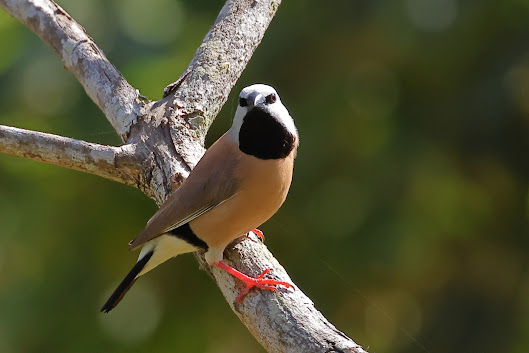
Lament for southern Black-throated Finches

Hollow logs for at risk birdies? Nature's nest boxes if you please Oh, such a clever wheeze So gather in twos and threes? Hundreds you w...