Showing posts with label Large-bill Gerygone. Show all posts

Monday, October 20, 2008

Birds in my face, under my feet

Female Rufous Whistler (Pachycephala rufiventris) flew so close to me I'd have missed this picture with other than my 28-300mm Tamron macro. Since I have no other lens, I got a picture.

Target until the whistler turned up was a juvenile Mistletoebird (Dicaeum hirundinaceum). The bird's feeding added to the colour of its vivid gape. But it stayed just out of range and light enough for a good shot.

No success with the camera at my favourite rainforest creek either. However, after joking earlier about taking years to find an Azure Kingfisher's dirt-tunnel nest, a bird popped out right under my nose (or feet) today.

Where was it? Two metres from where I watched and shot Large-billed Gerygones building their long dangling nest over the centre of a creek pool!

Over more than four weeks and at least 20 visits to the site - and many sightings of Azures - I saw no behaviour to suggest a pair of the birds had a nest virtually beneath my feet.

The water level has risen more than 600mm after recent rain. There's no easy crossing to the opposite bank. The tunnel entrance will be in shadow, severely backlit for much of the day, and eight metres off - too far for my in-camera flash.
But a bit of sit and watch is obviously called for. Keep you posted.

Sunday, October 12, 2008

Rare morning in the rainforest

The rainforest creek pools today produced rare local sightings of Orange-footed Scrubfowl (Megapodius reinwardt) and Channel-billed Cuckoo (Scythrops novaehollaniae). Noisy Pitta (Pitta versicolor), Shining Flycatcher (Myiagra alecto), MacLeay's Honeyeater (Xanthotis macleayana), Large-billed Gerygone (Gerygone magnirotris) and Azure Kingfisher (Alcedo azurea) also showed up.

Sadly, not one bird did a photographer any favours. The scrubfowl strode off sturdily, the pitta made a colourful exit into tall timber, where the channel-billed perched heavily for a few seconds before heading west, the Azure streaked away, the gerygones busied themselves in the nest, the honeyeater (below) grabbed an insect and departed, and the flycatchers mostly detoured around me.

The latter behaviour at least explained why the birds have been difficult to track. Most Shinings I've encountered elsewhere - even along similar small creek systems - stuck close to the low ground and shadowed areas. The present pair make darting flights sideways into the forest, or weave through the trees parallel to the creek before turning to forage again along the banks (male, below).

In Tyto proper, a Glossy Ibis (Plegadis falcinellus) - first for several months - stood out in the midst of the expanding set of regulars standing in the rapidly evaporating shallows.

Friday, October 10, 2008

Two's porny, three's allowed!

Just to show how grownup I can be, here's Lyophyllum connatum as a threesome and not the prurient pairing commonly seen, in nature - and elsewhere. Though the field guide talks of dense clumps and colonies, two or three caps growing from the grassiest of tracks is the Tyto norm.

In my eagerness to post Little Bittern pictures yesterday I neglected to include other details from the sighting.


Also close by was a Red-backed Fairy-Wren ferrying insects to a regular nesting area. The wren's disguised approach to the nest made more noise on the Scleria than the bittern.


So did a pair of Crimson Finches bouncing on the stems before taking nesting material to a hole in a paperbark. Even noisier was the rustling about of an Australian Reed Warbler.


Yet eight metres from me a relatively huge bird shifted around with little noise at all. It may be that the birds are more active feeders during the day than has been recognised. It's almost impossible to see them and now I find their secretiveness is much enhanced by quiet movement.


Missed out everywhere else on the rounds today. Shining Flycatchers, Azure Kingfishers and Large-Billed Gerygones made shadowy appearances and vanished. All the glorious leaves tiling the rainforest creek surface were scattered by overnight wind. I've declared the Lovely Fairy-Wren nest a lost cause, and am having doubts about my cuckoo thief theory.

Sunday, October 5, 2008

Nest news good and bad

First, the bad news. Not only no sight or sound of the Lovely Fairy-Wren (Amurus amabilis) but the nest was today one egg light and the surviving egg felt a bit cool. A quad bike had left minor skid marks on the dirt road right beside the nest. But the rider was probably a pig hunter, licit or illicit.

My suspicion is a cuckoo. Soon after reading about cuckoos supposedly carrying eggs to plant in nests I witnessed the end part of more probable behaviour. A Brush Cuckoo (Cacomantus variolosus) flew into view with a small white egg in mouth, landed on a branch, swallowed the egg, and flew off.

Many birds have demonstrated the capacity to distinguish between small numbers. If the preyed-on wrens know two from three, it makes sense that the parasitic predator does also. It would also make sense not to waste food by throwing the host bird's egg(s) away. Wren watch continues tomorrow.

The good news was stumbling upon Large-billed Gerygones (Gerygone magnirostris) and a White-browed Robin (Poecilodryas superciliosa) at their nests, the first about 750mm long dangling over a rainforest creek, the latter in plain view about two metres up in a dying Tulip Tree sapling in Tyto.

There is no thick rainforest in Tyto but the fire trails lead a kilometre or so southwest to a dense 4sq km patch of forest, swamp and riverine jungle, all largely hidden from the highway by stands of pines and conifers and semi-ringed by sugar cane and flood grasses.

Chasing the high-pitched 'zeep' of an Azure Kingfisher (Alcedo azurea), I edged down a steep creek bank, spooked a duck lurking in the dark-shadowed long pool - topped up by unseasonal rains - and found two Large-billed Gerygones flitting about in trees across the water in front of me. One was carrying nest material.

The bird flew toward me to the nest - which dangled with entry hole almost right in front of me - popped the additions in place and headed away for more. Another site to keep an eye on. I left them to it. Cuckoos may not however.Cuckoos also make use of White-browed Robins, which usually build low on horizontal branches in shaded groves. Today's find appears to break every building code. Will try for better picture tomorrow, and see if clambering up nearby tree allows a view into the nest.
More good news, but stop reading if you hold all creatures equally sacred.

Feral pigs (Sus scrofa) began running amok early last year. After months of failed action, the shire got a professional trapper in. Nine shot in one trap at the edge of the main lagoon today brought his kills to more than 80. Tough on the pigs, but left alone they churn and destroy huge areas, and cost cane farmers a lot of cash.

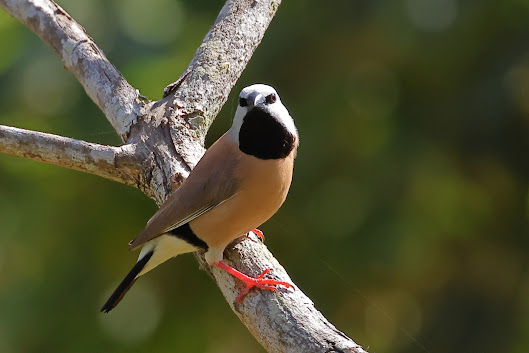
Lament for southern Black-throated Finches

Hollow logs for at risk birdies? Nature's nest boxes if you please Oh, such a clever wheeze So gather in twos and threes? Hundreds you w...