Jabiru junior shows robust health morning after alarming visitor with much head tossing and wing flapping interpreted as throat obstruction but more likely demands for food from parents.
Last pools at best viewing areas remain wetter than same time last year. But without rain by end of month mud will show through almost everywhere.
No more images of Jabiru (Black-necked Stork) senior jabbing into the water for slippery catches.
No more Black-fronted Dotterel immature poking about at edge of water.
And fewer close views of Brolgas flying in to forage through grasses and, less often, pools.
And no more chances to stand relatively close to Royal Spoonbills, trying combinations of cameras and lenses (top down: 1D+600; 1D+1.4x+600; 7D+1.4+600= 1344mm! Conclusion: kiss - keep it simple, stupid - is best).
Showing posts with label Royal Spoonbill. Show all posts
Tuesday, January 23, 2018
Sunday, December 20, 2015
Mungalla days not all about Yellow Wagtails
More chasing Yellow Wagtails at Mungalla for the last week, without notable capture of the species in the camera.
But it's not all about the flighty migrants. Rainbow Bee-eaters are breeding in their sand tunnels and watching for food passing on the wing.
A Royal Spoonbill pauses in the mopping up of prey in a fast-drying pool of mud and dying water hyacincth.
One Intermediate Egret shows out from scores of others atop nearby trees and drops in to feed.
An Australian Pipit has the hunt for food down pat.
White-breasted Woodswallow takes up higher vantage point.
One of the hundreds of sources of Pipit pedestals enjoys an extended scratch in an ear (probably not uncommon behaviour but something new to me).
Nearby, tight-coiled Carpet Python rests motionless, unconcerned as camera closes to within a metre.
Not so still, Gould's Monitor caught away from boltholes and trees to climb considers its situation: cautious walk away proves the right answer.
But it's not all about the flighty migrants. Rainbow Bee-eaters are breeding in their sand tunnels and watching for food passing on the wing.
A Royal Spoonbill pauses in the mopping up of prey in a fast-drying pool of mud and dying water hyacincth.
One Intermediate Egret shows out from scores of others atop nearby trees and drops in to feed.
An Australian Pipit has the hunt for food down pat.
White-breasted Woodswallow takes up higher vantage point.
One of the hundreds of sources of Pipit pedestals enjoys an extended scratch in an ear (probably not uncommon behaviour but something new to me).
Nearby, tight-coiled Carpet Python rests motionless, unconcerned as camera closes to within a metre.
Not so still, Gould's Monitor caught away from boltholes and trees to climb considers its situation: cautious walk away proves the right answer.
Sunday, July 24, 2011
Toeing, flowing and no-going on the water
Walking, winging on water: Comb-crested Jacana (Irediparra gallinacea) makes tracks in Tyto yesterday.
Walking, winging in water: Royal Spoonbill (Platalea regia) shakes feathers loose while feeding in drying creek pool today.
No walking here! Saltwater Crocodile bakes motionless (most days) at Macknade revegetation area east of Ingham.
Click pix to enlarge
Walking, winging in water: Royal Spoonbill (Platalea regia) shakes feathers loose while feeding in drying creek pool today.
No walking here! Saltwater Crocodile bakes motionless (most days) at Macknade revegetation area east of Ingham.
Click pix to enlarge
Friday, December 11, 2009
Standing out by standing around
Time to clear out some images that have stood around too long. First up, Bush Thick-knee (Burhinus grallarius) stands easy between cane train tracks near Ingham. Bird happily stood still till I tried lying down for more interesting angle. Quickly gone. It wasn't about to stand for any arty stuff!
Standing tall in a shallow pool by the Bruce Highway just south of Ingham, a second year Black-necked Stork (Ephippiorhynchus asiaticus) coming into adult plumage. The parent birds and one of two other siblings are members in good standing of the Tyto Wetlands frequent fliers club.
Finally, Royal Spoonbill (Platalea regia) stands watchful close to the Tyto hide. Not taken from the hide itself because its slatted upright boards - spaced for breezy ventilation - stand too far apart to hide those inside. Some birds will stand for shifting shadowy figures inside the hide, many will not.
Subscribe to:
Posts (Atom)
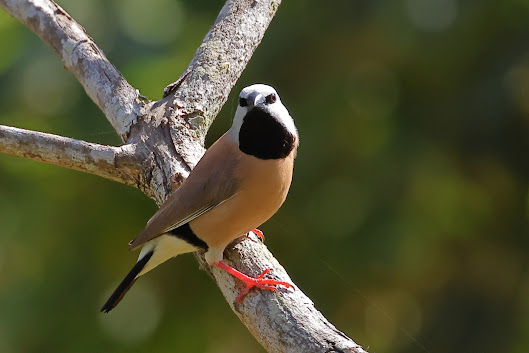
Lament for southern Black-throated Finches
Hollow logs for at risk birdies? Nature's nest boxes if you please Oh, such a clever wheeze So gather in twos and threes? Hundreds you w...
-
Seems Townsville will feel only the sting in Cyclone Debbie's tail. Nothing but light breeze and a rare drop of rain here yet as the c...
-
Hollow logs for at risk birdies? Nature's nest boxes if you please Oh, such a clever wheeze So gather in twos and threes? Hundreds you w...
-
Golden-headed Cisticola not so rusty when it comes to catching a feed See the eagle-eyed birdo doing his stuff. Eyes always on the move, mi...