Barking Owl? Or barking mad? Looks like both, but evil squint is deceptive. Bird was unconcerned by my presence. Nor was it reacting to low-set flash. Owls appear sometimes to shut their eyes almost as we might yawn when things are all a bit quiet. A highlight among recent sightings in Tyto this week..
What else is around? Just one of 10 to 20 Forest Kingfishers on show these mornings.
More Reed Warblers about in scleria with returns from south. Few, however, up in pandanus.
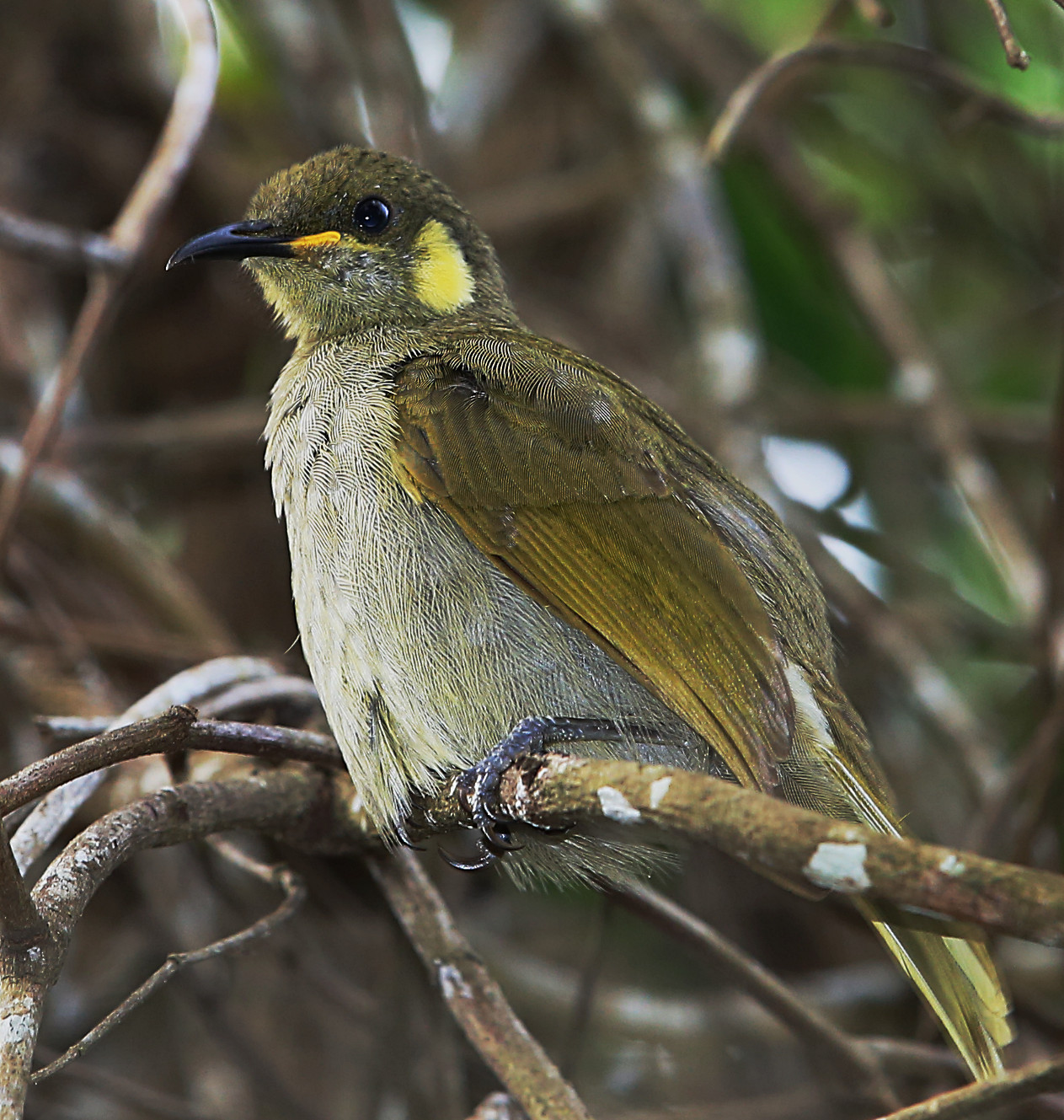
Yellow-spotted Honeyeater takes a break from preening in creekline tangle.
Little Bronze-cuckoo about as pale as the species gets.
And a young Crimson Finch feeding on seeds of grasses growing through footbridge.
Showing posts with label Yellow-spotted Honeyeater. Show all posts
Thursday, April 28, 2016
Tuesday, November 1, 2011
Tucking into honeyeater points
Yellow-spotted Honeyeater (Meliphaga notata) at Jourama Falls (25km south of Ingham) last week. Strong yellow gape streak pointing to mid-earmark is diagnostic in distinguishing from slightly smaller Graceful HE (weaker, paler streak points to bottom of earmark). Both species can give similar 'tuck' calls.
Click pix to enlarge
Monday, February 14, 2011
Farewell images of some Yasi survivors
Red-backed Fairy-wren (Malurus melanocephalus) in guinea grass at lookout heads today's last Tyto images for a time. Overdue NZ spell starts tomorrow.
Rufous Whistler (Pachycephala rufiventris) on a cheesewood branch. Easy to find the birds not blasted away by Cyclone Yasi, given defoliation of 50-75% most trees, though few knocked over.
Yellow-spotted Honeyeater (Meliphaga notata) searches for insect life surviving in the limited leafage.
Business as usual for young Comb-crested Jacana (Irediparra gallinacea). The species one of a few undiminished by Yasi.
Also surviving in usual numbers, White-browed Crake (Amaurornis cinerea), though above image not from today's final walk through the still-flooded wetlands.
So we say a fond farewell to Tyto. Return date uncertain. Hoping for some birding in the Land of the Long White Cloud. Bye for now ...
Click pix to enlarge
Rufous Whistler (Pachycephala rufiventris) on a cheesewood branch. Easy to find the birds not blasted away by Cyclone Yasi, given defoliation of 50-75% most trees, though few knocked over.
Yellow-spotted Honeyeater (Meliphaga notata) searches for insect life surviving in the limited leafage.
Business as usual for young Comb-crested Jacana (Irediparra gallinacea). The species one of a few undiminished by Yasi.
Also surviving in usual numbers, White-browed Crake (Amaurornis cinerea), though above image not from today's final walk through the still-flooded wetlands.
So we say a fond farewell to Tyto. Return date uncertain. Hoping for some birding in the Land of the Long White Cloud. Bye for now ...
Click pix to enlarge
Thursday, January 29, 2009
Gracefully spotting Yellow-spotteds
Two honeyeaters in Tyto can bring birders to a serious identity crisis. Yellow-spotteds (Meliphaga notata) and Gracefuls (M. gracilis) are found in woodland and creek forest areas, mostly outside the hot pre-Wet and wettest months (November-March).

So in this saturated January I was a little surprised to first hear and then get poor pictures of this Yellow-spotted earlier in the week (before the rain really set in - again!). The hearing is almost everything, until the birds get into close range.
Yellow-spotteds offer a metallic rattling (feebly echoing 'machinegun' bursts from much larger - but seldom in Tyto - lookalike Lewin's Honeyeater (M lewinii)). Gracefuls, slightly smaller, with longer, slender bills, mostly give one repetitious 'tuk' (louder further north: can trick southerners into looking for 'tinking' Bell Miners).
But birds don't always call on command. And slight bill differences can be hard to spot. You could try and see whether the earmark is a rounded yellow triangle (Yellow-spotted) or merely rounded (Graceful). Good luck with that idea!

How to tell them apart? Well, both have a yellow gape streak, which points at the earmark. The Yellow-spotted streak points to the centre of the earmark, but in the Graceful it curves down and points to the bottom of the earmark. (Sorry, can't lay hands on Graceful picture: two oldies of mine just checked are Yellow-spotteds!)
It's obvious when pointed out, though not every guidebook gets it right. So that's my out for never having noticed. Many thanks to Tyto visionary and birder supreme John Young for showing me the difference.
Subscribe to:
Posts (Atom)
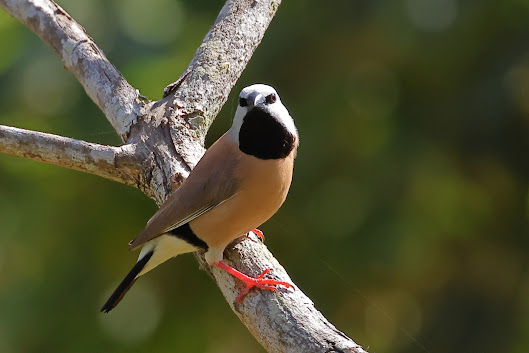
Lament for southern Black-throated Finches
Hollow logs for at risk birdies? Nature's nest boxes if you please Oh, such a clever wheeze So gather in twos and threes? Hundreds you w...
-
Seems Townsville will feel only the sting in Cyclone Debbie's tail. Nothing but light breeze and a rare drop of rain here yet as the c...
-
Hollow logs for at risk birdies? Nature's nest boxes if you please Oh, such a clever wheeze So gather in twos and threes? Hundreds you w...
-
Golden-headed Cisticola not so rusty when it comes to catching a feed See the eagle-eyed birdo doing his stuff. Eyes always on the move, mi...