Crimson Finch, Golden-headed Cisticola, Dollarbird, Red-tailed Black Cockatoo, Black Swan, Pelican and Royal Spoonbill, Red-backed Fairy-wren, and one of two unexplained recent arrivals.
Showing posts with label Red-backed Fairy-Wren. Show all posts
Sunday, December 24, 2017
Sunday, October 23, 2016
Some lovelies in place of refound Lovelies
Got first glimpse in two years of Lovely Fairy-wren near the Tyto hide this week. But only Red-backed Fairy-wrens to show for many hours in the wetlands.
And males proving as always extremely difficult to capture in all their black and red glory.
Also active around the hide and elsewhere, Olive-backed Sunbird. Above, male yet to come into full breast colour.
And a Yellow Honeyeater showing off briefly on same paperbark branch in front of hide.
Tuesday, August 21, 2012
Adorning our Structures
Drizzle dribbles off the caravan, grey gloom continues, laptop chores sort of done ... time to cook up stew of leftovers, but with grandiose theme: Adorning our Structures
Brown Goshawk (Accipiter fasciatus): Broadwater Forest Park rail
Forest Kingfisher (Todiramphus macleayii): Tyto Wetlands elevated walkway
Zitting Cisticola (Cisticola juncidis): Orient Station fence
Striated Heron (Butorides striata): Dungeness rail
Great Crested Tern (Thalasseus bergii): Dungeness rail
Red-backed Fairy-wren (Malurus melanocephalus): Orient Station fence
Click pix to enlarge
Monday, January 30, 2012
Closing in on Red-backed Fairy-wren
More images in the quest for one that does full justice to the male Red-backed Fairy-wren (Malurus melanocephalus). Getting better, but . . .
Click pix to enlarge
Wednesday, October 5, 2011
Red-backed Wrens fairy flitters
Red-backed Fairy-wrens (Malurus melanocephalus) sometimes show up in excited groups, teasing the observer/photographer with the prospect of five or six glowing males caught in focus showing off to similar numbers of females.
No such picture emerges. The small birds flash through scruffy, scrubby tangles of weeds, fallen trees, bladey grass, sedge and scleria. Seldom does one - let alone five or six - pause in clear view.
Even when one male does come to a brief halt on a sunny day there's the maddening problem of the gorgeous black sheen reflecting so much light that much feather detail is lost.
But on an overcast day the matt black can make a bird look drab.
Then there's the eyes, so dark they are often indistinguishable within the black mass of the head. But one must keep trying ...
Click pix to enlarge
No such picture emerges. The small birds flash through scruffy, scrubby tangles of weeds, fallen trees, bladey grass, sedge and scleria. Seldom does one - let alone five or six - pause in clear view.
Even when one male does come to a brief halt on a sunny day there's the maddening problem of the gorgeous black sheen reflecting so much light that much feather detail is lost.
But on an overcast day the matt black can make a bird look drab.
Then there's the eyes, so dark they are often indistinguishable within the black mass of the head. But one must keep trying ...
Click pix to enlarge
Saturday, July 30, 2011
Tyto sights for the luckless
Open days this weekend and Italian Festival next weekend mean big increases in Tyto visitor numbers. For those not able to make it - and for most who did, but didn't get lucky - a few birds from the past week or so.
Crimson Finch (Neochmia phaeton)
Yellow Honeyeater (Lichenostomus flavus)
Willie Wagtail (Rhipidura leucophrys)
Red-backed Fairy-wren (Malurus melanocephalus)
Helmeted Friarbird (Philemon buceroides)
Click pix to enlarge
Crimson Finch (Neochmia phaeton)
Yellow Honeyeater (Lichenostomus flavus)
Willie Wagtail (Rhipidura leucophrys)
Red-backed Fairy-wren (Malurus melanocephalus)
Helmeted Friarbird (Philemon buceroides)
Click pix to enlarge
Thursday, April 21, 2011
Flushed Nightjar triggers reddy theme
Serious case of red-eye from Large-tailed Nightjar (Caprimulgus macrurus) flushed - and fill-flashed - in dark patch of rainforest the other day. The eyes glow red even in weak torchlight.
Not so Red-backed Fairy-wren (Malurus melanocephalus). Male moving toward full colour in Tyto today.
Red-browed Finch (Neochmia temporalis) in Tyto, showing why birds were previously called firetails.
Finally, more subdued shades of male Rufous Whistler (Pachycephala rufiventris).
Not so Red-backed Fairy-wren (Malurus melanocephalus). Male moving toward full colour in Tyto today.
Red-browed Finch (Neochmia temporalis) in Tyto, showing why birds were previously called firetails.
Finally, more subdued shades of male Rufous Whistler (Pachycephala rufiventris).
Click pix to enlarge
Monday, April 4, 2011
Wren jinks, joins weather jinx
Red-backed Fairy-wren (Malurus melanocephalus) takes off in Tyto yesterday.
Split-second earlier, sharper, but looking wrong way. Timing is all ...
But all ain't what it used to be. Total count of species for February and March: 77; roughly 20-30 below pre-Yasi expectations, though La Nina must also be counted contributor to the shortfall.
Click pix to enlarge
Split-second earlier, sharper, but looking wrong way. Timing is all ...
But all ain't what it used to be. Total count of species for February and March: 77; roughly 20-30 below pre-Yasi expectations, though La Nina must also be counted contributor to the shortfall.
Click pix to enlarge
Monday, February 14, 2011
Farewell images of some Yasi survivors
Red-backed Fairy-wren (Malurus melanocephalus) in guinea grass at lookout heads today's last Tyto images for a time. Overdue NZ spell starts tomorrow.
Rufous Whistler (Pachycephala rufiventris) on a cheesewood branch. Easy to find the birds not blasted away by Cyclone Yasi, given defoliation of 50-75% most trees, though few knocked over.
Yellow-spotted Honeyeater (Meliphaga notata) searches for insect life surviving in the limited leafage.
Business as usual for young Comb-crested Jacana (Irediparra gallinacea). The species one of a few undiminished by Yasi.
Also surviving in usual numbers, White-browed Crake (Amaurornis cinerea), though above image not from today's final walk through the still-flooded wetlands.
So we say a fond farewell to Tyto. Return date uncertain. Hoping for some birding in the Land of the Long White Cloud. Bye for now ...
Click pix to enlarge
Rufous Whistler (Pachycephala rufiventris) on a cheesewood branch. Easy to find the birds not blasted away by Cyclone Yasi, given defoliation of 50-75% most trees, though few knocked over.
Yellow-spotted Honeyeater (Meliphaga notata) searches for insect life surviving in the limited leafage.
Business as usual for young Comb-crested Jacana (Irediparra gallinacea). The species one of a few undiminished by Yasi.
Also surviving in usual numbers, White-browed Crake (Amaurornis cinerea), though above image not from today's final walk through the still-flooded wetlands.
So we say a fond farewell to Tyto. Return date uncertain. Hoping for some birding in the Land of the Long White Cloud. Bye for now ...
Click pix to enlarge
Friday, December 31, 2010
Pick of the day, pic of the year
Final Tyto stroll for 2010 found one Crimson Finch (Neochmia phaeton) standing out among the usual plenty. Sometimes the bird is only part of the picture.
Too much to expect hyperactive Red-backed Fairy-wren (Malurus melanocephalus) to adopt artistic pose. Sprayed sedge an unwanted species.
Much easier to catch Rufous-throated Honeyeater (Conopophila rufogularis) in front of hide. Nest nearing completion.
Female Rufous Whistler (Pachycephala rufiventris) stayed in paperbark just long enough for quick shot.
Finally, two images to wrap up the year:
Brown-backed Honeyeater (Ramsayornis modestus) in paperbark by Tyto hide.
And my picture of 2010, Striated Heron (Butorides striata) with muddy catch near a coastal boat ramp.
Click pix to enlarge
Too much to expect hyperactive Red-backed Fairy-wren (Malurus melanocephalus) to adopt artistic pose. Sprayed sedge an unwanted species.
Much easier to catch Rufous-throated Honeyeater (Conopophila rufogularis) in front of hide. Nest nearing completion.
Female Rufous Whistler (Pachycephala rufiventris) stayed in paperbark just long enough for quick shot.
Finally, two images to wrap up the year:
Brown-backed Honeyeater (Ramsayornis modestus) in paperbark by Tyto hide.
And my picture of 2010, Striated Heron (Butorides striata) with muddy catch near a coastal boat ramp.
Click pix to enlarge
Subscribe to:
Posts (Atom)
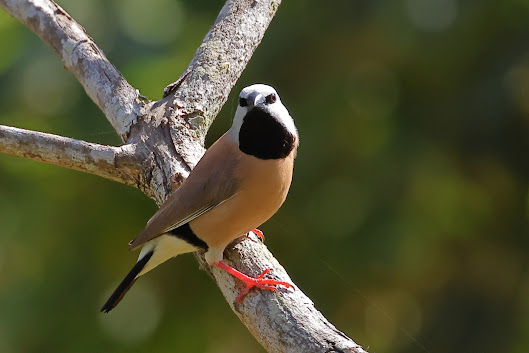
Lament for southern Black-throated Finches
Hollow logs for at risk birdies? Nature's nest boxes if you please Oh, such a clever wheeze So gather in twos and threes? Hundreds you w...
-
Hollow logs for at risk birdies? Nature's nest boxes if you please Oh, such a clever wheeze So gather in twos and threes? Hundreds you w...
-
White-faced Heron stands up and begs picture be taken at Tyto. The birds can develop some trust in people, but I've never found any aro...
-
Who gives way on footbridge, Yellow-spotted Monitor or unspotted bird watcher? Naturally, dinkum locals have right-of-way. I step aside, Spo...