Showing posts with label Crimson Finch (Neochmia phaeton). Show all posts

Monday, May 30, 2016

Crimsons lighten the morning


Came upon bunch of Crimson Finch (Neochmia phaeton) beside sugar cane railway tracks this morning as the clouds from 60mm overnight rain sullenly refused to disperse. So, decided to give them time to show us what they've got. And added couple of others. Are you reddy for them all?


Crimsons smoke, all right?

Friday, April 1, 2016

Challenges vary from Kingfishers to Lapwings


Slightly faster limp into Tyto today in vain search for Little Kingfisher. Seems March sighting may have been bird's first and last look for fish along creek. No big rain means no big flood into grasses means no fish breeding in grasses means no Little Kingfishers feeding on fish trapped in creeks. But did come upon Forest Kingfisher (Todiramphus macleayii) midway through morning bath. Not an easy species to sneak up on even when they are everywhere. The wetlands rings to their shrills at present as they squabble over feeding territories.


No fighting among Crimson Finch (Neochmia phaeton). But even they were mostly hiding away this morning. This bird's from earlier in the week. Taken at just beyond minimum focus distance for the 600mm lens. Closeup is cropped only, no colour adjustment or sharpening.


Not too difficult getting close to threatening Masked Lapwing (Vanellus miles) along Orient Road the other day. Bird didn't want me near four eggs on ground. It should have thought about that before laying almost on the road. We'll see how they're getting on next week.


Friday, March 4, 2016

A bird's gotta do what a bird's gotta do

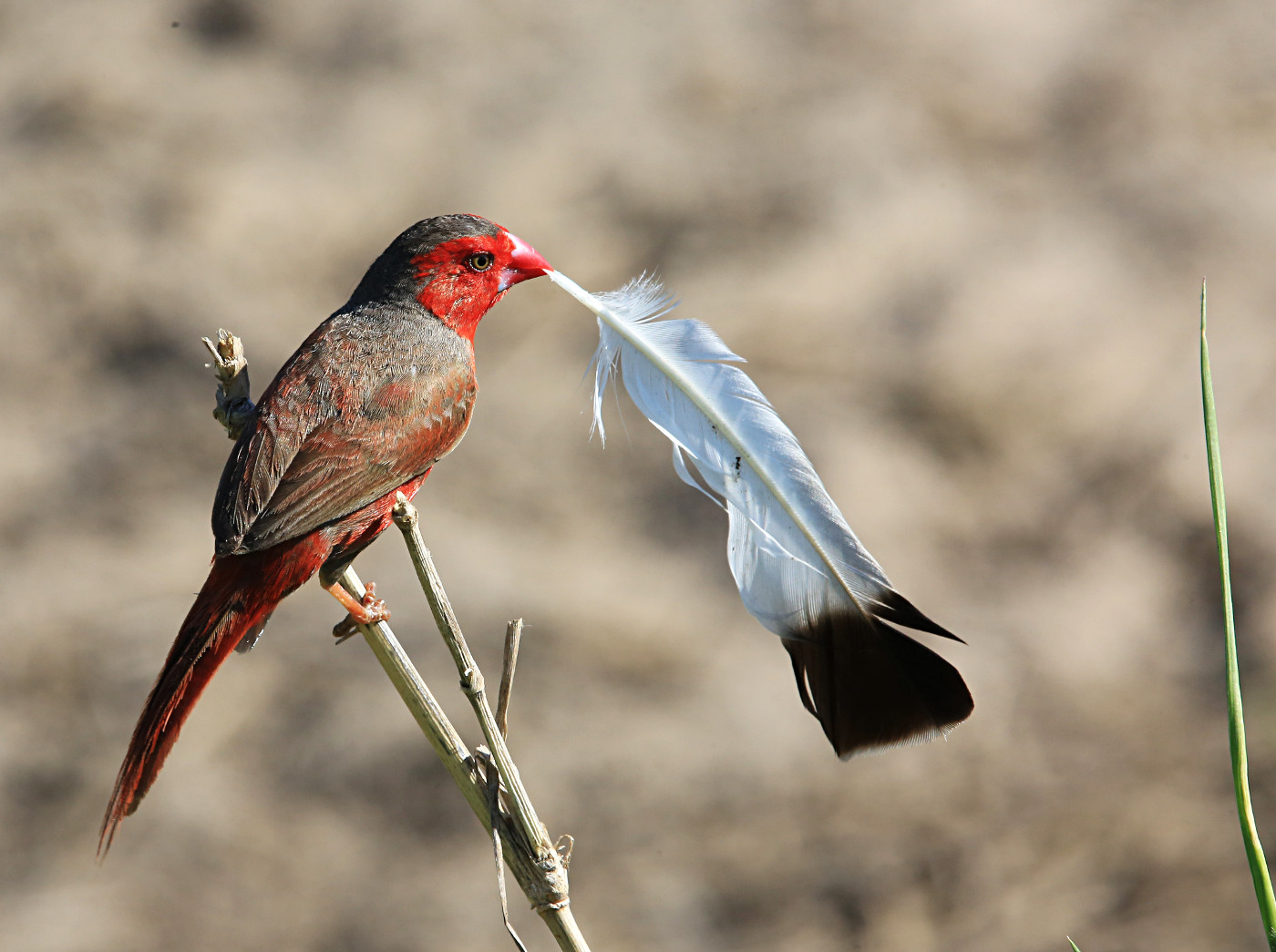
A nest-building Crimson Finch (Neochmia phaeton) tries to pick up every white feather it sees. Because the small soft ones are the ultimate in nesting comfort. And she who must be obeyed is fussy about what she'll accept for her coming clutch.
But it seems the birds lack much sense of timing or scale and can't discriminate between perfect bedding and impossibly large challenges. Eventually they find that some feathers just won't fly.

What's in a colour? Young Mistletoebird (Dicaeum hirundinaceum) comes with bright orange bill and gape. Parents carry plain old dull dark grey. Presumably because no one is going to try to poke food into them while inside a dark cute nest shaped like baby's bootee. Possibly also the colour helps parents locate their young after they've first left the nest.

Why the striking pattern? Young Pallid Cuckoo (Cacomantis pallidus) stands out in full sunlight. Soon it will take on the grey tones of a maturing bird. The juvenile plumage doesn't bear much resemblance to honeyeaters and other species parasitised by Pallids. It is said to perhaps offer dappling camouflage as the bird spills out over the small nests the egg is deposited in. It's the first juvenile Pallid I've seen for years.

Sunday, June 14, 2015

Kookaburra, Crimson Finch looking sharp


Two looks at female Blue-winged Kookaburra (Dacelo leachii) spotted untypically on the ground at Tyto yesterday without any prey in sight. A few seconds later and bird was back in nearby trees ready to pounce. 


No pouncing involved with Crimson Finch (Neochmia phaeton) on pandanus in Tyto. Two views again, this time to demonstrate the sharpness available through the image stabilisation of the Canon 600mm even when being hand-held by an offbalance photographer.

Ditto with this very uncommon visitor to Tyto, Restless Flycatcher (Myiagra inquieta) on dead lotus head in the main lagoon. Far from perfect but much better than I could ever hope for from 400mm nonIS lens.

Sunday, September 14, 2014

Beauty takes time to emerge

Can always count on Crimson Finch (Neochmia phaeton) for local colour in Tyto. Little beauties brightening most days, rain of shine. 


Sometimes, though, outer beauty takes time to emerge.

Also taking plenty of time to emerge, Australian Little Bittern (Ixobrychus dubius). Tucked away in the scleria for most of this year, male came out a few days ago.

May be visible more often between now and Xmas, a period when I think males can be in tussles for territory. 

In the meantime here's hoping for closer emergences and better luck with bigger prey.  

Sunday, August 24, 2014

Splash of blue signals Lovely arrival

Splash of bright blue amid the green understorey in Tyto yesterday signalled rare arrival of male Lovely Fairy-wren (Malurus amabilis). No sightings of species ever so far east in the wetlands. And no sign at all of the birds in years since Cyclone Yasi. Now the challenge is to get a decent picture.


A challenge also often with Pacific Baza (Aviceda subcristata). The specialist frog and phasmid munchers don't mind people getting close, but usually stay high in or atop the foliage. Bird above spent some time on lower limbs in Tyto the other day.


So did this young Yellow Honeyeater (Lichenostomus flavus), when it wasn't busy chasing others away from bottlebrush along the northwestern boundary track. Immaturity shows with yellow at base of gape (bill).

The challenge with Crimson Finch (Neochmia phaeton) has been to get a bird to sit somewhere other than surrounded by grass (natural feeding habitat at times) or background and foreground twiggery. No luck so far.

Tuesday, August 5, 2014

Stubble Quail kicks off high count

High count of 76 species seen in stiff northeasterly gusts at Mungalla Station today didn't bring too many worthwhile pictures but did kick off with closeup of Stubble Quail (Coturnix pectoralis).

And male Leaden Flycatcher (Myiagra rubecula) turned up in sheltered spot along choked creek, in place of the Little Kingfisher being targeted.

Seen today back on usual cattle pad habitat - a reappearance after briefly taking off elsewhere - but this one photographed last week, Australian Pratincole (Stiltia isabella).

Another species seen today but photographed earlier, Nankeen Night-Heron (Nycticorax caledonicus), one of 50-60 roosting by day in a tangle of cottonwoods.

Also, one of 50-60 birds often sheltering around the cottonwoods, Crimson Finch (Neochmia phaeton). 

Sunday, May 11, 2014

Crimson Finch numbers down

Seems timing of the wet spells this season has not been to benefit of 
Crimson Finch (Neochmia phaeton), though above maturing male looks to be coming along nicely.

Fewer young birds around Ingham and the juveniles are popping up in ones 
and twos rather than threes and fours to a family.

Better days for Australasian Pipit (Anthus novaeseelandiae), popping up in healthy numbers on grazing properties everywhere in the area.

One of the important soil inputs makes a top vantage point.

Among the reed beds at the Orient Station the other day, Brolga (Grus rubicunda) pair had been joined yesterday by more than 30 others stalking prey in the pasture. Probably be hundreds on the coastal stations soon.

Sunday, October 6, 2013

Darter one among many making a splash

Distant Little Bitterns exciting visiting Birdlife photographers this weekend, but not making same splash as this Australasian Darter (Anhinga novehollandiae) indulging today in circular water ballet of unknown cause. Some say rounding up fish. Seems not so to me, though who knows?

Can always rely on a splash of red from Crimson Finch (Neochmia phaeton), though usually more tidily feathered..

Similarly attractive - and tidier - Red-browed Finch (Neochmia temporalis).

Stepping out in style near the hide this morning, White-browed Crake (Amaurornis cinerea).

And stepping out near the entrance before latest scrub slashing moved it along, Buff-banded Rail (Gallirallus philippensis).

Lament for southern Black-throated Finches

Hollow logs for at risk birdies? Nature's nest boxes if you please Oh, such a clever wheeze So gather in twos and threes? Hundreds you w...