Mature White-bellied Sea-Eagle (Haliaeetus leucogaster) flies off with fish from Tyto lagoon clutched securely in both talons. But it and other raptors won't take any old dead or dying fish. Recent mass deaths of species unable to tolerate low oxygen levels left fish such as bony bream floating unwanted for days until they sank back down into the unhealthy waters that killed them.
Not even sure this immature sea-eagle has yet developed the skills needed to take live fish. Seemed more interested in chasing after the adult, which showed no willingness to share its small catch.
Another big attraction over the past week has been an Amethyst Python, sunning itself here on a grass track close to the main lagoon lookout. Lively and about 3.5 metres long, the snake shows its jewelled colours in morning sunlight.
Showing posts with label Amethyst Python. Show all posts
Saturday, March 15, 2014
Saturday, September 4, 2010
Python pokes tongue at prurience
Is there no end to your interest in my sex life? (Female still in pandanus today.)
Go away, prurient human person! Click pix to enlarge
Thursday, September 2, 2010
Amethyst Pythons shine in coital coiling
No hurried sex for pythons so little changed till mid-morning today. Male vanished first from the head-high pandanus clump. Two hours later the female also was gone. Perhaps she'll produce and care for her eggs in the wetlands. But it would need a microchip and tracking to confirm such a hope.
Click pix to enlarge
Sunday, August 23, 2009
Python pauses on pandanus

One day after commenting about pythons on another post (this is for you, Bronwen), and referring to their liking for pandanus, this Amethyst turned up in Tyto today. (It did so well away from the numerous visitors attending a Tyto Expo weekend, who were ferried around the lagoons by a fleet of golf buggies.)
How to find such snakes? Stand still frequently and listen carefully. Even small reptiles will make some noise if moving about on dry litter. This snake crunched through pandanus for some minutes before emerging and ascending the bare trunk it's semi-wrapped around.
No picture, but even louder noises in waist-high grasses yesterday - and seemingly coming from a large animal - signalled the purposeful progress of a particularly fat Red-bellied Black snake. Even from 30 metres away, the snake's swift flow through and high up in the grasses was audible and visible.
Most birds, naturally, ignored the many visitors, who, in turn, just as naturally failed to see most of the birds, but enjoyed the scenic beauty of their surroundings. Naturally, the skies were brilliantly blue through both days.

Got this Red-browed Finch (Neochmia temporalis) early today before the buggies began rolling around the place.

Same with this Red-backed Fairy-wren (Malurus melanocephalus), which paused just long enough on sunlit branch.

Not a lot of action out on the water apart from this Little Pied Cormorant (Microcarba melanoleucos) taking off after I appeared. They are very wary when in the water and almost nonchalant once parked up in trees.
Wednesday, January 21, 2009
Chasing wren to a conclusion

Chased a male Red-backed Fairy Wren back and forth along a small area of swampy woodland track for about 15 minutes in Tyto today. The bird danced in and out of small trees, vine-hung pandanus, scrubby weeds and long grasses. The first result? A few so-so pictures, one with fresh-caught grasshopper (above). A strong argument for purchase of flash unit.

Result two? The wren hopped across some scraggly vines, one of which dangled interestingly. As small Amethystine Pythons do. It had almost certainly been in the same position throughout all my chase after the wren. Hiding out in the open. Well, openly in the shade of a pandanus. A strong argument for standing still and and looking, looking, looking at our surroundings.
For now, I lean to the second argument. It's much cheaper, and applies universally.

Elsewhere today, came upon this Lace Monitor on a vacant block in the seaside suburb of Forrest Beach. The 1.2-1.3 metre beauty was taking the morning sun, as reptiles do, with throat and breast directed to the incoming warmth. Took some time to capture the flickering tongue as the animal got a long-range 'taste' of me and vanished into a culvert hidden by the long grass.
Wednesday, November 12, 2008
Luck's spotty, like the birds
Luck's been spotty with birds spotted in the distance. Didn't even know the Nankeen Night Heron (Nycticorax caledonicus) disappearing fast from view at Tyto today was a spotty juvenile till I downloaded the images. From distance the bird looked a somewhat drab adult.
Pheasant Coucal (Centropus phasianinus), in black and brown breeding plumage, is more streaked than spotted, and more often spotted running along the ground looking - as in Judith Wright's marvellous set of bird poems - like a granny tripping along tiptoe with skirts up.Difficult to catch these crafty birds in clear view, on boughs or in the air. They almost invariably clamber high within a tree and launch themselves out the other side away from perceived danger. Their flight is not so clumsy as often described.
Though from the cuckoo family, it's hard to see much about them that other cuckoos would admire. Pheasant Coucals build their own ground nests, incubate the eggs, feed the young, and generally behave like good bird parents.
If they stopped eating other birds' eggs and young all would be happy. I guess they won't and will continue to be mobbed as relentlessly as, say, Blue-winged Kookaburras and Little Eagles.
Spotted close to the long-deserted nest, the quicksilver pair of Lovely Fairy-Wrens. As ever, they flashed across a track, spent a split-second in lantana close to their decaying nest, and disappeared into thick tangles of more lantana and guavas. But I will get them!
Also spotted from distance - and genuinely spotty - this Wood Sandpiper (Tringa glareola), at the mill treatment ponds yesterday evening. We played a wee game of see-if-the-photographer-falls-in-the-scum-chasing-the-bird-beside-the-pond - and declared it a 0-0 draw: no top shots of bird, no muddy feet for me. Meantime, the mystery dark sandpiper of last week was nowhere to be seen.
And here's a biggie to finish. The best-conditioned, thickest Amethyst Python (Morelia amethistina) I've yet seen in Tyto. About 3.5 metres of muscular, shimmering gorgeousness, so heavy it left deep grooves in the shortish wet grass. Perfection! Until it came to keeping its tongue in frame and itself out in the open.What do you say to an almost 12-foot snake as it goes by? So long! What else could you say?
Spot you later, as they say.
An afterword: Problems with downloading pictures, formats that kept changing, and supposedly lost internet connections added at least an hour to posting this blog. Do others strike similar posts or days? It's maddening to space everything perfectly, introduce another image and find spacing's gone haywire and font and type size has changed. Happens whether I paste stuff in or enter it directly.
Subscribe to:
Posts (Atom)
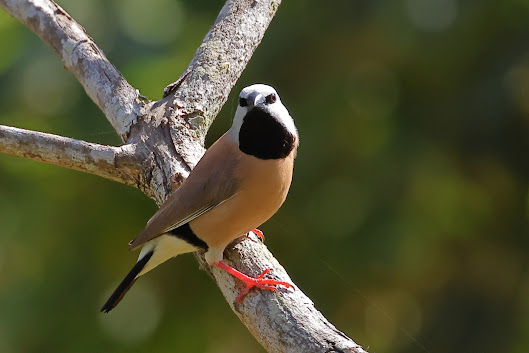
Lament for southern Black-throated Finches
Hollow logs for at risk birdies? Nature's nest boxes if you please Oh, such a clever wheeze So gather in twos and threes? Hundreds you w...
-
Seems Townsville will feel only the sting in Cyclone Debbie's tail. Nothing but light breeze and a rare drop of rain here yet as the c...
-
Hollow logs for at risk birdies? Nature's nest boxes if you please Oh, such a clever wheeze So gather in twos and threes? Hundreds you w...
-
Golden-headed Cisticola not so rusty when it comes to catching a feed See the eagle-eyed birdo doing his stuff. Eyes always on the move, mi...