Showing posts with label Pacific Golden Plover (Pluvialis fulva). Show all posts

Sunday, November 25, 2018

Uncommon sightings give way to drier days

Rare week or two with several uncommon sightings showed signs today of settling back to drier days ahead. Pectoral Sandpiper casting reflection in Payet pool yesterday became no-show for first time since last Sunday.

Quartet (possibly quintet) of Eastern Yellow Wagtails down to two yesterday and again today at Melaleuca viewing area. Blotchy bird above was in company with even lighter immature.

Not so many Australian Pipits confusing the wagtail seekers either.

But resident Willie Wagtails (fantails, not true wagtails) hold their places. Juvenile bird pictured today.

Gone though, Pacific Golden Plover, thought to be juvenile bird with worn and thus gold-free plumage.

But sighting of the week came with Brown Goshawk swooping on to broken pandanus with frog clutched in talons. Clutched insecurely as it turned out. Goshawk looked down split second after landing and frog somehow leapt free. Thirty seconds of action at exactly the time I arrived at Jacana hide for lucky frames. 

Whereas hundreds of failed splash-action frames preceded indifferent shot of sopping Yellow Honeyeater on branch at Payets.

And talking of Payets, words of praise for Queensland Parks and Wildlife. Selective chainsaw work has restored great viewing from the tower. Not needed so much in the Dry, as now, but essential for the coming Wet. Well done, rangers!


Monday, November 19, 2018

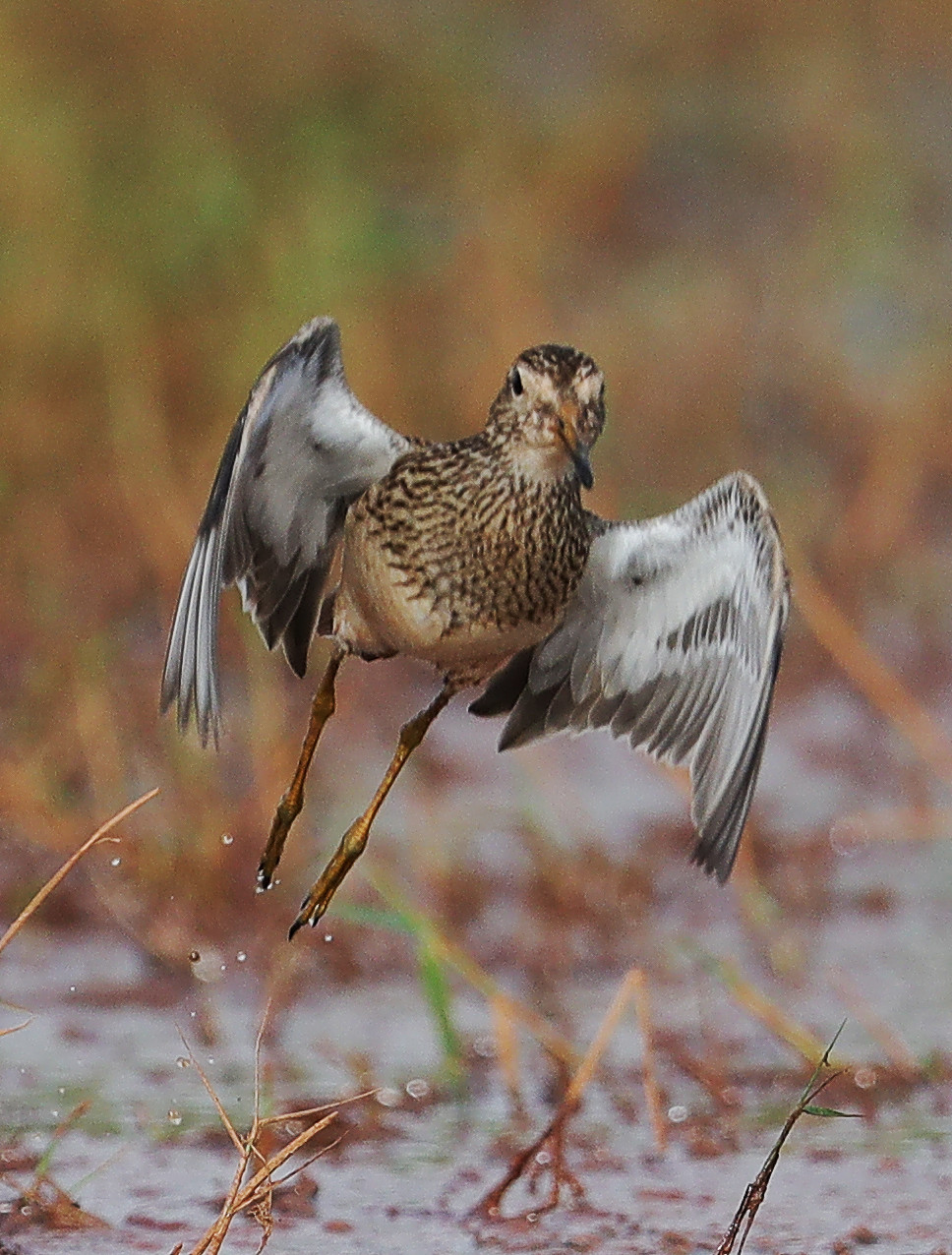
Pectoral Sandpiper in flight shows Sharp differences

Uncommon and often unnoticed, Pectoral Sandpiper launches into view at Payet Tower pool today. Obvious differences from commoner Sharp-taileds - when seen up close - streaky breast with sharp upsloping cutoffs, light colouring at base of bill, yellow-green legs (if light is right) mean almost nothing from 50 metres away.

But crawl in through the tall grass and inch (millimetre really, but that's not yet a verb) forward, and talk nicely to the bird, and bingo! all doubts about identity disappear. This bird seems content with companionship of 8-9 Sharpies, but here today, gone tomorrow may well apply.


Just up the road to the neighbouring wetland extension at Melaleuca viewing area in Townsville Town Common Conservation Park, Eastern Yellow Wagtails made it a week of sightings, though just two and not the regular three were on show today. Jump and flight images from yesterday.


Surprise newcomer this morning at Melaleuca, Pacific Golden Plover. Probably a juvenile with somewhat worn feathers, thus lacking any hint of gold spangling on its back. Two images, dark one from early morn, lighter other much later. What will tomorrow bring?

Tuesday, January 6, 2015

Little Curlew joins uncommon appearances

Fewer rarities among migratory species touching down around Ingham this season, so surprising to see Little Curlew (Numenius minutus) along Orient Station yesterday.

Attempted to stalk bird from the old Troopy but it slipped under fence and walked off across distant pasture.

Another one-off sighting recently, Oriental Pratincole (Glareola maldivarum), another bird to tease from afar and quit the district as suddenly as it appeared.

Not so uncommon, Pacific Golden Plover (Pluvialis fulva), with vestiges of breeding colouring on show.

Thursday, October 23, 2014

Mungalla mob masses amid mud

Massed Egrets and Spoonbills crowd Mungalla Station wetlands for final feeding flurries before the shallows become fast-drying mud, probably  within a fortnight as the dry season intensifies.


Some migratory visitors are more than happy to see more mud. Pacific Golden Plover (Pluvialis fulva) numbers lower than in past seasons but starting to rise.


Also showing up to spend time on the mud, Red-capped Plover. Nonbreeding plumage gives only hints of the birds' breeding colours. 


From an earlier, rather colourless day, pair of White-browed Crake (Amaurornis cinerea) poke about among blue waterlilies. 

Lament for southern Black-throated Finches

Hollow logs for at risk birdies? Nature's nest boxes if you please Oh, such a clever wheeze So gather in twos and threes? Hundreds you w...