Showing posts with label Red-browed Finch. Show all posts

Sunday, February 19, 2012

Tidying up with four from Tyto

Bird numbers down everywhere so time to tidy up the Tyto holdovers, starting with Red-browed Finch (Neochmia temporalis), on guinea grass stalk – since whipper-snipped - near the lookout.

Rarer sight, White-throated Gerygone (Gerygone albogularis) sitting still in a paperbark near hide.

More common, Rufous-throated Honeyeater (Conopophila rufogularis), also in paperbark near hide.

To finish off, Chestnut-breasted Mannikin (Lonchura castaneothorax) pauses during feeding.
Click pix to enlarge  

Sunday, August 14, 2011

Martins amid mud at Macknade


Found small flock of Fairy Martins (Petrochelidon ariel) busy mixing building and foraging today at Macknade Wetland Project near Halifax. 


Pink blob is out-of-focus water lily.


Not so many Red-browed Finches (Neochmia temporalis) in Tyto lately. 


But small group turned up the other day and messed about amidst Yasi debris. 
Click pix to enlarge

Thursday, April 21, 2011

Flushed Nightjar triggers reddy theme

Serious case of red-eye from Large-tailed Nightjar (Caprimulgus macrurus) flushed - and fill-flashed - in dark patch of rainforest the other day. The eyes glow red even in weak torchlight.


Not so Red-backed Fairy-wren (Malurus melanocephalus). Male moving toward full colour in Tyto today.


Red-browed Finch (Neochmia temporalis) in Tyto, showing why birds were previously called firetails.


Finally, more subdued shades of male Rufous Whistler (Pachycephala rufiventris).
Click pix to enlarge

Sunday, March 20, 2011

Finch sticks around for picture

More super Wet and flooding in Tyto early this week, giving way to weak sunshine from Friday.  


Today, found slight increase - to 31 bird species - over previous Sunday. Notable rise in numbers of Chestnut-breasted Manikins. Very few ducks and cormorants. No egrets or ibises.


This Red-browed Finch (Neochmia temporalis) one of few birds that stayed close enough for a picture.
Click pix to enlarge

Sunday, October 3, 2010

Red-browed Finch hard to pin down

Crafty Red-browed Finch (Neochmia temporalis) gathers nest material near Tyto hide today.


Hard to spot nest because bird enters one tree and then sneaks across high into another, where the nest is hidden.


Good chance, however, to get bit closer to the wary species.


Yesterday, chased in-flight images of Rainbow Bee-eaters (Merops ornatus) in high winds along my favourite country road.


But couldn't shoot fast enough in the cloudy conditions.


Anyone else finding their multiple picture uploads no longer working properly?    
Click pix to enlarge  

Wednesday, June 23, 2010

Finches to the fore

Red-browed Finches (Neochmia temporalis) dwell doubly in the shade in Tyto: overshadowed somewhat by Crimsons, and preferring under-tree areas to sunlit grasses.

Both species enjoy sheltered margins of drying creek pools. Red-browed likes getting down to the muddy bits. And all too often behind some twig.

Crimson Finch (Neochmia phaeton) spends more time surveying things below. Little wonder Crimsons feature more often.

And, mopping up the finches, here's a Double-barred Finch (Taeniopygia bichenovii) feeding on seeds from grasses dying off in middle of dirt road.

Wednesday, March 17, 2010

Finches splash the red about

Plenty of Crimson Finches (Neochmia phaeton) young and old adding their range of reds to the wetlands greenery these days.

The full range of colour splashed about the place much determined by sunshine. However nothing makes most birds shine more than highlights in the eye. It's tempting (and easy) to add same. I have resisted all temptation - in this post!

Immature bird caught today. No glint in the eye for plain youngster.

And a little more red. This Red-browed Finch (Neochmia temporalis) brought glint to my eye. Closest I've come lately to satisfying shot of species. Pity morning glare and shadow proved too much to fix.

Caught these Red-backed Fairy-wrens (Malurus melanocephalus) preening yesterday. Eye problems here: female mostly kept nictitating membrane up as male preened her; his eye, as always with species, lost against black plumage.

Wednesday, March 10, 2010

Salvage work sharpens Whistler

Rufous Whistler (Pachycephala rufiventris) pops in just two metres from the hide. Quick shot and bird's off again. Too sudden to change camera settings. Too close for desirable depth of field. Not much of a picture. But ...

But ... lose the blurry bits, reshape the final image and the picture looks a bit better. Not always so lucky.

Tried various crops with this Red-browed Finch (Neochmia temporalis). To no avail. Some shots just don't have enough quality to repay extra effort

Monday, December 14, 2009

Bit of patter before a Pitta pity


Frustratingly close to catching up with two elusive species in the rainforest behind Ingham Airstrip today. Well, did catch them, but lacked any 'up', as in up close. So, will open with better couple of birds on sticks. First, male Rufous Whistler (Pachycephala rufiventris) lines up in the morning sunshine.


Second, Red-browed Finch (Neochmia temporalis) intent on higher issues.


And the first of today's distant efforts. Noisy Pitta (Pitta versicolor) in forest considerably darker than it appears. Pittas commonly pitter-patter along amid leaf litter but are more often heard than seen. In part because they spend a lot of time up in trees and birders spend a lot of time looking for them on the ground. Ventriloquial birds, that's what they are.


Second distant shot, immature Nankeen Night-Heron (Nycticorax caledonicus), announced its arrival with a strangled 'grawwwk'. It then flew low to forest creek bank, peered in, and dived out of sight! I didn't see it emerge. Don't know if it was splash-showering or hunting, perhaps for freshwater mussels (not equipped for chasing fish underwater). Next sighting, image above, taken from 40 metres away. Tried stalking close. Bird off. Just one of those mornings...  


Sunday, December 6, 2009

'Reddy' theme for big picture change


Get 'reddy' for bigger pictures. Should be able now to click on any to enlarge because I've finally twigged to benefits of Blogger's new editor. Opening with Comb-crested Jacana (Irediparra gallinacea). And throwing in a choc box shot from distance at Macknade Wetland early today (below).


And here's a male Red-backed Fairy-wren (Malurus melanocephalus) carrying a red 'love token' near the Tyto hide. Well, most of the bird anyway! All another male (below).


Finally, pair of Metallic Starlings (Aplornis metallica) near Ingham today. Trick of reflected light shows strange colour on head of right-hand bird.

Friday, November 6, 2009

Three morsels of food for thought


Food for thought in three Tyto encounters. Above, perhaps evidence of a successful underground strike - skink? frog? grasshopper? - by this Common Tree Snake (Dendralaphis punctulata). Spotted the snake half hidden within a wide crack during a recent evening outing. It re-emerged looking rather pleased with itself, almost to be described as licking its lips! Anthropomorphosis, anyone?


Little Black Cormorant (Phalacrocorax sulcirostris) comes up with a catch courtesy of an unknown predator that must have lost this fish after taking a severe bite from it. Though no more than knee deep and roughly 50 x 25 metres, the minor pool near Tyto's main lagoon could be carrying large eels, barramundi and turtles. Croc? A very long-odds maybe.


Red-browed Finch (Neochmia temporalis) clutches an African Tulip Tree (Spathodea campanulata) seed envelope. A pair of the birds spent several minutes picking up, carrying about and then discarding envelopes. Doubt if the birds are equipped to free the seed from the envelope. Haven't seen such interest previously. In fact, only Scaly-breasted Lorikeets (Trichoglossus chlorolepidotus) show a taste for the seeds. But they feed direct from split and drying pods, which hold hundreds of envelopes in three stacks.


Sunday, August 23, 2009

Python pauses on pandanus


One day after commenting about pythons on another post (this is for you, Bronwen), and referring to their liking for pandanus, this Amethyst turned up in Tyto today. (It did so well away from the numerous visitors attending a Tyto Expo weekend, who were ferried around the lagoons by a fleet of golf buggies.)

How to find such snakes? Stand still frequently and listen carefully. Even small reptiles will make some noise if moving about on dry litter. This snake crunched through pandanus for some minutes before emerging and ascending the bare trunk it's semi-wrapped around.

No picture, but even louder noises in waist-high grasses yesterday - and seemingly coming from a large animal - signalled the purposeful progress of a particularly fat Red-bellied Black snake. Even from 30 metres away, the snake's swift flow through and high up in the grasses was audible and visible.

Most birds, naturally, ignored the many visitors, who, in turn, just as naturally failed to see most of the birds, but enjoyed the scenic beauty of their surroundings. Naturally, the skies were brilliantly blue through both days.


Got this Red-browed Finch (Neochmia temporalis) early today before the buggies began rolling around the place.


Same with this Red-backed Fairy-wren (Malurus melanocephalus), which paused just long enough on sunlit branch.


Not a lot of action out on the water apart from this Little Pied Cormorant (Microcarba melanoleucos) taking off after I appeared. They are very wary when in the water and almost nonchalant once parked up in trees.

Wednesday, August 5, 2009

Flitting after finch and flycatcher


The quest for top pictures of Red-browed Finches (Neochmia temporalis) goes on. These two entries merit a showing, but don't quite do full justice to the birds.


Indeed, the species might have a case for cruel and unusual caricature after being shot in the round at Tyto today.


Also flitting shy of satisfaction, the Shining Flycatcher (Myiagra alecto) that has been keeping company (more or less) with a Little Kingfisher (Ceyx pusilla) at a creek pool. Here's an earlier picture of the Little up close.

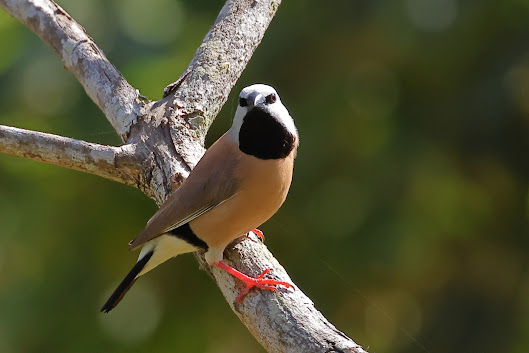
Lament for southern Black-throated Finches

Hollow logs for at risk birdies? Nature's nest boxes if you please Oh, such a clever wheeze So gather in twos and threes? Hundreds you w...