Showing posts with label Rufous Whistler. Show all posts

Tuesday, June 19, 2018

Young cormorants and darter in touching relationship

Too chilly in Townsville this morning for birding in shivery shade. Riverbank by Palmetum Botanical Gardens promised desired east-facing warmth. And where were the birds? Sitting - several in clustered nests - along the sunlit Ross. Juvenile Australian Darter stands (below) in a nest touching two others holding pairs of Little Pied Cormorants (above) and close to another with three young cormorants.

Youth also on the water, with immature Comb-crested Jacana treading daintily across waterlily leaves.

Nearby, immature male Rufous Whistler shows breast and head markings about to become bolder mature colouring.


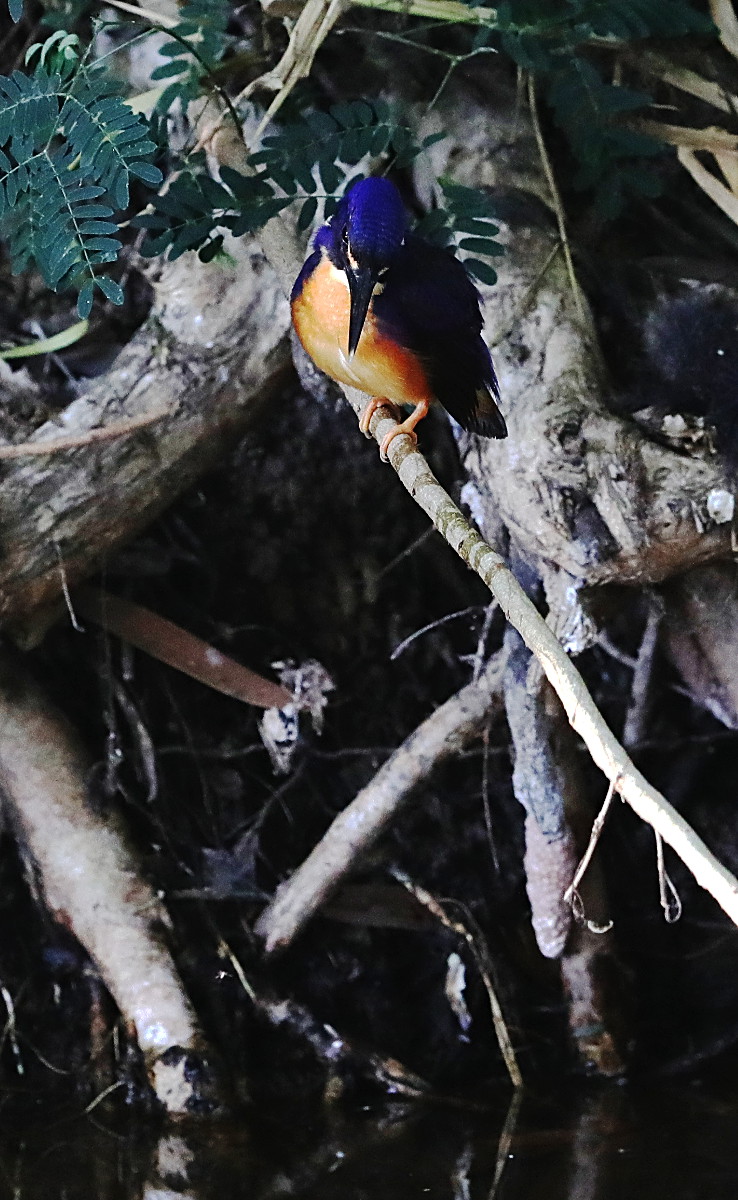
Not so young or close to the camera but always boldly coloured, Azure Kingfisher, one of a pair teasing with fast showings - and goings.

Finally, chance encounter between a Pacific Black Duck and seeming quizzical Freshwater Turtle wanting to know where the bird's right eye is. 'Gone'.

Monday, November 21, 2011

Clean as a Whistler

Big branch got between us, but male Rufous Whistler (Pachycephala rufiventris) didn't get clean away and makes for tidy study of feather details.


Also provides chance to run image of female, also taken in Tyto.
Click pix to enlarge

Thursday, April 21, 2011

Flushed Nightjar triggers reddy theme

Serious case of red-eye from Large-tailed Nightjar (Caprimulgus macrurus) flushed - and fill-flashed - in dark patch of rainforest the other day. The eyes glow red even in weak torchlight.


Not so Red-backed Fairy-wren (Malurus melanocephalus). Male moving toward full colour in Tyto today.


Red-browed Finch (Neochmia temporalis) in Tyto, showing why birds were previously called firetails.


Finally, more subdued shades of male Rufous Whistler (Pachycephala rufiventris).
Click pix to enlarge

Friday, December 31, 2010

Pick of the day, pic of the year

Final Tyto stroll for 2010 found one Crimson Finch (Neochmia phaeton) standing out among the usual plenty. Sometimes the bird is only part of the picture. 


Too much to expect hyperactive Red-backed Fairy-wren (Malurus melanocephalus) to adopt artistic pose. Sprayed sedge an unwanted species.


Much easier to catch Rufous-throated Honeyeater (Conopophila rufogularis) in front of hide. Nest nearing completion.


Female Rufous Whistler (Pachycephala rufiventris) stayed in paperbark just long enough for quick shot.


Finally, two images to wrap up the year:


Brown-backed Honeyeater (Ramsayornis modestus) in paperbark by Tyto hide.


And my picture of 2010, Striated Heron (Butorides striata) with muddy catch near a coastal boat ramp.   
Click pix to enlarge

Sunday, September 19, 2010

Rufous Whistler gives game away

Male Rufous Whistler (Pachycephala rufiventris) gave the game away by flying to and fro with green caterpillar near a Tyto track today. 


Why not eat the juicy morsel? Because nearby juvenile needed food more. Youngster must have fluttered down from a nest. Quick pictures and left the pair alone. Both gone   an hour later.      
Click pix to enlarge   

Tuesday, July 13, 2010

Paying account to some bills

Female Rufous Whistler (Pachycephala rufiventris) shows strength of versatile bill, prying large chunk of bark from branch (cheesewood tree, from memory) in search of insects, in Tyto last week.


Brown-backed Honeyeater (Ramsayornis modestus) with all-purpose reddish bill adds webbing to nest (now completed) in Leichhardt tree over creek pool.


Male Olive-backed Sunbird (Nectarinia jugularis) displays specialist long curving, nectar-probing bill (even longer tongue not on display).    

Wednesday, March 10, 2010

Salvage work sharpens Whistler

Rufous Whistler (Pachycephala rufiventris) pops in just two metres from the hide. Quick shot and bird's off again. Too sudden to change camera settings. Too close for desirable depth of field. Not much of a picture. But ...

But ... lose the blurry bits, reshape the final image and the picture looks a bit better. Not always so lucky.

Tried various crops with this Red-browed Finch (Neochmia temporalis). To no avail. Some shots just don't have enough quality to repay extra effort

Monday, December 14, 2009

Bit of patter before a Pitta pity


Frustratingly close to catching up with two elusive species in the rainforest behind Ingham Airstrip today. Well, did catch them, but lacked any 'up', as in up close. So, will open with better couple of birds on sticks. First, male Rufous Whistler (Pachycephala rufiventris) lines up in the morning sunshine.


Second, Red-browed Finch (Neochmia temporalis) intent on higher issues.


And the first of today's distant efforts. Noisy Pitta (Pitta versicolor) in forest considerably darker than it appears. Pittas commonly pitter-patter along amid leaf litter but are more often heard than seen. In part because they spend a lot of time up in trees and birders spend a lot of time looking for them on the ground. Ventriloquial birds, that's what they are.


Second distant shot, immature Nankeen Night-Heron (Nycticorax caledonicus), announced its arrival with a strangled 'grawwwk'. It then flew low to forest creek bank, peered in, and dived out of sight! I didn't see it emerge. Don't know if it was splash-showering or hunting, perhaps for freshwater mussels (not equipped for chasing fish underwater). Next sighting, image above, taken from 40 metres away. Tried stalking close. Bird off. Just one of those mornings...  


Wednesday, September 30, 2009

Little Bittern makes a return


Thought the Australian Little Bitterns (Ixobrychus dubius) had flown off after the Jan-Feb floods perhaps never to be seen again. But here's a woeful picture to celebrate a return. Bird was distinctly visible from long way off yesterday, but there was little chance of sneaking up close. As things turned out, it fled back into the scleria when a nearby egret spooked it. But a hopeful sign coming as the lagoon shallows dry out. More sightings probable. Better pictures? Maybe.


Even when close to a bird in the clear, things don't always work out. Here's a Golden-headed Cisticola (Cisticola exilis) in 'clumsy' pose and, it must be said, an awful natural frame. Of course, it's ugly because it fails to meet a human's standard of beauty. The bird, happily, knows nothing of such things.


Same with this curiously coloured female Rufous Whistler (Pachycephala rufiventris). Twigs littered all over the place, including across the bird. No trouble. Clone some of them away. It's more an art form than a skill, cloning, they say. They're right. And I've always been hopeless at art! Would the cloning be obvious without my mentioning it?

Monday, August 10, 2009

Mannikins head memorable morning


Some days start well and just keep getting better. Hard to top today's start of Chestnut-breasted Mannikins (Lonchura castaneothorax) sprucing up in one of the new pools near Tyto's entrance. So, two pix for them.

Onwards, to one of many Brown-backed Honeyeaters (Ramsayornis modestus) busy, busy, busy gathering nesting material. (Yellows, and Browns doing likewise).


Nearby, male Rufous Whistler (Pachycephala rufiventris) sang and danced methodically through the cheesewoods in typical togetherness with mate (which didn't pose for me).


Plaintive noises from amid the mistletoe led to juvenile Red-winged (Aprosmictus erythropterus) whingeing at parent, which seemed immune to pleas, suggesting the youngster knuckle down and find its own fare by following mother's example. Later, similar story with male (below) and another juvenile.

Still better to come. Splash and dash from pool announced presence of Little Kingfisher (Ceyx pusilla). Bit of chasing about led to another pool and bird sitting pretty high off water. (Have helped several birdos find the reclusive Littles lately.)


No trouble finding Forest Kingfisher (Todiramphus macleayii). But few of them are willing to sit around when people come by. Picture one of several taken with new 2x converter, which means losing Auto Focus and many, many botched shots!)


No need for 2x when White-browed Robin (Poecilodryas superciliosa) turns up close to the Little Kingfisher pool. Bird jaunted about in the shadows briefly and just as quickly flashed off deeper into the trees.


Last bird of the morn, Rufous-thoated Honeyeater (Conopophila rufogularis) head down and hard at it to gather soft lining for nest in nearby paperbark. (Brown-backed and Rufous specialise in big bulky ovals with verandahed side entrances.)


To round off the outing, a Common Tree Snake sunning as I entered the hide, re-emerged from hiding, tasted the air, decided there was no threat and came from three metres away and almost over my outstretched hand before heading out and up off the bench and into a paperbark.

As I said, the morning just kept getting better!

(Note: used Picasa tools to fast-process all this post. One nit: can't scale images, so some inconsistent sizing.)

Tuesday, November 25, 2008

Saving them from ourselves

Oh, look, the poor little bird has fallen from the nest. It's fluttered up on to that old birdo's bicycle. Isn't it cute? What shall we do?

We'd better try to put it back. Pick it up and find the nest. Let's take it home and look after it. Wrong! Wrong! Wrong!

We're so keen to do the right thing we often get it all upside down. Doctors are told (but then sometimes go on to ignore the dictum): First, do no harm.

So it should be with us and wildlife. We almost all know not to get between wild animals and their young. That's because it's dangerous for us. But our thoughts should be first for the good of the young.

So when the above fledgling Rufous Whistler lost a tenuous grip on some outer foliage at Tyto today and fell at my feet, I naturally stepped back to get a picture. And to think about its welfare.


Yes, in that order and without any thought of saving the bird. That's what parents are for. Right on cue a male whistler turned up. With food in mouth. But it didn't go near the fledgling. It ducked here and there close by. Then it swallowed the caterpillar.

What's the problem? I'm probably the problem. Whistlers are trusting birds, but instinct runs counter to heading direct to the young. I back off. Still nothing doing. So I clear right off for 10 minutes.

On return it takes me five minutes to find the 'helpless' fledgling near the top of the tree it fell from. Doesn't seem judging by its fretful calls to be getting all it demands from parents but how's that different from most hungry juveniles? It's safe and sound!

I know, not all cases match such happy outcomes. My principle, though, is always to do as little as possible to interfere - or 'help'. How do others feel?

Thursday, November 6, 2008

Deserving cases find places

Male Rufous Whistler (Pachycephala rufiventris) takes in the morning sun.

Themes running in recent posts left some deserving pictures with no place to go. So, here's a place for them.

Black-necked Stork (Ephippiorhyncus asiaticus) kicks up the mud as she lifts off.


Female Shining Flycatcher (Myiagra alecto) perches in the rainforest.

Dragonfly (Diplacodes haematodes) takes a rest.

Lament for southern Black-throated Finches

Hollow logs for at risk birdies? Nature's nest boxes if you please Oh, such a clever wheeze So gather in twos and threes? Hundreds you w...