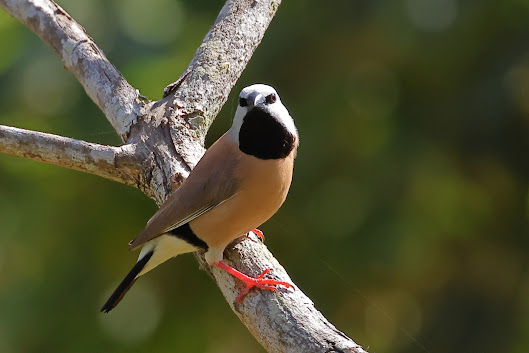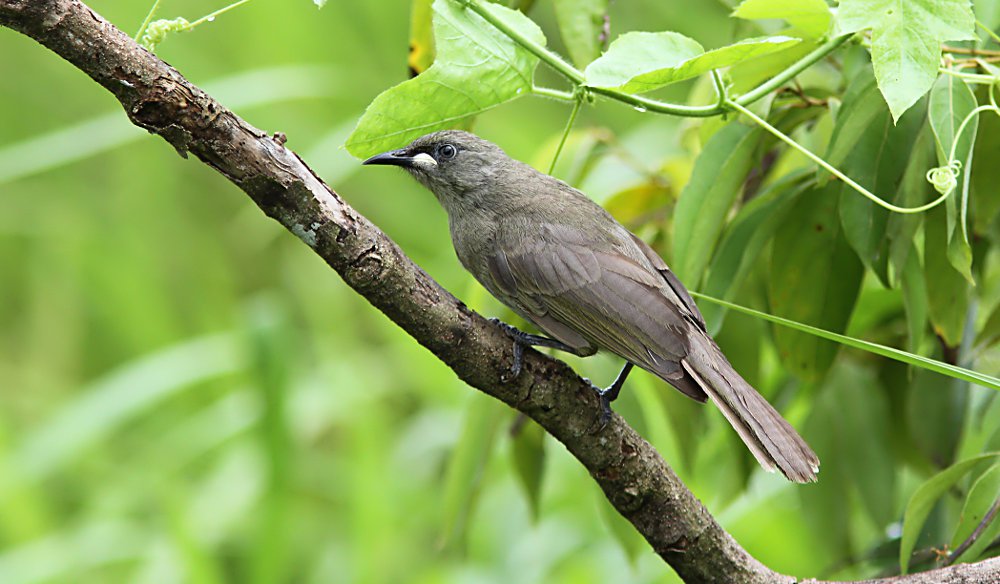


 Green, Yellow, Banana. All colourful names. But no more for the male Australasian Figbird (Sphecotheres vielloti), above thinking about swallowing another of the dry, tasteless (to us humans) fruits it loves - and few other birds show great fondness for.
 Closely related to figbirds (usually on the same page in field guides), the Olive-backed Orioles (Oriolus sagittatus) are less obvious and seldom so brightly plumaged as the above juvenile bird. Much of the contrasting colour on the back will disappear with adult plumage.
 So much for colour. What about sounds? I've often been struck by what appears in honeyeaters to be more curiosity about strange noises than other birds show. This White-gaped Honeyeater today seemed to react to the Canon's clattering shutter.
I'd been standing in long grass chasing Tawny Grassbirds when the White-gaped darted in and struck several 'listening' poses as the camera clacked away. Honeyeaters are also among the few birds ever to react at my otherwise ineffectual 'pishing'.
While on the subject of theories, limited searches of possible Little Bittern daytime hideouts have revealed absolutely nothing resembling the apparently shaped space found last month at the base of a small tree springing from Scleria (Razor Grass). Guess it was just a natural artifact.
Finally, the issue of huge fish and small Azure Kingfishers nestlings. First readings suggest the birds simply truck the fish in. If the fish is eaten, fine. If not, it can sit and rot in the darkness. Along with bones, other unwanted morsels, excreta, and anything that may have crawled in.
Can't wait till nestlings have fledged and I get a chance to sniff the delicate odour of Azure domestica! :-(

 No way of knowing where or what nest this Horsfield's Bronze-Cuckoo (Chrysococcyx basalis) sprang from. The young bird was sitting solo on a footbridge handrail. Lack of colour on back and no dark stripe through eye makes ID a tad dodgy. But the plainness of young Horsfield's can be a telling point.
 No problems with ID-ing juvenile Brown Honeyeater (Lichmera indistincta). Browns and Yellow Honeyeaters dominate the woodlands. The yellow gape at the base of the bill tells of the bird's immaturity. The typical long honeyeater tongue is a bonus.
 This oddly coloured Grey Whistler (Pachycephala simplex) arrived at the rainforest pool today in company with two others. But they didn't seem to be getting along. The small rufous 'ear patch' may perhaps mark the bird as a juvenile. I can't recall seeing anything similar and the guide books haven't helped.
Also at the rainforest pool today, a brief flurry of action after a long period of nothing larger than mozzies in the air. Silvereyes, White-browed Robins, Shining Flycatchers, Large-billed Gerygones, Little Shrike-Thrushes and Brush Cuckoos showed up noisily. Five minutes later, all quiet.
In back of it all, an Azure Kingfisher sat carrying a huge fish (about twice the size of that in previous post). But the bird would not cross to the nest burrow. So I quit my 'hiding' place. The question is: how do the nestlings cope with a (relatively) gigantic fish? I have no idea, so I'll chase it up.
Hollow logs for at risk birdies? Nature's nest boxes if you please Oh, such a clever wheeze So gather in twos and threes? Hundreds you w...