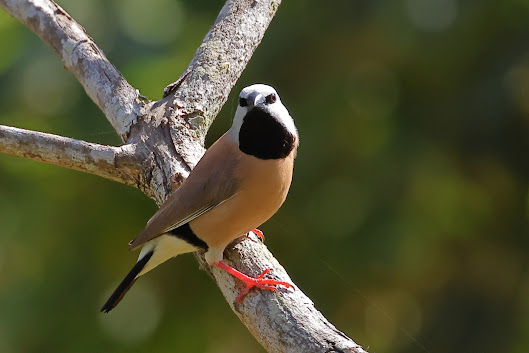
Terrible (only) 2007 picture of the Lovely Fairy Wren parent birds
How can two birds, no matter how small, hide for nine months in 100 hectares?
Ask the Lovely Fairy Wrens. Unseen by me all year (but reliably reported twice), Malurus amabilis showed up briefly today at the southwestern boundary of the wetlands. To be exact, a drabbish female carrying nesting material paused for a second on a high branch in deep shadow and launched deeper into head-high tangles of vine and emerging trees.
Forty minutes patrolling a dirt road running 10 metres away and parallel to the bird's flight yielded no sight of the (presumed) pair. No sound either. But they are so very soft of voice it is almost impossible to follow them in cover by sound alone. And they do love cover within brambly tangles.
So, bird found. Game of patience begins. Can I carefully seek the nest and find the birds before they produce, say, three young, as they did last year? (Please don't ask where the junior trio went. I have enough trouble with the sedentary parents.)
Perhaps I should 'call' the birds out? Some would and do. I don't, for reasons practical and ethical/ecological, (he said piously). I don't because I'm a hopeless mimic. Birds do appear on occasion but only to fall about laughing at the strange sounds.
On a more serious note, consider the argument against calling in relation to today's sighting.
A pair of common enough birds, but rare to an area, are building a nest. One is carrying material. From nearby comes sound of a rival bird/birds. It's a challenge? What to do? Leave it to the male? Drop material and go see? Who knows? But it's an intrusion in a way that the clumsiest birder is not.
Consider further. The shyest and rarest birds are often the target of calls. Shy and rare birds almost certainly are more than usually vulnerable to stress. Calling adds to their stress. Yes, I know, where's the evidence for this? It's here (pointing to my head).
One selection, from memory, of a New Scientist magazine about 2004. In an African national park with high conservation values birds living near tourist tracks were compared by size, weight, parasite load, breeding success and other factors to those of the same species living in unvisited areas. The distant birds rated about 7 per cent fitter. It seems even mild disturbance (stress) does harm.
Wider implications are obvious. 'We always hurt the things we love' springs to mind. Perhaps a bit extreme. But being aware of potential for damage should lead to considered and sensible compromises. (Oops, too many long words bespeaks a soapbox. Time to hop off!)
 Almost bumped into this dingo (Canis lupus dingo) on a track near the rainforest pools today. She and another larger dingo were standing rock-still and staring intently into some guinea grass and lantana.

 Oh, look, the poor little bird has fallen from the nest. It's fluttered up on to that old birdo's bicycle. Isn't it cute? What shall we do?
 Yes, in that order and without any thought of saving the bird. That's what parents are for. Right on cue a male whistler turned up. With food in mouth. But it didn't go near the fledgling. It ducked here and there close by. Then it swallowed the caterpillar.