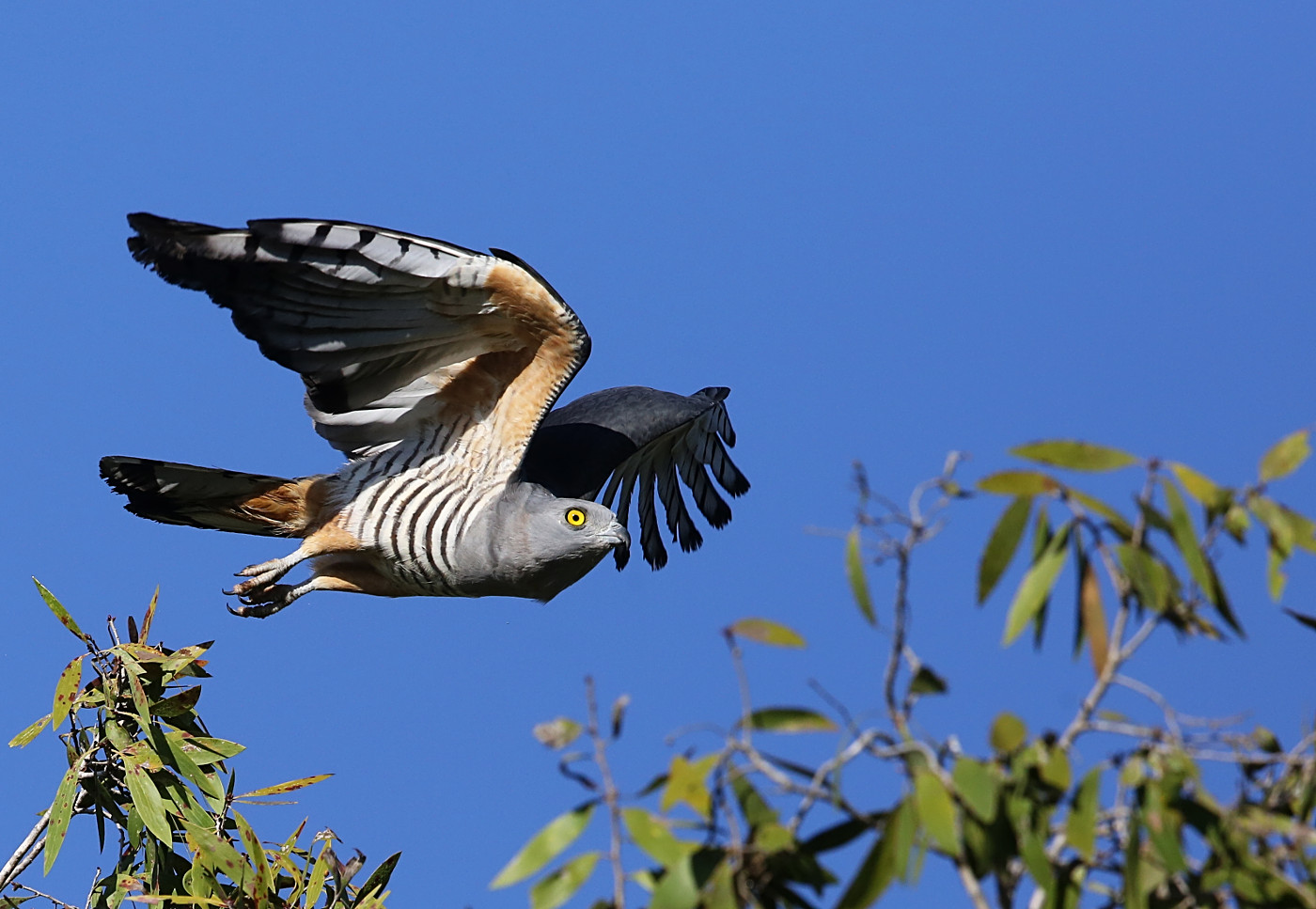
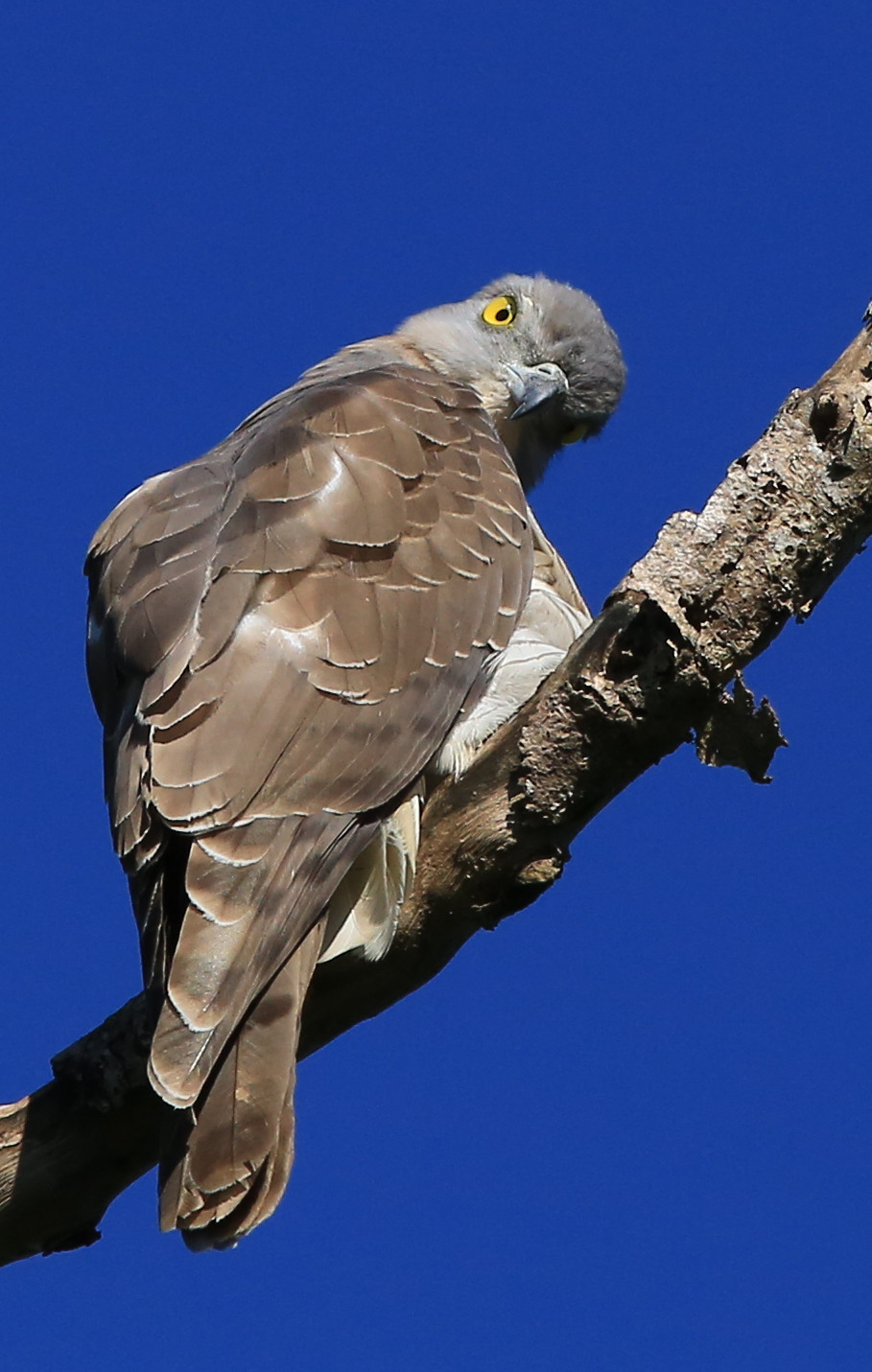
The Baza is an honest bird
Whose 'Ee-chew' rings true to word
For frogs and insects in the trees
'Ee-chew' equals 'Eat-you', if you please
Pleased to Eat-you. Oops, I mean, meet you.
Showing posts with label Pacific Baza (Aviceda subcristata). Show all posts
Sunday, July 15, 2018
Saturday, July 8, 2017
Luck allows look at Baza launch and lunch overhead
Caught big break after catching up with resident trio of Pacific Bazas in Townsville Common today.
Bird launched from top of nearby tree ...
... flew back overhead with juicy catch ...
... quickly got down to business ...
... and within minutes Green Tree Frog was no more.
Bird launched from top of nearby tree ...
... flew back overhead with juicy catch ...
... quickly got down to business ...
... and within minutes Green Tree Frog was no more.
Wednesday, June 28, 2017
Raptors ruffled and unruffled
Striking contrast between raptors from recent morning surveys: Nankeen Kestrel neat, unruffled ...
... White-bellied Sea-eagle, less than unruffled, though not ruffled by my close presence ...
... and female Eastern Osprey showing splendid spread of feathers on return to nest tree.
Next morning Baza bonus:
... White-bellied Sea-eagle, less than unruffled, though not ruffled by my close presence ...
... and female Eastern Osprey showing splendid spread of feathers on return to nest tree.
Next morning Baza bonus:
Tuesday, December 27, 2016
Cracking start to the day for young and old
Red-tailed Black Cockatoos can't get enough Casuarina (she-oak) nuts some mornings, cracking into them and digging out the tasty seed within. Other days they fly on by, usually from south to north. But the more common fare is Sea Almonds. Male bird above quitting Casuarina (twiggy background) and preparing for landing amid the almonds.
Female carries green almond away. the birds seldom wait for the fruit to turn a ripe purple. And often chomp and tear away the flesh from one end only before moving on to another. The reward for persisting through to cracking the almond pod (stone) open is a single small seed. I guessthe birds must get some sustenance from the green fruit fibres.
Easier to see where the sustenance comes from for this young Pacific Baza, getting excited by the approach of food-bearing parent. Another of the seeming never-ending cicada supply. So many still in trees you'd think the youngster, one of a pair being fed by both parents yesterday near the Town Common gate, would be able to grab some for itself.
But no, that's what the oldies are for. Hop to it, Ma or Pa!
Meanwhile, as their offspring may be eating something meaty courtesy of deceived parents, Eastern Koel pair tuck into figs, a leisurely life free from the burden of babycare. Koels are, like most cuckoos, lucky: they take the kids back around the equivalent of human teen time. No dramas. Off they go. Happy as. Or, at least, so it seems. Can't see that ever ending happily among us. Though, some parents ... and some teens ... maybe???
Female carries green almond away. the birds seldom wait for the fruit to turn a ripe purple. And often chomp and tear away the flesh from one end only before moving on to another. The reward for persisting through to cracking the almond pod (stone) open is a single small seed. I guessthe birds must get some sustenance from the green fruit fibres.
Easier to see where the sustenance comes from for this young Pacific Baza, getting excited by the approach of food-bearing parent. Another of the seeming never-ending cicada supply. So many still in trees you'd think the youngster, one of a pair being fed by both parents yesterday near the Town Common gate, would be able to grab some for itself.
But no, that's what the oldies are for. Hop to it, Ma or Pa!
Thursday, December 1, 2016
Young blue male Koel soon to be black as coal
Got along to the Common an hour before gate opening this morning to search for immature male
Eastern Koel (Eudynamys orientalis) seen as blue beauty in full sunlight yesterday.
Heard and then sighted bird in trees near the automatic 6.30-6.30 gate (hoon guard). Views not up to yesterday's vivid colouring.
But 'pushing' the blues a bit in processing so-so flight picture hints at the spectacle the young males briefly offer. After maturing the birds look mostly black, unless seen in right light. Amazing what colours 'black' can hold.
Up the road after the gate opened met Pacific Baza (Aviceda subcristata) terrorising phasmids (not a bit interested in the cicadas everywhere).
Fly. Perch. Scan. Fly. Pounce. Fly. Shred. Shred. Swallow. All gone. Repeat. Repeat. Busy Baza.
Eastern Koel (Eudynamys orientalis) seen as blue beauty in full sunlight yesterday.
Heard and then sighted bird in trees near the automatic 6.30-6.30 gate (hoon guard). Views not up to yesterday's vivid colouring.
But 'pushing' the blues a bit in processing so-so flight picture hints at the spectacle the young males briefly offer. After maturing the birds look mostly black, unless seen in right light. Amazing what colours 'black' can hold.
Up the road after the gate opened met Pacific Baza (Aviceda subcristata) terrorising phasmids (not a bit interested in the cicadas everywhere).
Fly. Perch. Scan. Fly. Pounce. Fly. Shred. Shred. Swallow. All gone. Repeat. Repeat. Busy Baza.
Sunday, June 5, 2016
Sacred dive heads day of splashy catches
Catching Sacred Kingfisher (Todiramphus sanctus) on the dive one of several highlights at Mungalla Station over weekend.
Can't claim super reflexes for this one. Bird was one of three launching from atop Leichhardt tree and swooping on insects just above water level and on hymenachne growing along the edge of pool below.
And White-bellied Sea-Eagle (Haliaeetus leucogaster) happened along overhead in time for leisurely tracking. The major blessing is having the underwings well lit.
Catch of the day for Whiskered Tern (Chlidonias hybrida) came with the bird's only deep dive. After mostly scooping smaller fish from the surface, the bird took a steeper line into the water. It wasn't where I'd been focussing. No time for viewfinder so spun lens on gimbal and jammed shutter button for high-speed burst (almost always have camera on the setting). My catch not quite so perfect as bird's. Splashy though.
No such luck in Tyto today. Managed to draw glare from Pacific Baza (Aviceda subcristata). It's a mark of the species' acceptance of people that this look came after much arm-waving and whistling.
Can't claim super reflexes for this one. Bird was one of three launching from atop Leichhardt tree and swooping on insects just above water level and on hymenachne growing along the edge of pool below.
And White-bellied Sea-Eagle (Haliaeetus leucogaster) happened along overhead in time for leisurely tracking. The major blessing is having the underwings well lit.
Catch of the day for Whiskered Tern (Chlidonias hybrida) came with the bird's only deep dive. After mostly scooping smaller fish from the surface, the bird took a steeper line into the water. It wasn't where I'd been focussing. No time for viewfinder so spun lens on gimbal and jammed shutter button for high-speed burst (almost always have camera on the setting). My catch not quite so perfect as bird's. Splashy though.
No such luck in Tyto today. Managed to draw glare from Pacific Baza (Aviceda subcristata). It's a mark of the species' acceptance of people that this look came after much arm-waving and whistling.
Sunday, August 24, 2014
Splash of blue signals Lovely arrival
Splash of bright blue amid the green understorey in Tyto yesterday signalled rare arrival of male Lovely Fairy-wren (Malurus amabilis). No sightings of species ever so far east in the wetlands. And no sign at all of the birds in years since Cyclone Yasi. Now the challenge is to get a decent picture.
A challenge also often with Pacific Baza (Aviceda subcristata). The specialist frog and phasmid munchers don't mind people getting close, but usually stay high in or atop the foliage. Bird above spent some time on lower limbs in Tyto the other day.
So did this young Yellow Honeyeater (Lichenostomus flavus), when it wasn't busy chasing others away from bottlebrush along the northwestern boundary track. Immaturity shows with yellow at base of gape (bill).
The challenge with Crimson Finch (Neochmia phaeton) has been to get a bird to sit somewhere other than surrounded by grass (natural feeding habitat at times) or background and foreground twiggery. No luck so far.
A challenge also often with Pacific Baza (Aviceda subcristata). The specialist frog and phasmid munchers don't mind people getting close, but usually stay high in or atop the foliage. Bird above spent some time on lower limbs in Tyto the other day.
So did this young Yellow Honeyeater (Lichenostomus flavus), when it wasn't busy chasing others away from bottlebrush along the northwestern boundary track. Immaturity shows with yellow at base of gape (bill).
The challenge with Crimson Finch (Neochmia phaeton) has been to get a bird to sit somewhere other than surrounded by grass (natural feeding habitat at times) or background and foreground twiggery. No luck so far.
Monday, July 2, 2012
Death comes with a whoosh
Australian Hobby (Falco longipennis) whooshed over sugar cane road near Ingham today and struck unidentified bird before the Toyota beast could stop and turn (it's not fully trained yet).
Feathers and fresh meat fast flew this way and that and then the Hobby flew thataway.
Pacific Baza (Aviceda subcristata) slower though equally thorough in grabbing and munching tree frog in Tyto the other day.
Not too much meat on those long legs.
But check out these legs: immature Southern Boobook (Ninox novaeseelandiae) in Tyto on Saturday before being told to leg it by pugnacious Willie Wagtail.
Click pix to enlarge
Monday, June 11, 2012
Baza dinner towed from a hole
Forget toad-in-the-hole, Pacific Baza (Aviceda subcristata) about to dine on Green Tree Frog towed from a hole and toed in the whole.
Click pix to enlarge
Subscribe to:
Posts (Atom)
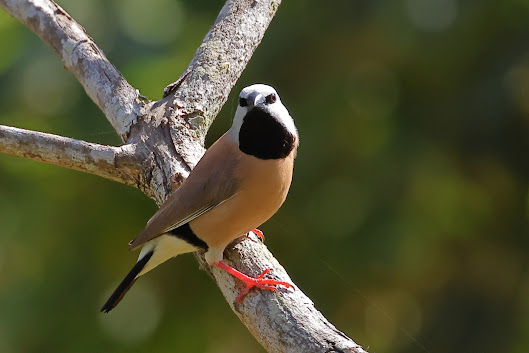
Lament for southern Black-throated Finches
Hollow logs for at risk birdies? Nature's nest boxes if you please Oh, such a clever wheeze So gather in twos and threes? Hundreds you w...
-
Hollow logs for at risk birdies? Nature's nest boxes if you please Oh, such a clever wheeze So gather in twos and threes? Hundreds you w...
-
White-faced Heron stands up and begs picture be taken at Tyto. The birds can develop some trust in people, but I've never found any aro...
-
Who gives way on footbridge, Yellow-spotted Monitor or unspotted bird watcher? Naturally, dinkum locals have right-of-way. I step aside, Spo...