Enough with crocs and snakes, time to have a look at June's best birds in the Town Common Conservation Park. - with a call for some effort from followers. Heap of bird names first, pictures to follow. He must be feeling lazy, did I hear somebody say? Right on. Busy day crawling around front suspension of the old Troopy after sudden arrival of ominous noises yesterday. As always, parts proved a problem. But eventually bodged up a fix or sorts. Careful test over the corrugated Town Common road tomorrow. So, the birds: Pacific Baza, Blue-winged Kookaburra, Crimson Finch, Australian Reed-Warbler, White-browed Crake, Willie Wagtail.
Showing posts with label Pacific Baza. Show all posts
Friday, June 30, 2023
Saturday, January 20, 2018
Pipit swims into view after dry Aussie crawl
Bit of dry Aussie crawl across baked mud at Melaleuca viewing area today brought Australian Pipit closer than commonly - for a few frames.
Pity, bird didn't offer 'that' perfect pose. Then, better pose, but greater distance.
Too much greenery to allow crawl up on Horsfields Bushlark. The species can, however, be surprisingly tolerant of people walking patiently toward them. Not at all tolerant, and thus unphotographed, pair of Brown Quail and a Red-backed Buttonquail unseen till flushed from long couchgrass nearby.
If only their behaviour matched that of Owlet Nightjar. Haven't got daytime look at species in the Town Common. Got lucky early in the week at western edge of Townsville while having casual look for honeyeaters near bottom of highway climb up local range. Spotted huge scar 20-metres up towering gum - with curious grey blob.
Which resolved through binoculars into alert nightjar. No way down 20m drop off highway and 40-50m across to gum, so lucky find could not become lucky sharp image.
If only nightjars thronged like Rainbow Lorikeets. In this case, to rose gums flowering at eastern fence edge of the Town Common. Plenty of action again today: bird above feeding on Thursday morning.
No thronging for Eastern Koels, but above female and a male tucked into a mixture of native figs beside the entry gate this morning.
And to polish things off, immature Pacific Baza about to end several minutes of carrying big colourful caterpillar and polish it off with one quick swallow.
Pity, bird didn't offer 'that' perfect pose. Then, better pose, but greater distance.
Too much greenery to allow crawl up on Horsfields Bushlark. The species can, however, be surprisingly tolerant of people walking patiently toward them. Not at all tolerant, and thus unphotographed, pair of Brown Quail and a Red-backed Buttonquail unseen till flushed from long couchgrass nearby.
If only their behaviour matched that of Owlet Nightjar. Haven't got daytime look at species in the Town Common. Got lucky early in the week at western edge of Townsville while having casual look for honeyeaters near bottom of highway climb up local range. Spotted huge scar 20-metres up towering gum - with curious grey blob.
Which resolved through binoculars into alert nightjar. No way down 20m drop off highway and 40-50m across to gum, so lucky find could not become lucky sharp image.
If only nightjars thronged like Rainbow Lorikeets. In this case, to rose gums flowering at eastern fence edge of the Town Common. Plenty of action again today: bird above feeding on Thursday morning.
No thronging for Eastern Koels, but above female and a male tucked into a mixture of native figs beside the entry gate this morning.
And to polish things off, immature Pacific Baza about to end several minutes of carrying big colourful caterpillar and polish it off with one quick swallow.
Sunday, December 5, 2010
Am I my Baza's keeper?
Here's the quandary. Friday morning, juvenile Pacific Baza (Aviceda subcristata) 25 metres below the nest, behind the Tyto info centre. Nest tree one of several towering paperbarks on small island connected by metal footbridges in landscaped lagoon precinct surrounded by Ingham suburbia and football ground. No way to get bird up into the trees. What to do? Interfere only as last resort. Back off. Let nature do its job. Return twice later in day and first find bird on concrete pillar in lagoon and then in small tree beside lagoon.
Early Saturday morning no sight or sound of Bazas, but late in morning and here's junior in bigger trouble. Bird's travelled 200 metres west from nest island, and become grounded in long grass in an area swarming with green ants. What to do? Nature can be too cruel. Toss plastic parka over bird. Pick all the (now getting angry) ants off.
No sign of parent birds, so put junior up into the small tree from evening before. Today, juvenile Baza calls coming from deep within trees in flooded section of the wetlands. It's up to the parents now.
Click pix to enlarge
Early Saturday morning no sight or sound of Bazas, but late in morning and here's junior in bigger trouble. Bird's travelled 200 metres west from nest island, and become grounded in long grass in an area swarming with green ants. What to do? Nature can be too cruel. Toss plastic parka over bird. Pick all the (now getting angry) ants off.
No sign of parent birds, so put junior up into the small tree from evening before. Today, juvenile Baza calls coming from deep within trees in flooded section of the wetlands. It's up to the parents now.
Click pix to enlarge
Sunday, November 21, 2010
Baza goes for smash and grab
Smash and grab Pacific Baza (Aviceda subcristata) spreads wide and handsome in tree-top hunt for frogs and mantids. The birds sometimes choose to crash into upper foliage, shocking prey. Pair nesting high behind Tyto info centre amid tall paperbarks come and go mostly unnoticed.
Also active, until the latest rains reflooded the area, pair of Brahminy Kites (Haliastur indus). Keen interest in weed-free lagoons coincided with schools of fish 'hoovering' surface water.
Click pix to enlarge
Also active, until the latest rains reflooded the area, pair of Brahminy Kites (Haliastur indus). Keen interest in weed-free lagoons coincided with schools of fish 'hoovering' surface water.
Click pix to enlarge
Thursday, August 13, 2009
Baza about - watch out frogs!

Pacific Baza (Aviceda subcristata) didn't spend too long sitting around in this rain tree before launching after a tree frog. Tried to follow the action but bird took off for distant parts, accompanied by pathetic barking from the doomed frog.

But not every frog suffers such a fate. Here's one turning from green to brown among the timbers of the Tyto hide. The smallish tree snakes in the roof of the hide have apparently given up trying to put the bite on large frogs that have called the hide home for weeks.

Sulphur-crested Cockatoo (Cacatua galerita) only too happy to put the bite on many things, including parts of the nest made and erected in Tyto in an effort to attract Ospreys. Here's a cockatoo today coming in to land on the remnants of the nest, only to find me lurking nearby (trying to grab shots of Little Kingfishers).
Sunday, November 16, 2008
Baza solves raptor puzzle
Pacific Baza (Aviceda subcristata) circles at a distance above me near Tyto's western boundary today. Hours before I had a tantalising glimpse of what appeared in the early morning light to be an oddly white and grey raptor carrying some small leggy prey.The later sighting of a Baza - with a Willie Wagtail bouncing off its back - almost certainly clarified the question. Probably one of what proved to be a pair of Bazas, and equally probably the prey would have been a tree frog.
Bazas do love big juicy tree frogs, and crunchy mantids. So much so they'll sometimes fling themselves at outer foliage to see what shakes. Don't see much of the behaviour in Tyto, the trees in the main neither suiting nor rewarding such extreme foraging.
Nor are the birds that occasionally drop into the wetlands as unconcerned by human presence as they can be elsewhere, particularly in and near coastal settlements.
In the Daintree I've seen small flocks chatting (rather like New Zealand's Keas) as they fly between offshore roosts and mainland feeding areas. But never more than a pair, or an adult plus a juvenile (parent birds seem to split up and look after one juvenile apiece) around Ingham.
Female Leaden Flycatcher checks the nest for shape today. The birds were nowhere to be seen for most of the morning. Only when I was getting down for a sneaky crawl to try for close-up shots of Green Pigmy Geese in water just behind the nest tree did the female appear clutching nest material. Since yesterday the nest has grown and shows bits of bark added to it.
Subscribe to:
Posts (Atom)
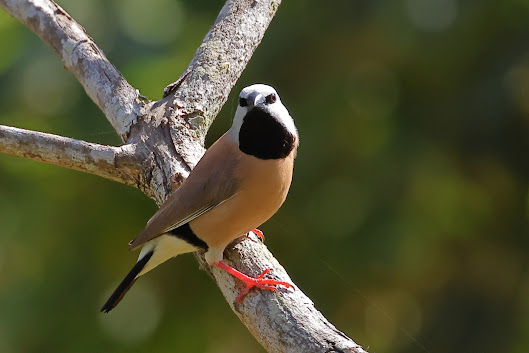
Lament for southern Black-throated Finches
Hollow logs for at risk birdies? Nature's nest boxes if you please Oh, such a clever wheeze So gather in twos and threes? Hundreds you w...
-
Seems Townsville will feel only the sting in Cyclone Debbie's tail. Nothing but light breeze and a rare drop of rain here yet as the c...
-
Hollow logs for at risk birdies? Nature's nest boxes if you please Oh, such a clever wheeze So gather in twos and threes? Hundreds you w...
-
Golden-headed Cisticola not so rusty when it comes to catching a feed See the eagle-eyed birdo doing his stuff. Eyes always on the move, mi...