Getting ready for takeoff, male Black-necked Stork lightens the load at Melaleuca viewing area, Town Common, Townsville this morning.
Job done, the bird decided it wasn't that concerned about my approach across the wetland weeds and would stick around
Not standing around by himself. Close by were juniors one and two. It seems from sightings at the area in recent weeks that the female seldom accompanies the youngsters. The four turned up a few weeks ago just as a family of five - whose nest is known to be somewhere slightly northeast of Melaleuca - began to drift apart, though all the birds have on occasion been seen more or less together elsewhere in the conservation park.
Missed the young birds' departure but here's the male on his way, spooked by some mild alarm from ducks and assorted waders further away.
Not a cause - this time - of the alarm, untidy Swamp Harrier overhead at Melaleuca the other day.
Just missed getting bird into the frame originally. Quick bit of added frame and some clumsy cloning and the picture's a little more complete. Do try this at home. With more care than I care to use it's a great tool.
But some potentially great shots just cannot be easily tarted up. This Little Pied Cormorant has become regular chat partner at the Freshwater hide in the early mornings after claiming ownership to standing rights on the log that's emerged at the water level drops. After fishing (diving underwater and chasing prey) the bird washes by part-rolling busily in the water. No easy way to remove unwanted stalks, I'm afraid.
Showing posts with label Little Pied Cormorant (Microcarba melanoleucos). Show all posts
Sunday, November 10, 2019
Thursday, May 9, 2019
Missing the target has its compensations
Chasing Little Kingfisher up and down Townsville's Mundy Creek, near my unit in Rowes Bay, lately - for no more reward than glimpses of blue and white blur streaking off in the distance. But there have been some bonus sightings, such as Little Pied Cormorant, above.
Spangled Drongo spangled nicely in the morning light today.
Male Red-backed Fair-wren popped up from the long grass nearby.
Magpie paused briefly from its foraging alongside upper reaches of the creek.
And elsewhere this morn, Bush Stone Curlew family stayed still just long enough for family portrait.
Spangled Drongo spangled nicely in the morning light today.
Male Red-backed Fair-wren popped up from the long grass nearby.
Magpie paused briefly from its foraging alongside upper reaches of the creek.
And elsewhere this morn, Bush Stone Curlew family stayed still just long enough for family portrait.
Wednesday, June 7, 2017
Zorry! Zose Zittings zey izn't zere
Longish walk for bung knee today in quest of info from the field after hearing of purported Zitting Cisticola sightings in the Town Common. Four kilometres, four hours and 54 Cisticolas (yep, 54!) later and nothing but Golden-headeds. Zip Zittings. Zilch Zittings. Zero Zittings. Okay?
Not much room along the bund between Freshwater and Bald Rock given the hordes of Cisticolas, but Little Pied Cormorant spied chance to drop in on two pals.
Also crowded with action, paperbarks and eucalypts at walk's outward end (for me), with both Helmeted (above) and Little Friarbirds prominent, though neither species calling, unlike plenty of honeyeaters and others.
Bit of luck too, catching the only Australasian Grebe seen, coming up with green frog. Probably regular enough part of the diet, but I can't recall any similar sighting. Sorry about image; long way off.
Not much room along the bund between Freshwater and Bald Rock given the hordes of Cisticolas, but Little Pied Cormorant spied chance to drop in on two pals.
Also crowded with action, paperbarks and eucalypts at walk's outward end (for me), with both Helmeted (above) and Little Friarbirds prominent, though neither species calling, unlike plenty of honeyeaters and others.
Bit of luck too, catching the only Australasian Grebe seen, coming up with green frog. Probably regular enough part of the diet, but I can't recall any similar sighting. Sorry about image; long way off.
Friday, August 23, 2013
Pallid Cuckoo scores on football ground
Uncommon visitor to the Tyto precinct, Pallid Cuckoo (Cacomantis pallidus) drops in for hairy caterpillars on the football ground yesterday. Bird found the rugby posts a splendid vantage point. No thoughts of offering the prey a sporting chance.
Most other birds sticking to the trees, which are being added to lately through various small plantings about the wetlands. There'll be more Leichhardt trees for Eastern Great Egret (Ardea modesta) to overtop after locals get in to plant seedlings provided by the shire this Sunday.
Elsewhere, Grey Fantail (Rhipidura albiscapa) takes a bough (geddit?).
As does Northern Fantail (Rhipidura rufiventris).
And Forest Kingfisher (Todiramphus macleayii).
Finally, sunning at front lagoons,Little Pied Cormorant (Microcarba melanoleucos).
Subscribe to:
Posts (Atom)
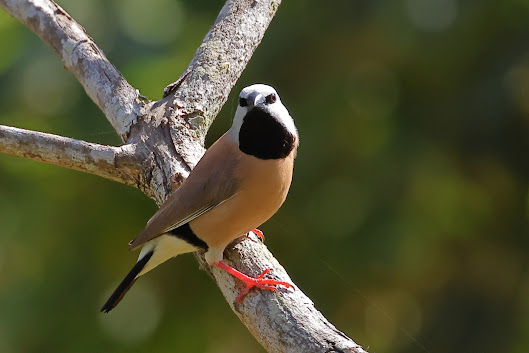
Lament for southern Black-throated Finches
Hollow logs for at risk birdies? Nature's nest boxes if you please Oh, such a clever wheeze So gather in twos and threes? Hundreds you w...
-
Hollow logs for at risk birdies? Nature's nest boxes if you please Oh, such a clever wheeze So gather in twos and threes? Hundreds you w...
-
Brown-backed Honeyeaters ( Ramsayornis modestus ) flourish in Tyto in spite of many nesting failures. They usually build their bulky, dangli...
-
Golden-headed Cisticola not so rusty when it comes to catching a feed See the eagle-eyed birdo doing his stuff. Eyes always on the move, mi...