Showing posts with label Scaly-breasted Lorikeet. Show all posts

Monday, January 25, 2010

Rainbows lighten up the grey days


Plenty of grey around North Queensland with Cyclones Neville and Olga collapsing into rainy lows. So a bit of colour needed. And what's more colourful than Rainbow Lorikeets (Trichoglossus haematodus), specially on Rose Gum flowers? Beetle is bonus, unnoticed at time.


Not so gaudy, but every bit as noisy and scarcely less numerous lately, Scaly-breasted Lorikeet (Trichoglossus chlorolepidotus), on Euodia (Corkwood - also popular with Ulysses butterflies).


Sunny or grey, January shaping as lowest species count in Tyto in recent years. December usually the -100 month: but 114 last month; 99 this month. Why? Who knows? Not me!

Tuesday, January 27, 2009

Rainbow Lorikeet over the top


A problem with Rainbow Lorikeets (Trichoglossus haematodus) is the temptation to crank up saturation to psychedelic levels. But the colours are dazzling enough, there's no need to go over the top.

Nobody told this bird (click pic to enlarge) about not going over the top. Came upon it bouncing on a dead stump of branch in Tyto this week. The bird kept mouthing and 'licking' a leaf of the tree. Couldn't see any insect life at all on the leaf. Nor was the bird biting chunks out of the leaf.

Rather, it seemed the bird might be drawing something 'chemically interesting' from the ragged edge of the leaf. After each mouthing/lick it would bounce up and down on the branch, then throw its head vigorously left and right. Licking, bouncing, head tossing. Bouncing, licking, head tossing. And so on for more than 10 minutes. A few random screeches and a bit of chattering added to the colourful encounter.

A few other Rainbows then turned up, but landed in a nearby Euodia. They paid no heed to the bouncing bird and it showed no interest in them. But it gave me a last screech and took off. Hard to be sure, but it may have been joined in departure flight by the newcomers.

I have absolutely no idea what the episode was all about. Took a tentative taste of leaf. Nothing. No taste, smell, reaction of any sort. Never seen any lorikeets in the tree before, nor any other birds acting oddly.

Am trying to nail ID for tree. Don't hold your breath! (Feb 6: hope you didn't hold breath! Tree is 'Alphitonia excelsa, commonly known as the Red Ash or Soap Tree, is a species of tree in the Rhamnaceae family. It is endemic to Australia, being found in New South Wales, Queensland, Northern Territory and the northeastern tip of Western Australia. It is used in bush regeneration as a pioneer species and for amenity planting.' Thanks, Wiki, and Greg Calvert, who told me name, which I forgot.)


While on the subject of lorikeets, here's a holdover Scaly-breasted (T. chlorolepidotus) from an earlier post, for comparison between the closely related species.  

Sunday, January 18, 2009

Lorikeets in two minds


A Scaly-breasted Lorikeet (Trichoglossus chlorolepidotus) tucks in to Euodia (commonly, Evodia) flowers during an extended feeding spell in Tyto yesterday. The bird's partner shot off early on. Expecting the pictured bird to do likewise, I rattled off several quick bursts. Then, we settled down: the lorikeet to enjoy foraging; me to stay close for a chat.


There's always a fly or two in the (app)ointment however. Birdwatcher first and photographer second, and engrossed in the chat, I failed to change camera settings to take advantage of improving light. So, pictures noisy and suffering for lack of tripod - back in car and put aside in favour of umbrella.

Rather appropriate, being in two minds about what to set out with, then having extended chat with a bird that itself often seems in two minds. Smaller and plainer than Rainbow Lorikeets (T. haematodus), Scalys give the impression they would be amazed to be told they were not Rainbows.


I'm sure they think themselves merely a little less colourful. And though their smaller relative size leaves them open to bullying, it's no surprise that aviary escapees in Melbourne and elsewhere are said to readily find Rainbow and other lorikeet breeding partners. (But I cannot remember ever seeing any intermediate forms.) 

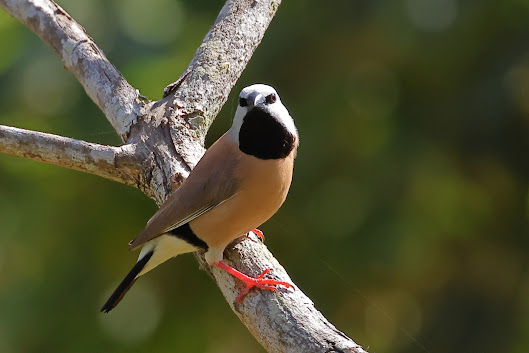
Lament for southern Black-throated Finches

Hollow logs for at risk birdies? Nature's nest boxes if you please Oh, such a clever wheeze So gather in twos and threes? Hundreds you w...