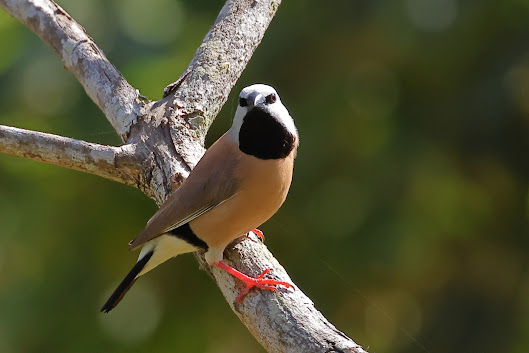
Chased pair of Shining Flycatchers back and forth along section of tangled mangroves at edge of small wetland (mostly dry, but muddy!) in Townsville this morning after hearing male (above) calling.
It helps to know the species - especially the male - usually forages predictably, low, along the edges of heavily shadowed wet areas. So, first catch up with the birds, then try to get ahead of them and wait.
Allow for probability they'll turn back and leave you standing. Several times. Also allow for frustration in failing to get clear sightings most of the time.
As also with Leaden Flycatcher the other day. Great pose, pity about the shadow.
Bit luckier with Buff-banded Rail recently. Only this one shot saw bird's tail cocked enough to clear blade of grass otherwise obscuring it.
Showing posts with label Leaden Flycatcher (Myiagra rubecula). Show all posts
Thursday, August 13, 2020
Thursday, September 5, 2019
Bee-eater takes flight but others show no fright
Rainbow Bee-eater took flight this morning in the Townsville Town Common but a few other birds have been more camera friendly lately.
None more so than immature White-eared Monarch. Almost perched on lens today. Too close to focus. Naturally, whizzed away far beyond reach when it did decide to go. So, picture from earlier in week.
Yesterday, male Leaden Flycatcher had plenty to say along fire break between road and golf course. If the bill was turned a little more the bird might present as one of those bird or rabbit illusions.
Bit of a puzzle with juvenile Black-necked Storks this week. Three youngsters became four yesterday. Seems a loner turned up and more or less joined the regular trio. Today, loner alone. No sign of juniors. Above, female parent yesterday.
Much smaller and harder to gain focus on, Fairy Gerygone two days ago stayed still long enough for an almost sharp shot.
And here's a reminder of the golden rule: don't be lured to eating fruit and berries because the birds in the bush are gobbling them up. Here's an Australian Raven chomping into Black or Deadly Nightshade. Black is deadly and ripe Deadly is black. Stick to Blackberries and leave black berries well alone.
Last, reminders of Tyto Wetland days in Ingham with one of the Common's Crimson Finches. Not many to be seen for a few months but they're popping up here and there these days. Not always quite so prettily as this male.
None more so than immature White-eared Monarch. Almost perched on lens today. Too close to focus. Naturally, whizzed away far beyond reach when it did decide to go. So, picture from earlier in week.
Yesterday, male Leaden Flycatcher had plenty to say along fire break between road and golf course. If the bill was turned a little more the bird might present as one of those bird or rabbit illusions.
Bit of a puzzle with juvenile Black-necked Storks this week. Three youngsters became four yesterday. Seems a loner turned up and more or less joined the regular trio. Today, loner alone. No sign of juniors. Above, female parent yesterday.
Much smaller and harder to gain focus on, Fairy Gerygone two days ago stayed still long enough for an almost sharp shot.
And here's a reminder of the golden rule: don't be lured to eating fruit and berries because the birds in the bush are gobbling them up. Here's an Australian Raven chomping into Black or Deadly Nightshade. Black is deadly and ripe Deadly is black. Stick to Blackberries and leave black berries well alone.
Last, reminders of Tyto Wetland days in Ingham with one of the Common's Crimson Finches. Not many to be seen for a few months but they're popping up here and there these days. Not always quite so prettily as this male.
Friday, November 18, 2016
Leaden Flycatchers stick to site in the open
Stern talking to didn't stop Leaden Flycatcher building nest low on open branch in small paperbark almost on major Tyto track. But female, above, stopped flitting away when I began talking to it as I approached. Male - sharing sitting duties, mainly in early morning - not so keen on conversation. The birds - or other pairs - have used the same tree for more than six years, without previously building in such an exposed position.
Close by, caught Little Shrike-thrush with insect extracted from cracked bark of Cheese Tree. This and many other species has been busy building and breeding lately. The nests are always tucked carefully away in shadowy foliage, often in Cheese Trees,
Captured so-so images of Welcome Swallow on the wing the other day. But no results from efforts to catch White-breasted Woodswallows on the wing as they come and go near the Tyto hide, building a nest in a major vertical fork (as usual) of a large paperbark. Rubbing failure in - and evidence of the breeding rush - another pair of Woodswallows this morning darted here and there feeding a ravenous youngster.
Grimmer sign of hunger in the wetlands, found this Agile Wallaby feeding near entry track yesterday. Seemed almost unaware and unhampered by gaping surface wound, result of Dingo or dog attack. Bits of ear also missing. Dried wound looked infection-free, so animal appears a lucky survivor.
Close by, caught Little Shrike-thrush with insect extracted from cracked bark of Cheese Tree. This and many other species has been busy building and breeding lately. The nests are always tucked carefully away in shadowy foliage, often in Cheese Trees,
Captured so-so images of Welcome Swallow on the wing the other day. But no results from efforts to catch White-breasted Woodswallows on the wing as they come and go near the Tyto hide, building a nest in a major vertical fork (as usual) of a large paperbark. Rubbing failure in - and evidence of the breeding rush - another pair of Woodswallows this morning darted here and there feeding a ravenous youngster.
Grimmer sign of hunger in the wetlands, found this Agile Wallaby feeding near entry track yesterday. Seemed almost unaware and unhampered by gaping surface wound, result of Dingo or dog attack. Bits of ear also missing. Dried wound looked infection-free, so animal appears a lucky survivor.
Tuesday, May 8, 2012
Little Kingfisher talks back
Ha! Take this and the next all you who prick the pride of the Tyto knowall with your banter about the mythical Little Kingfisher (Ceyx pusilla).
My little friend and I enjoyed many magic minutes together this morning at the footbridge to the lookout. Much more peaceful without those southern interlopers, said one of us. And the other agreed. But we both smiled, I swear. (The ALB stayed away again!)
Bit of a turnup today also, with six Sacred Kingfisher (Todiramphus sanctus) seen here and there.
And here's a male Leaden Flycatcher (Myiagra rubecula) from Saturday at the Osprey tree pool (where the LK was briefly to be found).
Not too much action at the hide over the weekend but this Crimson Finch (Neochmia phaeton) showed some interest in previous paperbark nesting site, and did a quick robin impression. Apparently it can't do LKs.
Click pix to enlarge
Subscribe to:
Posts (Atom)
Lament for southern Black-throated Finches
Hollow logs for at risk birdies? Nature's nest boxes if you please Oh, such a clever wheeze So gather in twos and threes? Hundreds you w...
-
Seems Townsville will feel only the sting in Cyclone Debbie's tail. Nothing but light breeze and a rare drop of rain here yet as the c...
-
Hollow logs for at risk birdies? Nature's nest boxes if you please Oh, such a clever wheeze So gather in twos and threes? Hundreds you w...
-
Golden-headed Cisticola not so rusty when it comes to catching a feed See the eagle-eyed birdo doing his stuff. Eyes always on the move, mi...