Sticks. Some birds need stacks of them. Whistling Kite returns towards nest after seeing off cheeky young Brahminy Kite that ventured too close. But on the way home, why not stop off for a bit of extra for the relatively modest nest high in eucalyptus?
Young White-bellied Sea-eagle not so long ago stood upon stack of sticks vastly outweighing the kite's. Parent birds lately heard honking from their massive creation in Townsville Town Common Park. Be no surprise soon to see them carrying fresh stocks of sticks to the nest.
Then there's those that stick to standing stock still on sticks. Nankeen Night Heron, in early morning light, for example. Or Little Pied Cormorant.
Pheasant Coucal not sticking totally to the theme, half on, half off.
White-bellied Cuckoo-shrike goes one better, all on and all off.
Little Friarbird, meanwhile, sticks to daily preening routine, stock-in-trade for all birds whether from the sticks or the heights.
Showing posts with label Nankeen Night Heron. Show all posts
Wednesday, March 20, 2019
Wednesday, November 12, 2008
Luck's spotty, like the birds
Luck's been spotty with birds spotted in the distance. Didn't even know the Nankeen Night Heron (Nycticorax caledonicus) disappearing fast from view at Tyto today was a spotty juvenile till I downloaded the images. From distance the bird looked a somewhat drab adult.
Pheasant Coucal (Centropus phasianinus), in black and brown breeding plumage, is more streaked than spotted, and more often spotted running along the ground looking - as in Judith Wright's marvellous set of bird poems - like a granny tripping along tiptoe with skirts up.Difficult to catch these crafty birds in clear view, on boughs or in the air. They almost invariably clamber high within a tree and launch themselves out the other side away from perceived danger. Their flight is not so clumsy as often described.
Though from the cuckoo family, it's hard to see much about them that other cuckoos would admire. Pheasant Coucals build their own ground nests, incubate the eggs, feed the young, and generally behave like good bird parents.
If they stopped eating other birds' eggs and young all would be happy. I guess they won't and will continue to be mobbed as relentlessly as, say, Blue-winged Kookaburras and Little Eagles.
Spotted close to the long-deserted nest, the quicksilver pair of Lovely Fairy-Wrens. As ever, they flashed across a track, spent a split-second in lantana close to their decaying nest, and disappeared into thick tangles of more lantana and guavas. But I will get them!
Also spotted from distance - and genuinely spotty - this Wood Sandpiper (Tringa glareola), at the mill treatment ponds yesterday evening. We played a wee game of see-if-the-photographer-falls-in-the-scum-chasing-the-bird-beside-the-pond - and declared it a 0-0 draw: no top shots of bird, no muddy feet for me. Meantime, the mystery dark sandpiper of last week was nowhere to be seen.
And here's a biggie to finish. The best-conditioned, thickest Amethyst Python (Morelia amethistina) I've yet seen in Tyto. About 3.5 metres of muscular, shimmering gorgeousness, so heavy it left deep grooves in the shortish wet grass. Perfection! Until it came to keeping its tongue in frame and itself out in the open.What do you say to an almost 12-foot snake as it goes by? So long! What else could you say?
Spot you later, as they say.
An afterword: Problems with downloading pictures, formats that kept changing, and supposedly lost internet connections added at least an hour to posting this blog. Do others strike similar posts or days? It's maddening to space everything perfectly, introduce another image and find spacing's gone haywire and font and type size has changed. Happens whether I paste stuff in or enter it directly.
Sunday, October 26, 2008
Heron, but hearing no bitterns
Did first transect and stood at listening post as part of national Little Bittern (Ixobrychus minutus) survey today. Not a gurgle was heard. Should be sightings soon as males start sorting out things before breeding. Almost sure the birds stick around all year though guide books talk of possible migration to Papua New Guinea.
If there's no bittern to be seen, what's next best? Well, next to them in some books is the Nankeen Night Heron (Nyticorax caledonicus). Right on cue, a heron flew out of a paperbark close to a lotus pool tucked away in a seldom visited corner of the wetlands.
Night herons enjoy freshwater mussels. Opened shells along the waterline are a sign of the bird. (But shells piled in heaps mean rats at work). Once flushed the birds usually fly off some distance and warily keep an eye on their disturber.
Today, I noted the probable hideout tree, circled around and checked out other birds. An hour later I snuck in on the bird's blindside - and almost got away with it. But not quite. So, a distant flight shot with lighting far from helpful. Another for a next time.
Did a bit better with an eclipse male White-winged Triller (Lalage sueurii). Two birds foraged among new-growth weeds before one obliged by flying up close to me. The White-wingeds come and go. A few breeding males were active and noisy early last month but nothing much came of their frantic hover-fluttering and calling (to show females where the male plans to build and mate).
Evaporation on the main lagoon is speeding up. But as yet the consequence has been many more departures than arrivals. Sandpipers and others should find the shallows and mud more to their liking by beginning of November.
If there's no bittern to be seen, what's next best? Well, next to them in some books is the Nankeen Night Heron (Nyticorax caledonicus). Right on cue, a heron flew out of a paperbark close to a lotus pool tucked away in a seldom visited corner of the wetlands.Night herons enjoy freshwater mussels. Opened shells along the waterline are a sign of the bird. (But shells piled in heaps mean rats at work). Once flushed the birds usually fly off some distance and warily keep an eye on their disturber.
Today, I noted the probable hideout tree, circled around and checked out other birds. An hour later I snuck in on the bird's blindside - and almost got away with it. But not quite. So, a distant flight shot with lighting far from helpful. Another for a next time.
Did a bit better with an eclipse male White-winged Triller (Lalage sueurii). Two birds foraged among new-growth weeds before one obliged by flying up close to me. The White-wingeds come and go. A few breeding males were active and noisy early last month but nothing much came of their frantic hover-fluttering and calling (to show females where the male plans to build and mate).Evaporation on the main lagoon is speeding up. But as yet the consequence has been many more departures than arrivals. Sandpipers and others should find the shallows and mud more to their liking by beginning of November.
Subscribe to:
Posts (Atom)
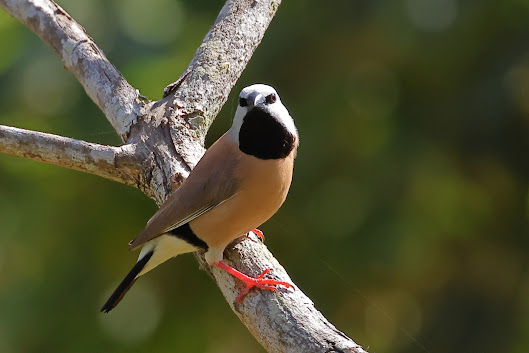
Lament for southern Black-throated Finches
Hollow logs for at risk birdies? Nature's nest boxes if you please Oh, such a clever wheeze So gather in twos and threes? Hundreds you w...
-
Hollow logs for at risk birdies? Nature's nest boxes if you please Oh, such a clever wheeze So gather in twos and threes? Hundreds you w...
-
White-faced Heron stands up and begs picture be taken at Tyto. The birds can develop some trust in people, but I've never found any aro...
-
Who gives way on footbridge, Yellow-spotted Monitor or unspotted bird watcher? Naturally, dinkum locals have right-of-way. I step aside, Spo...
