Showing posts with label fungi. Show all posts

Friday, October 10, 2008

Two's porny, three's allowed!

Just to show how grownup I can be, here's Lyophyllum connatum as a threesome and not the prurient pairing commonly seen, in nature - and elsewhere. Though the field guide talks of dense clumps and colonies, two or three caps growing from the grassiest of tracks is the Tyto norm.

In my eagerness to post Little Bittern pictures yesterday I neglected to include other details from the sighting.


Also close by was a Red-backed Fairy-Wren ferrying insects to a regular nesting area. The wren's disguised approach to the nest made more noise on the Scleria than the bittern.


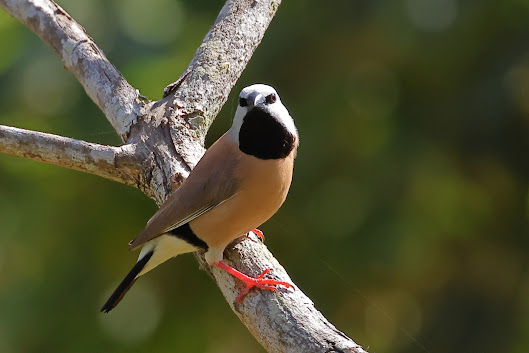
So did a pair of Crimson Finches bouncing on the stems before taking nesting material to a hole in a paperbark. Even noisier was the rustling about of an Australian Reed Warbler.


Yet eight metres from me a relatively huge bird shifted around with little noise at all. It may be that the birds are more active feeders during the day than has been recognised. It's almost impossible to see them and now I find their secretiveness is much enhanced by quiet movement.


Missed out everywhere else on the rounds today. Shining Flycatchers, Azure Kingfishers and Large-Billed Gerygones made shadowy appearances and vanished. All the glorious leaves tiling the rainforest creek surface were scattered by overnight wind. I've declared the Lovely Fairy-Wren nest a lost cause, and am having doubts about my cuckoo thief theory.

Thursday, August 28, 2008

Yellow Spoonbill fronts up

Bigger of Australia's spoonbills, the Yellow-billed (Platalea flavipes) ranges over most of the country - and even gets to New Zealand - but seldom drops in to Tyto, where the Royals (Platalea regia) are relatively common in small numbers.

Another major difference, as in the bird pictured (only the second of 2008), is the plumage. Yellows just don't come in the spotless white of Royals and the even whiter white of Great and Intermediate Egrets. Nor do the Yellows glory in the startling yolky yellow breeding patches above the eyes of Royals. Seems a bit unfair, given the name, missing out on glorious yellow markings, doesn't it?


When foraging in the shallows, the birds sweep their heads rhythmically left-right-left-right, pausing in this metronomic pattern to swallow such prey as the sensitive bills have located and captured. I've never seen a spoonbill catch hold of a fish or, say, frog big enough to be seen clearly. This would explain why small parties of spoonbills often have an egret, usually the large Great, stalking along and accepted beside them. The spoonbills feel their prey, the egret sees its meals. No competition, no squabbles.


The latest Yellow arrival probably won't stay long. Even though often solitary, the birds obviously by their general absence throughout most of every year do not find Tyto's lagoon system as welcoming as do the Royals. On the plus side, the bird is not flighty, so long as the approacher moves slowly and doesn't seek to get inside the 'zone of confidence': which varies with all living things - in this case 20-25 metres.


So, if I can get close why isn't the picture better? Good question. I've just rechecked the focussing on the Panasonic FZ30. In short, it doesn't. Well, of course it does, but not super sharply. The Pana's days are numbered. If I'd known then what I now know etc etc...


But it has taken 62,000 images without any problems apart from the hand grip stretching (cut it away and glue-on two small velcro circles) and the 1.7x lens cover cap falling off (tiny drops of super glue dried hard on cover's six ribs).


Finally, the return of the slime!!! Couldn't resist picture of this colony of Fuligo septica (about 500mm x 250mm). And a last look at the sporangium of the earlier post, now slowly fading away.

Sunday, August 24, 2008

Fungi fun and name games

Coming to an 'understanding' of the problem

Covered the almost endless depths of my ignorance about slime moulds by delving into Bruce Fuhrer's Field Guide to Australian Fungi. What then could be simpler than finding fungi in the rainforest, getting them to smile and say cheese (and truffles) and naming them all from the book. Too easy!

Sure, most snakes are almost impossible to photograph, let alone name. Little brown birds can make one a twittering wreck. But a few fungi. How hard can that be?

Much harder than expected. Few fungi found. Not all photographed well. And even with book in hand names didn't pop out easily - or at all. But I liked the pictures enough to give two of the fungi a run.

Naturally, we'll start with a mystery entry. Can't find anything like this one in the book. Seems to be a 'clumper' that's been growing for quite some time. Width about 150mm. The picture is a view from above. The same species, shot from below and growing on the same fallen tree, opens this post.


Think I'm on surer ground with this one. Microporus xanthopus is found throughout tropical Australia. Large (up to 90mm) and small. I find the funnel 'flowers' mainly on small fallen branches in drier patches of forest.

Lament for southern Black-throated Finches

Hollow logs for at risk birdies? Nature's nest boxes if you please Oh, such a clever wheeze So gather in twos and threes? Hundreds you w...