Showing posts with label Australian Little Bittern. Show all posts

Monday, October 10, 2016

Luck takes a hand in what's spied from the hide

Lady Luck got to work for me in Tyto today. Been haunting the hide of late because water levels gradually dropping and offering bit more mud for White-browed Crakes - in particular - to forage on out in the open. Doubly lucky to get a bird right below hide, after just missing great action shot yesterday.

And there have been teasing calls - mainly from afar, once quite near - from Australian Little Bittern/s. More luck. Today's sighting of female and male could not have been made from the hide. Distant picture above of male with treefrog (probably Peron's - usually brownish, but as with many frogs able to change colour) came as I was returning after quick check on nesting fantails and sunbathing python.

More luck. Walk to Northern Fantail nest led me to almost step on Large-tailed Nightjar. Blur of brown before my eyes and much diversionary fluttering followed. 

Bird kept trying to lure me away. I kept trying to locate egg/s/hatchling/s, oh so cryptic and laid or lying near the track. We both failed. But all the time being taken produced the lucky sighting of the bitterns.

So, just for luck I'll throw in a few more from the latest Tyto outings, starting with Brown-backed Honeyeater.

And ever-present Crimson Finch, female chomping weed seeds.

Solitary Sulphur-crested Cockatoo sitting a while before beginning to chomp chucks out of perch.

And Common Koel male taking break from noisy advertising for females. But he'll probably get lucky. Just not so lucky as this watcher.


Saturday, December 24, 2011

Santa presents Little Bittern presence

Look what Santa brought me today in Tyto! Live Australian Little Bittern (Ixobrychus dubius) to play with. 


Just the present for a birding boy, though asking for its presence is a tall order.


And it didn't really want to play very much at all. But that'll do me. Thanks, Santa! And Merry Xmas faithful followers.
Click pix to enlarge

Monday, October 25, 2010

Little Bitter among minor miracles

Much made for and against in Australia lately about two miracles needed to create this nation's first saint, but among unsaintly types minor miracles roll out without nearly so much fuss. Thus, sighting today and yesterday of Tyto's rarity, Australian Little Bittern (Ixobrychus dubius). Each time bird flew from flooded lagoon edge, across 40m open water and dropped down into scleria. One flight and sighting is a blessing, two in two days nothing less than birdwatching miracle. Three in a row too much to contemplate!


And another good news tale. White-browed Robins (Poecilodryas superciliosa) yesterday frantic to protect grounded fledgling from opportunist green ants. Parents kept picking at the biting menace. Junior fluttered around feebly. Finally scrambled off the ground. Today, no sight or sound of family so presumably all's well. Just a very minor miracle.            
Click pix to enlarge    

Wednesday, September 8, 2010

Little Bittern fourth issues forth

Fourth sighting for 2010 of Australian Little Bittern (Ixobrychus dubius) in Tyto this morning coincided with copy of The Bittern Chronicle ('Reed all about it') in day's mail.


For 2009-10, 38 Littles were recorded at 26 wetlands (mainly southeast and southwest mainland Australia); 94 Australasian Bitterns were recorded in 63 wetlands (mainly southeast and southwest, and Tasmania). No estimate is offered of total Littles. 'Threatened' status is sought for Australasians, which may number fewer than 1000 (NZ has 500-2000).


I am certain many more Littles are out there. But being smaller, quieter and living farther from birding hotspots means fewer reports. The surveys continue.


No shortage ever of White-browed Crakes (Amaurornis cinerea) in Tyto, though high lagoon levels mean many are stalking unseen through reeds and fewer are out treading the lily leaves. 
Click pix to enlarge  

Saturday, December 19, 2009

Little Bittern in the hand, sadly


Found a sad rare bird in the hand today. This Australian Little Bittern (Ixobrychus dubius) tangled with barbed wire fencing at a small wetlands near Ingham overnight. Still alive when unhooked, the bird had suffered too much damage. The vet did what I had feared would fall to me. 


Imagine the suffering of any bird or animal caught in such terrible position. It's even sadder when the species is of limited and perhaps declining numbers. Today's was the second Little Bittern I've found barbed in two years. Use of unbarbed top wires would stop many such deaths.


But it's too close to Christmas to end with notes of gloom. So here's a happier pair of birds on wire. First, juvenile Welcome Swallow (Hirundo neoxena) finds Tyto footbridge wire walking and wing stretching harder than simply sitting and waiting to be fed.


Rainbow Bee-eater (Merops ornatus) contents itself with merely looking glorious, in a subdued sunsetty way, as it waits for prey to rise from the western end of Ingham airstrip.

Sunday, November 29, 2009

Little Bittern caught out in open


Australian Little Bittern (Ixobrychus dubius) makes a rare daylight foray along the edge of scleria in the northeast corner of the main Tyto lagoon early yesterday. Couldn't have asked the bird - a male of subdued colouring - to do more regarding position and poses.


But sadly I was 50 metres away across the water and unable to move much closer. In fact, even at such distance the bird would have darted back into cover in a flash at any sudden or great movement.


Talking of movement, the clumsiness of the bird's passage jumping and jerking across the base of the scleria was surprising. All my previous sightings suggested a life of stealthy, silent stalking, not clumsy and surely noisy leaping from foothold to foothold. My toehold on knowledge grows ever tinier!

Wednesday, November 18, 2009

Cor, cormorants and blurry bittern


Interesting bits later, the one decent picture first. Little Pied Cormorant (Microcarba melanoleucos) in solo pose near a Tyto lagoon. Little Pieds stand alone, in contrast to Little Black Cormorants (Phalacrocorax sulcirostris). Any fish the solitary hunter Pied takes brings no threat of theft from a fishing companion.


But Little Blacks hunt in packs. The advantage appears to be a 'herding' of fish ahead of the swift swimming pack. The disadvantage is an instant challenge against any bird that takes a fish too large to be immediately swallowed. Side note: 50-60 Little Blacks in Tyto overnight the only large group of the species to spend much time in the wetlands in six years or more.


Worst for last. Australian Little Bittern (Ixobrychus dubius) disappears across scleria in Tyto today. Male, but you'll have to take my word for it. My only flight picture in six years. Saw male and female yesterday, without even bad picture. Tomorrow ...

Wednesday, September 30, 2009

Little Bittern makes a return


Thought the Australian Little Bitterns (Ixobrychus dubius) had flown off after the Jan-Feb floods perhaps never to be seen again. But here's a woeful picture to celebrate a return. Bird was distinctly visible from long way off yesterday, but there was little chance of sneaking up close. As things turned out, it fled back into the scleria when a nearby egret spooked it. But a hopeful sign coming as the lagoon shallows dry out. More sightings probable. Better pictures? Maybe.


Even when close to a bird in the clear, things don't always work out. Here's a Golden-headed Cisticola (Cisticola exilis) in 'clumsy' pose and, it must be said, an awful natural frame. Of course, it's ugly because it fails to meet a human's standard of beauty. The bird, happily, knows nothing of such things.


Same with this curiously coloured female Rufous Whistler (Pachycephala rufiventris). Twigs littered all over the place, including across the bird. No trouble. Clone some of them away. It's more an art form than a skill, cloning, they say. They're right. And I've always been hopeless at art! Would the cloning be obvious without my mentioning it?

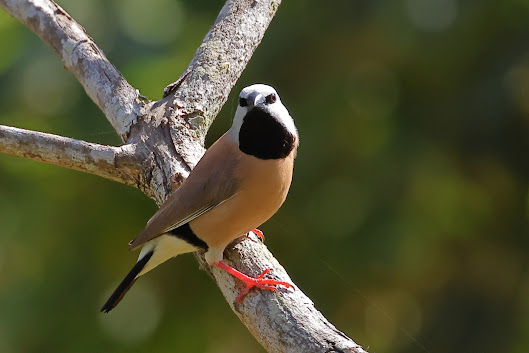
Lament for southern Black-throated Finches

Hollow logs for at risk birdies? Nature's nest boxes if you please Oh, such a clever wheeze So gather in twos and threes? Hundreds you w...