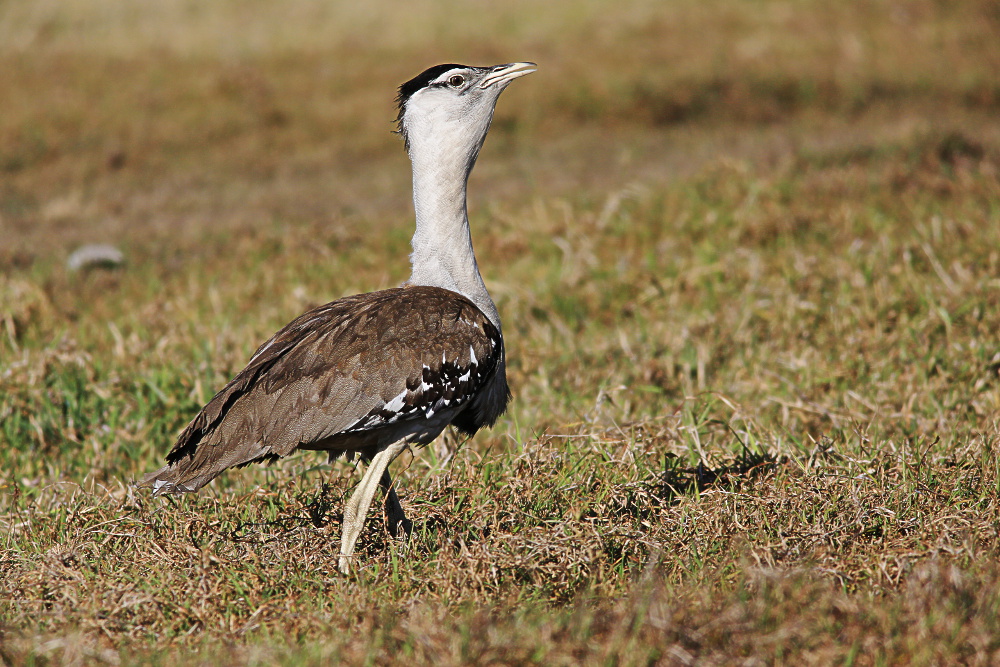
Morning encounter with Australian Bustard (Ardeotis australis) brought surprise.
After circling bird slowly it walked towards rather than away from the Troopy and began series of stretches.
Bit of showing off followed before unhurried flight to get on with hunting up breakfast.
May have been same bird getting ready to tuck into inkweed two mornings earlier.
Showing posts with label Australian Bustard (Ardeotis australis). Show all posts
Tuesday, January 13, 2015
Wednesday, August 27, 2014
Crimson Finch tucks into weed seed feed
Female Crimson Finch (Neochmia phaeton) tucks into hymenachne weed at Mungalla Station today. Above, it's not easy trying to be a tidy eater. Below, quick flick to clean the bill and looking neater.
Also in Mungalla, Australian Pratincole (Stiltia isabella), one of several likely to settle in for a few months' residency, and probably some breeding.
Recent migratory arrival, Latham's Snipe (Gallinago hardwickii) also appears to have settled in for a long spell, feeding in pools alongside Palm Creek.
A longterm resident, Australian Bustard (Ardeotis australis), stands out on track running above the creek. Much male posturing for months so local breeding possible, though I've never seen any younsters running about the Ingham area.
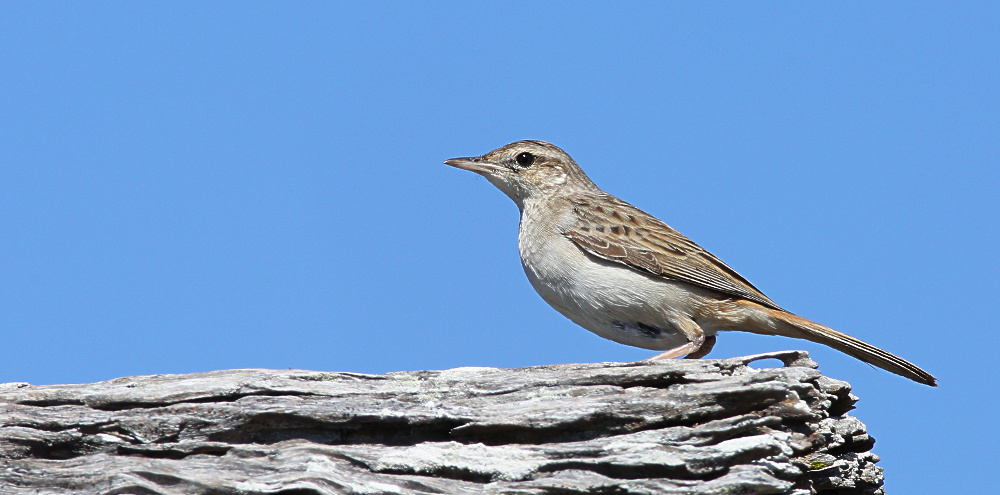
And another longtermer - always in big numbers - Australasian Pipit (Anthus novaeseelandiae) leaves the dusty ground for a brief taste of the high life.
Also in Mungalla, Australian Pratincole (Stiltia isabella), one of several likely to settle in for a few months' residency, and probably some breeding.
Recent migratory arrival, Latham's Snipe (Gallinago hardwickii) also appears to have settled in for a long spell, feeding in pools alongside Palm Creek.
A longterm resident, Australian Bustard (Ardeotis australis), stands out on track running above the creek. Much male posturing for months so local breeding possible, though I've never seen any younsters running about the Ingham area.
And another longtermer - always in big numbers - Australasian Pipit (Anthus novaeseelandiae) leaves the dusty ground for a brief taste of the high life.
Wednesday, May 28, 2014
Going to ground and crawling around the mound
Becoming a bit of a crawler lately. Getting down isn't too hard, but age shows in the creaky rising. And there are certain mounds of material best avoided. But those same mounds come in handy, as above for Australasian Pipit (Anthus novaeseelandiae).
Plenty of the same in dusty territory of Willie Wagtail (Rhipidura leucophrys), another local at Mungalla Station.
As also is this Australian Bustard (Ardeotis australis), in a greener part of the station.
Plenty of the same in dusty territory of Willie Wagtail (Rhipidura leucophrys), another local at Mungalla Station.
As also is this Australian Bustard (Ardeotis australis), in a greener part of the station.
Thursday, November 14, 2013
Bustard big on necking
Mr Bustard (Ardeotis australis) out to drive the girls wild with his special take on necking.
Displaying his morning glory, a super-rack breast-sac.
Bit of a drag if it dangled all day.
He's always showing off, said another Mungalla local.
Displaying his morning glory, a super-rack breast-sac.
Bit of a drag if it dangled all day.
He's always showing off, said another Mungalla local.
Saturday, August 31, 2013
Rufous Songlark stands firm
Not always easy to find in the browning grasses, the bird has stuck to the old stockyards area for several months.
Another longterm stayer has been this Australian Bustard (Ardeotis australis), often seen previously with three others but lately walking alone.
Also alone at the station, handsome eucalypt (motionless during a recent still morning: there is a bird on show, by accident).
Friday, July 5, 2013
Big mornings with two Mr Bigs
Big morning near Wallaman Falls featured leisurely walk down the road with resident Mr Big, Southern Cassowary (Casuarius casuarius). Not much fallen tucker about the place so fruitful stops proved rare. Three birds seen together lately so breeding seems probable. Good news for the endangered species.
Another Mr Big, Australian Bustard (Ardeotis australis), the continent's heaviest flyer, pauses during a morning stroll at Mungalla Station, just east of Ingham. Four birds at present call the station's paddocks home.
Biggish bird feeding big appetite at Tyto Wetlands the other day, Pacific Heron (Ardea pacifica). Though striking mostly at prey in mud and shallow water, the bird didn't neglect its greens. Something for parents of fussy feeders to consider given talk of people going insectivorous?
Another Mr Big, Australian Bustard (Ardeotis australis), the continent's heaviest flyer, pauses during a morning stroll at Mungalla Station, just east of Ingham. Four birds at present call the station's paddocks home.
Biggish bird feeding big appetite at Tyto Wetlands the other day, Pacific Heron (Ardea pacifica). Though striking mostly at prey in mud and shallow water, the bird didn't neglect its greens. Something for parents of fussy feeders to consider given talk of people going insectivorous?
Wednesday, May 22, 2013
Rare rubberneck at some Red-necks
Eight very uncommon visitors standing in shallows at Mungalla Station today. Plenty of Red-necked Avocet (Recurvirostra novaehollandiae) further south but seldom seen this far northeast. Be interesting to see if they stick around.
Still wandering about the place today, this Australian Bustard (Ardeotis australis), one of four calling Mungalla home these days.
Another home bird (seen again today in family of four, but photographed last week) Sacred Kingfisher (Todiramphus sanctus). Cool, eh?
Sunday, April 7, 2013
Mangrove Robin reveals nest site
Bit of luck at the end of Orient Station road today with Mangrove Robin (Peneonanthe pulverulenta) giving away nest site.
Bird sits neatly in cup, which sits neatly in thick fork of dying mangrove.
Here's a closer look at one of the nesting pair, taken previously.
Elsewhere along the station road recently, pair of Brown Quail (Coturnix ypsilophora) venture briefly from cover.
And an Australian Bustard (Ardeotis australis) does a little morning preening and flapping.
Wednesday, May 30, 2012
Bustard busted, but unflustered
Big birds, big surprise. Couple of Australian Bustard (Ardeotis australis) along Orient Station road this week.
Not spotted one near Ingham before, though probably they've been present, unreported.
This is not a Bustard flustered, both birds being relaxed, so long as the Troopy rumbled along slowly after them.
Click pix to enlarge
Subscribe to:
Posts (Atom)
Lament for southern Black-throated Finches
Hollow logs for at risk birdies? Nature's nest boxes if you please Oh, such a clever wheeze So gather in twos and threes? Hundreds you w...
-
Hollow logs for at risk birdies? Nature's nest boxes if you please Oh, such a clever wheeze So gather in twos and threes? Hundreds you w...
-
White-faced Heron stands up and begs picture be taken at Tyto. The birds can develop some trust in people, but I've never found any aro...
-
Who gives way on footbridge, Yellow-spotted Monitor or unspotted bird watcher? Naturally, dinkum locals have right-of-way. I step aside, Spo...