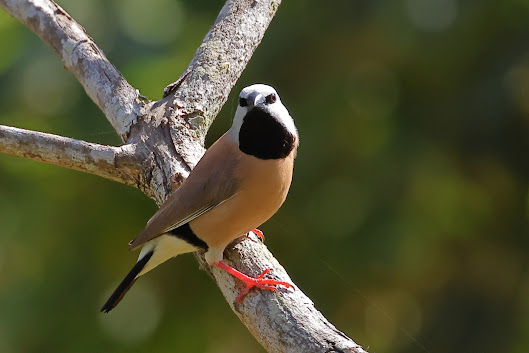
Brown-backed Honeyeaters (Ramsayornis modestus) flourish in Tyto in spite of many nesting failures. They usually build their bulky, dangling, domed-entry nests lowish over water and away from prying eyes (that's us, folks!).
Their caution doesn't stop other honeyeaters from stealing from the mass of nesting material. It does make the nests more difficult to find than their size would indicate.
The bird pictured and its mate have chosen as bad a site as could be imagined. Smack in front of the bird hide, high off the dry ground, and in an area teeming with tree snakes (three or four live in the hide roof!) and the odd passing vandal. Any chance of a happy outcome? Not one.
They should have asked the Yellow Honeyeaters that built and abandoned a much smaller nest tucked secretly within the same branch system what life near a hide was like. 'Too much for us,' would have been the reply. 'We couldn't stand all the noise and movement. Couldn't shift quickly enough!'
Or quizzed the Willie Wagtail sitting on a neat cup nest slightly above human eyes looking out of the hide to the southwest. 'We love it here,' she'd say. 'We got cheesed off with vandals destroying the nests we built inside the hide. But this is perfect.'
Or tried to find the Red-browed Finches that reared the usual big family in the top of the tree. So cunning were the parents, they'd fly in to one tree and dart across it into the nest tree. Almost totally unseen and all high out of harm's way.
I'll let things play out without stepping in as I'm sure the Brown-backeds will soon realise their mistake. After vandals twice destroyed nests of Willies sitting on eggs I began removing all material as soon as building began. The birds took the hint and have since reared young in two of the three trees around the hide.
Elsewhere today, brief sighting of female and probable male Lovely Fairy-Wren (not far from abandoned nest), another sighting of pale Horsfield's Bronze-Cuckoo seen last week being ignored by a Red-backed Fairy-Wren, today fed by three wrens, and fleeting fly-bys from the Azure Kingfisher (seemingly too busy to stop at the nest tunnel - which may as yet be more tunnel than nest).