Thursday, January 1, 2009

Colourful start to 2009

2009 looks gloomy in prospect, so a bit of colour might help give us a lift!


How about a pollen-laden honeybee (Apis mellifera) visiting a Tyto blue lotus today?


Or a Carpenter bee (Xylocopa spp.) leaving a lotus?


Pink and red are always cheering. A dragonfly (Diplacodes haematodes) rests on a lotus.


Must include at least one colourful bird. Comb-crested Jacana (Irediparra gallinacea) does a tip-toe wing stretch on the main lagoon today.

Happy New Year to all of us! 

Tuesday, December 30, 2008

Oily boids get ... caterpillars


Gloriously 'oily' Metallic Starlings (Aplonis metallica) were busy taking to caterpillars on a Leichhardt tree in Tyto today. The birds appear to have migrated south in lesser numbers this year.

Favourite trees (usually rain trees: Albiza spp, I think) carry fewer of their bulky 'apartment' buildings. Perhaps Ingham has not retained the favour of these spectacularly plumaged tourists. There may be greater numbers elsewhere.


One small blessing will be reduced mortality around town. All the birds, but particularly the immatures, are terribly naive. Their low, swift flights lead tailenders to crash into windows, fences, power lines and vehicles.

An aside on Leichhardt trees. It's curious how one or two trees will be ravaged by caterpillars (sorry, no idea of species) grazing on the surface of the large leaves , yet others nearby go untouched.   

Monday, December 29, 2008

Duck makes a X landing


X marks the spot as a Wandering Whistling Duck (Dendrocygna arcuata) hits the main lagoon in Tyto today. Pretty handy, having your own X. Means always landing on the right spot.

After much eXiting there's not a lot of competition for landing spots right now. About XXX Plumed Whistling Ducks spend their days on dry land. Pacific Black Ducks and Green Pigmy Geese number in the XXs. Little Black and Little Pied Cormorants and Darters together wouldn't make X. Leaves XXX Comb-crested Jacanas with the run of things.

Friday, December 26, 2008

Rufous-throated in golden haze

Rufous-throated Honeyeater (Conopophila rufogularis) bathes in the golden haze of morning sunlight at Tyto today against a background of bare earth and perched on plastic mesh protecting a recently planted tree.

Not the usual sort of spot for a Rufous-throated. The birds prefer life in trees and bushes close to the edge of water and out amid lotuses on the lagoon. They compete with Brown-backed Honeyeaters for dangling branches overhanging water and build similar bulky nests.

It's worth remarking on the plastic. Trees planted in the latest revegetation have all been protected by mesh secured to a triangle of wooden stakes. Birds have shown much more liking for the thick mesh as perch than the thin chicken wire previously used. The plastic also bounces back when accidentally knocked by wallabies moving about at night and so better protects young trees.


Sticking close to the water's edge today brought the reward of some time spent watching a male Cotton Pigmy Goose (Nettapus coromandelianus) trying to join a few Green Pigmy Geese (N. pulchellus). Any Cottons are rare on the lagoon and solo males are least likely to appear.

Though not actively hostile, the temporarily resident Greens didn't respond positively to the Cotton's advances, swimming off as the newcomer drew close. It had no better luck with a pair of Pacific Black Ducks. Unless another Cotton turns up within a day or two the male will get the message and seek its own kind elsewhere.


It wasn't the only bird getting a cold shoulder. This female Black-necked Stork marched right by its three begging juveniles. Remarked in previous post about plaintive calling by young bird. Today, all three were at it.

What's odd is that the same birds exhibited no such demands in many weeks leading to the present. And I never saw the parents feed them. Perhaps they fed them at the roost/nest site (somewhere close, but not known to me). Or perhaps it's no easy job learning how to keep such a large body fueled.


Here's another large body needing plenty of food. This White-bellied Sea-Eagle (Haliaeetus leucogaster) occasionally takes up an early morning spot on a tall eucalypt overlooking the deepest water.

Why I don't know - except as a triumph of optimism over experience (to steal a phrase). The eagles do score a feed in Tyto from time to time, but never in my sight from the water. Nor do they seem to go for dead wallabies.

I suspect its mainly smaller stuff, some even killed by mowers - snakes, turtles, even large insects. Seems a bit demeaning for such a glorious bird, doesn't it? 

Wednesday, December 24, 2008

Portrait of Adoring Grey


Bit of a grab bag for Santa's night. Start with the best first on Xmas Eve, shall we? Besides which, pun lodged in my grey matter and refused to be erased. So, Black-faced Woodswallow (Artamus cinereus) strikes ageless pose in the later afternoon light. 

I'm repaying the species with kindness after one of their kind recently took against me. For unknown reason it began buzzing me when I neared its evening perch on a nearby road sign. Odd. (Years ago seagulls launched at me when marathon jogging. Something about the outline and black shorts, I think.)


Onwards and upwards. Garishly awful picture of Rainbow Lorikeet (Trichoglossus haematodus) serves to show why Tropical North Queensland is covered in mistakenly admired Tulip trees. Many weeds, sadly, look oh so attractive!

The profuse seed heads hold huge numbers of feather-light capsules in triple stacks. Lorikeets love them but are fussy about it, feasting for a day or so on some trees, ignoring others, then quitting the area.

The birds carry seeds away of course. But their feeding helps loosen and scatter huge numbers of seeds. The wind does the rest. Some days, tracks in Tyto are almost covered by the thumbnail-sized seed envelopes. No wonder the woodland is full of seedlings. 


Onwards and inwards. The Azure Kingfishers (Ceyx azureus) have flown the burrow. Must have been two or three days ago. I suspected as much yesterday when pictured bird sat and stared unconcerned at me for about half an hour.

It had turned up without calling, and without any fish in bill. Nervy at first, it settled to an occasional head bob. Encouraged, I edged closer on hands and knees, then, clumsily, on bottom, like a rower sliding forward.

If a kingfisher can be amused, this was such a bird. I inched closer till only the pool's width separated us. It never flinched. I asked after the family and got only smug silence as answer. I looked away briefly and it was gone.


Today, I returned. No sight, sound or sign of kingfishers, apart from the tidy hole in the bank. Carefully inserted leafy branch into tunnel. Nothing to feel but the tunnel's earth. And only an earthy smell on the leaves after withdrawing the branch.

Here's the curious thing. I'm not at all downcast about missing the exit of the young birds. It was always going to be a matter of luck. And thoughts of getting good pictures met the reality that professionals would use fixed cameras, motion sensors and auto flashes.

So I count myself lucky to have had about two months off and on with two glorious and secretive little birds. I learned a tiny bit more about them. And a bit more about myself.


Monday, December 22, 2008

Distant, is what they are

Not a great fan of distant birding. I've never possessed a decent telescope. And far-off birds don't mean a lot when photographed.


But distant pictures may help tell a story or two. Take these two Black-necked Storks. Carrying across the reed flats yesterday morn came a plaintive little call - to put it unkindly, a whining 'peeee, pee-pee, youoooo'.

I surveyed all likely areas for the 'small bird' source. Nothing. Finally realised it was standing 60 or so metres in front of me. The juvenile Jabiru was begging. Didn't do it any good. The female above marched distantly straight by the youngster and left it to fend for itself. Fair enough, too. It's long past need of babying. 

Can't say I've heard the like before. That said, my hearing, though still sharp enough, isn't matched by good aural memory. Bird songs and calls often fool me.


And here's another bird about 60 metres away. It's a male Little Bittern (dead centre: don't strain eyes too much!) at the edge of a Scleria (razor grass) island in the main lagoon at Tyto today.

The bird launched from one island and alighted on another. Four minutes later it flew into grass and weeds on a one-paperbark island. Soon after it flew back into the Scleria. And then it retraced the way it originally came and plonked down out of sight.

Four relatively extended sightings of the chocolatey-custardy back of the bittern, and not a single blurred in-flight shot! It's frustrating, trying to photograph distant bitterns. On the other hand, I've never had a string of four flights before.


To make up for such long-range views, here's a closer look at a Wood Sandpiper, taken yesterday near the Jabirus, from a distance, but without too much camera shake (shooting at 1/2000sec). The bird was alone, as usual. Most Woods appear to prefer to remain apart from others of their species. Distant, is what they are.    

Friday, December 19, 2008

Three, two, one - it's all go!

Came upon these three Willie Wagtail (Rhipidura leucophrys) hiding in a Leichhardt tree near the Tyto entrance today. In fact, parent birds gave the game away with their chattering and scolding runs at me. Luck continued when the centre bird tried to burst into sound just as I was snapping. Win some, lose some. Birds above lack the symmetry of same three but with righthand bird turning head left (below). And, sadly, didn't manage to keep all three in sharp focus.


Similar focus failure with these two Brown Honeyeaters (Lichmera indistincta). Kept hoping also that birds would either get into perfect mirror image, or, failing that, form a bill-to-tail circle. Another almost all round.


Finally for the day, one Little Friarbird (Philemon citreogularis) made an unexpected appearance. It turned up head down for much of the short time it spent foraging near me. Very few Little Friars have visited the wetlands in the second half of the year. They like Tulip tree flowers but find them less attractive at this time of year.

Thursday, December 18, 2008

Azure Kingfisher up a bit closer

'You're not going to show them yet another Azure Kingfisher picture, are you?

'They all look the same anyway. Always with a honking great fish poking out of their bills. Why don't you just run last week's picture? Safe time messing around with Gimp.


'And that's virtually the same male Shining Flycatcher picture as last time too. There's plenty more birds in the bush. Get out and capture something different, why don't you?'

That's not a real person talking, you understand. It's the little voice in my head. Little voice? Big mouth, more like. Are not all kibitzers thus?

And the reply?

Well, I could spend more time on other birds, but the Azures have a hold on me (with Shining Flycatchers a bonus). The chances of getting anything worthwhile when the youngsters (however many there may be) emerge from the nest tunnel are slim. 

But when else will I ever get any such chance again? Even though the birds are said to reuse tunnels, there's no certainty they will.

Perhaps they leave them fallow for a season or so. A sort of natural fumigation. Get rid of the stinking debris, the excreta, and, no doubt, a load of parasites.

So the cycling and sweating over now flooded tracks will go on. So too the slapping at the mozzies, the stiff standing, and the bum-numbing sitting.

Mostly forgotten today when one of the parents faced me (about 8 metres away) and the tunnel (about 3m). Didn't stay long on the old branch poking from the creek pool and didn't go to the tunnel, but seemed less concerned at my presence. Perhaps a happy sign of some acceptance once the fledglings emerge.

Elsewhere today, a very rare sight in Tyto of more than 100 White-throated Needletails hawking low over the main lagoon and higher over the grasslands, and a male Little Bittern taking a typical 20-25 metre flight up from, across, and back down into the Scleria.

Wednesday, December 17, 2008

Butterflies save rainy day

Poured down for hours early today so spent some time housekeeping picture folders and importing a new browser after heeding latest IE security warnings. So, what's in the rainy-day folder?

What about a couple of male butterflies, both largely failures as pictures, but one having perhaps a little merit regarding intent if not execution?


First, Shining Oak-blue (aka Common Oak-blue: Arhopala micale), on a dewy palm tree flower stalk in early morning light. Too much noise in background and not quite sharp enough. How would anyone know it was a bright blue? Just have to take my word for it. And I'm no expert on butterfly IDs.


Easier to name, a Varied Eggfly (Hypolimnas bolina) on lantana (also only too easy to ID!). Trial here was to get some light flashed on the body without blowing out the wing white. So, unsuccessful. But at least there's a hint of the gorgeous glowing dark purple in the wings.

Overall, the lesson must be: don't send a 300mm lens to do a macro's job! 

Tuesday, December 16, 2008

Who gives a fig for colour?

Green, Yellow, Banana. All colourful names. But no more for the male Australasian Figbird (Sphecotheres vielloti), above thinking about swallowing another of the dry, tasteless (to us humans) fruits it loves - and few other birds show great fondness for.

Figbirds came in two races, S. vielloti and S. flaviventris, till the split was ended with a revised list (Christidis & Boles) early this year. The male birds will continue to show big differences: northern yellows grading through to southern greens.

Closely related to figbirds (usually on the same page in field guides), the Olive-backed Orioles (Oriolus sagittatus) are less obvious and seldom so brightly plumaged as the above juvenile bird. Much of the contrasting colour on the back will disappear with adult plumage.


So much for colour. What about sounds? I've often been struck by what appears in honeyeaters to be more curiosity about strange noises than other birds show. This White-gaped Honeyeater today seemed to react to the Canon's clattering shutter.

I'd been standing in long grass chasing Tawny Grassbirds when the White-gaped darted in and struck several 'listening' poses as the camera clacked away. Honeyeaters are also among the few birds ever to react at my otherwise ineffectual 'pishing'.


While on the subject of theories, limited searches of possible Little Bittern daytime hideouts have revealed absolutely nothing resembling the apparently shaped space found last month at the base of a small tree springing from Scleria (Razor Grass). Guess it was just a natural artifact.


Finally, the issue of huge fish and small Azure Kingfishers nestlings. First readings suggest the birds simply truck the fish in. If the fish is eaten, fine. If not, it can sit and rot in the darkness. Along with bones, other unwanted morsels, excreta, and anything that may have crawled in.


Can't wait till nestlings have fledged and I get a chance to sniff the delicate odour of Azure domestica! :-(

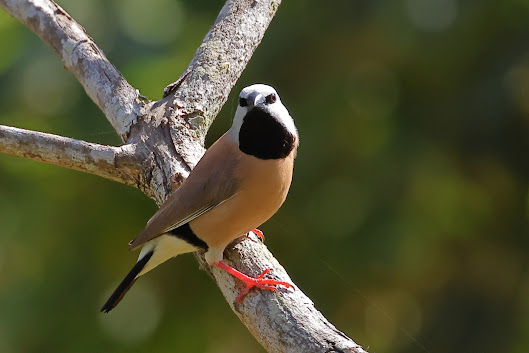
Lament for southern Black-throated Finches

Hollow logs for at risk birdies? Nature's nest boxes if you please Oh, such a clever wheeze So gather in twos and threes? Hundreds you w...