Tuesday, December 8, 2009

Yellow Honeyeater digs in


Yellow Honeyeater (Lichenostomus flavus) about to enjoy a juicy catch after much effort dragged fat prey out from its tightly curled leaf home at Tyto today. Honeyeaters are partial to insect prey, Yellows particularly so. Bill length and shape helps tell the story.


So no trouble seeing that a Brown Honeyeater (Lichmera indistincta) spends more time chasing nectar with its more delicate bill and tongue. 


Brown-backed Honeyeater (Ramsayornis modestus) - in typical quizzical pose - will, with others of the species, take over flowering paperbarks and drive other honeyeaters away, but more usually enjoys a general diet.      


Sunday, December 6, 2009

'Reddy' theme for big picture change


Get 'reddy' for bigger pictures. Should be able now to click on any to enlarge because I've finally twigged to benefits of Blogger's new editor. Opening with Comb-crested Jacana (Irediparra gallinacea). And throwing in a choc box shot from distance at Macknade Wetland early today (below).


And here's a male Red-backed Fairy-wren (Malurus melanocephalus) carrying a red 'love token' near the Tyto hide. Well, most of the bird anyway! All another male (below).


Finally, pair of Metallic Starlings (Aplornis metallica) near Ingham today. Trick of reflected light shows strange colour on head of right-hand bird.

Thursday, December 3, 2009

Stacking up some aerial shots


Stack of Magpie Geese (Anseranas semipalmata) about the place at present. They don't always present so obligingly stacked as this shot from earlier today. Nor have too many presented overhead as did the one below.


Also caught in midair, an Intermediate Egret (Ardea intermedia) sets off beady-eyed to drive another away from its patch near the centre of the main lagoon (parts of which are again drying after last month's unseasonal 250mm of rain).


Plenty of Purple Swamphens (Porphyrio porphyrio) lately, though proving difficult to sneak up on. Seems they always have the odds stacked in their favour. For the present ...

Tuesday, December 1, 2009

Sea-Eagle plunge misses target


White-bellied Sea-Eagle (Haliaeetus leucogaster) turns away empty-taloned after sending wings whirring in all directions at Tyto yesterday.


While lining up an egret in flight, I heard alarm calls and panicked flurries. Plunging form filled the viewfinder as I turned. Didn't expect to see it almost in the water below me. Bird had tried to ambush group of flying cormorants fighting over a fish. Eagle missed target and just avoided feet-first splash. Then it was gone, out of sight high to west. Hard work being a top predator!

Sunday, November 29, 2009

Little Bittern caught out in open


Australian Little Bittern (Ixobrychus dubius) makes a rare daylight foray along the edge of scleria in the northeast corner of the main Tyto lagoon early yesterday. Couldn't have asked the bird - a male of subdued colouring - to do more regarding position and poses.


But sadly I was 50 metres away across the water and unable to move much closer. In fact, even at such distance the bird would have darted back into cover in a flash at any sudden or great movement.


Talking of movement, the clumsiness of the bird's passage jumping and jerking across the base of the scleria was surprising. All my previous sightings suggested a life of stealthy, silent stalking, not clumsy and surely noisy leaping from foothold to foothold. My toehold on knowledge grows ever tinier!

Friday, November 27, 2009

Buttonquail vanishes with a zip


Red-backed Buttonquail (Turnix maculosus) takes a rare few steps away from cover before realising error and zipping back into the long stuff at Tyto yesterday. Have flushed a few lately, but the birds show no preference for any particular area so sightings are a matter of luck.


Lucky to see a Dusky Moorhen (Gallinula tenebrosa). This maturing bird dropped in for a few days and just as randomly disappeared. Unlike the only other Dusky sighted in the wetlands the bird stayed well away from the edges of the main lagoon.

Sticking close to the edges of the new lagoons under the even newer walkway from the info centre to the near completed cafe/civic centre/lookout tower, the two Muscovy Ducks that turned up earlier in the week. New species for Tyto, but a potential challenge to native birds.

Also turning up from out of the blue, an Oriental Cuckoo (Cuculus optatus). Spotted the bird flying from the west toward Rain Trees near the carpark two days ago. No sign since. Seldom seen in Tyto and last seen early in 2008.

Wednesday, November 25, 2009

Muscovy Ducks make goose of me


How's this for making a goose of oneself? Posted above picture of female on BirdingOz under title 'ugly goose' because pair of the birds turned up yesterday, engaged in vigorous mating, and my ancient brain forgot there existed any such thing as a Muscovy Duck (Cairina moschata) and asked for species ID. Doh! Wouldn't want to see the birds establish themselves, yet the head does hold some colourfully grotesque fascination. Doesn't it?


Here's another head full more of character than beauty. This Australian Ibis (Threskiornis molucca) appears to have a Cheese Fruit (Morinda citrifolia) habit. The solitary bird patrols plantings along the northern boundary to Tyto in its search for 'ripe' (also known as Vomit Fruit) falls. Not to my taste, though I'm partial to Camembert and Brie.


Heading towards a pleasing finish, a pair of Wandering Whistling-Duck (Dendrocygna arcuata) glide across a still morning's mirroring waters on the main Tyto lagoon. Though kitsch ducks on walls come in threes, in nature pairs are paramount.

Sunday, November 22, 2009

Cold-blooded encounters


Change from feathers to cold-blooded types after a couple of lucky encounters this week. First, Keelback (Freshwater Snake) (Tropidonophis mairii) moves through a sunlit patch of leaf litter on the lookout knoll. The keeled scales show clearly along the back. Most Tyto Keelbacks are this orangey-brown coloration, or dark-light mix of greys.


Second, Striped Rocketfrog (Litoria nasuta) finally stopped mad zigzag jumping through the reeds and settled down for closeup. Plenty of the frogs about, but fewer Keelbacks seen out among the reeds lately. The unseasonal rains may have made it harder for the snakes to track the frogs.


Third, though it lacks a common name, here's what I call the Common Striped Skink (Ctenotus robustus: similar to C. spaldingi and rarer C. nullum). It's one of two large (110mm snout to vent) skinks in Tyto. The other, much trickier to photograph, is the plainer Eastern Water Skink (Eulamprus quoyii).

Last, and odd footnote on the theme: picked from my forearm today the first leech I've met in six years. Not in Tyto, but possibly from, of all things, a metal gate at another little wetlands. Strange.

Friday, November 20, 2009

Darter swallows up slippery catch


Australasian Darter (Anhinga novehollandiae) shows how to go about catching a fish after catching a fish at Tyto today. Not as easy as it looks.


But all's well that ends swallowed.


Wednesday, November 18, 2009

Cor, cormorants and blurry bittern


Interesting bits later, the one decent picture first. Little Pied Cormorant (Microcarba melanoleucos) in solo pose near a Tyto lagoon. Little Pieds stand alone, in contrast to Little Black Cormorants (Phalacrocorax sulcirostris). Any fish the solitary hunter Pied takes brings no threat of theft from a fishing companion.


But Little Blacks hunt in packs. The advantage appears to be a 'herding' of fish ahead of the swift swimming pack. The disadvantage is an instant challenge against any bird that takes a fish too large to be immediately swallowed. Side note: 50-60 Little Blacks in Tyto overnight the only large group of the species to spend much time in the wetlands in six years or more.


Worst for last. Australian Little Bittern (Ixobrychus dubius) disappears across scleria in Tyto today. Male, but you'll have to take my word for it. My only flight picture in six years. Saw male and female yesterday, without even bad picture. Tomorrow ...

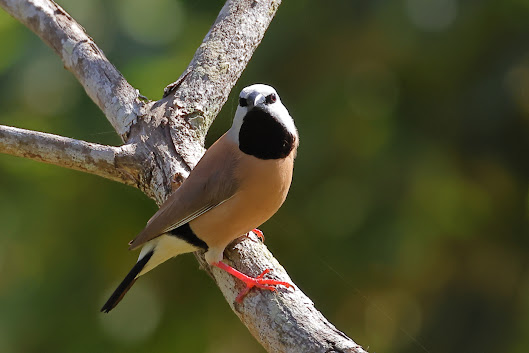
Lament for southern Black-throated Finches

Hollow logs for at risk birdies? Nature's nest boxes if you please Oh, such a clever wheeze So gather in twos and threes? Hundreds you w...