Busy time for Noisy Pitta (Pitta versicolor) bringing food to nest too well hidden for me to locate at Jourama Falls. Should be easy, finding nest on ground, usually within rainforest tree buttress, but three lots of parents are outsmarting me.
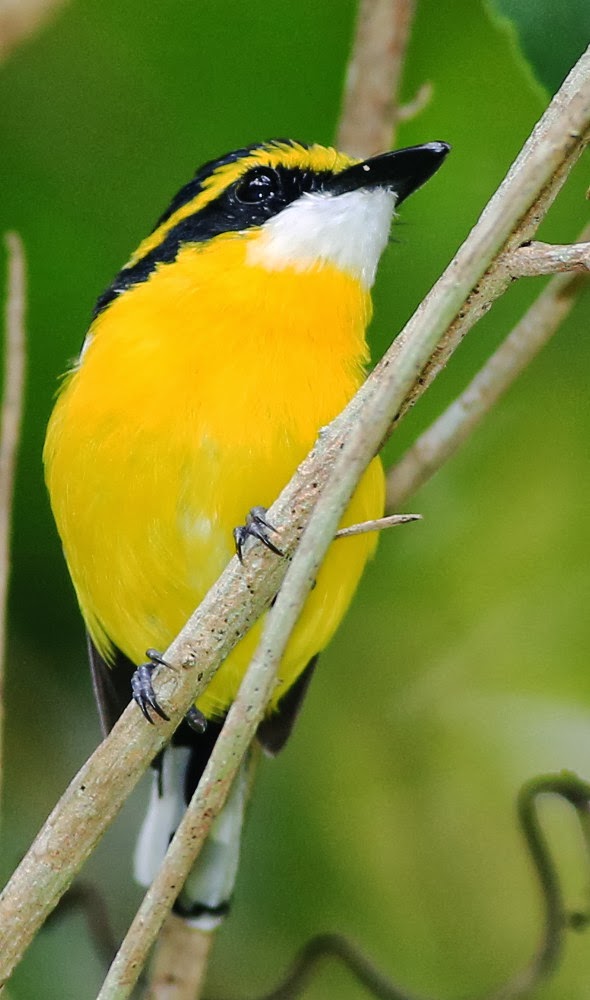
Did get close to Yellow-breasted Boatbill (Machaerirhynchus flaviventer) in the thick(et) of things at Jourama. Nature's so untidy!
Ditto with mangroves surrounding female Olive-backed Sunbird (Nectarinia jugularis) near Forrest Beach the other day.
And even more tree in the way of meeting with the world's largest moth, female Hercules (Coscinocera hercules), at Jourama this week. Even the camera conspired against me, locking out of focus for lost open-wing sequence. To gauge the moth's size make the leafy image 12" or 30cm diagonally. More gargantuan than herculean.
Much tromping about in the Jourama Falls creek forest lately chasing Buff-breasted Paradise-Kingfisher (Tanysiptera sylvia) after seeing breeding pair and an immature bird but only above image of male to display. The remains of twin white tail streamers are obscured.
Better tale and tail with White-browed Robin (Poecilodryas superciliosa) in the same forest another day.
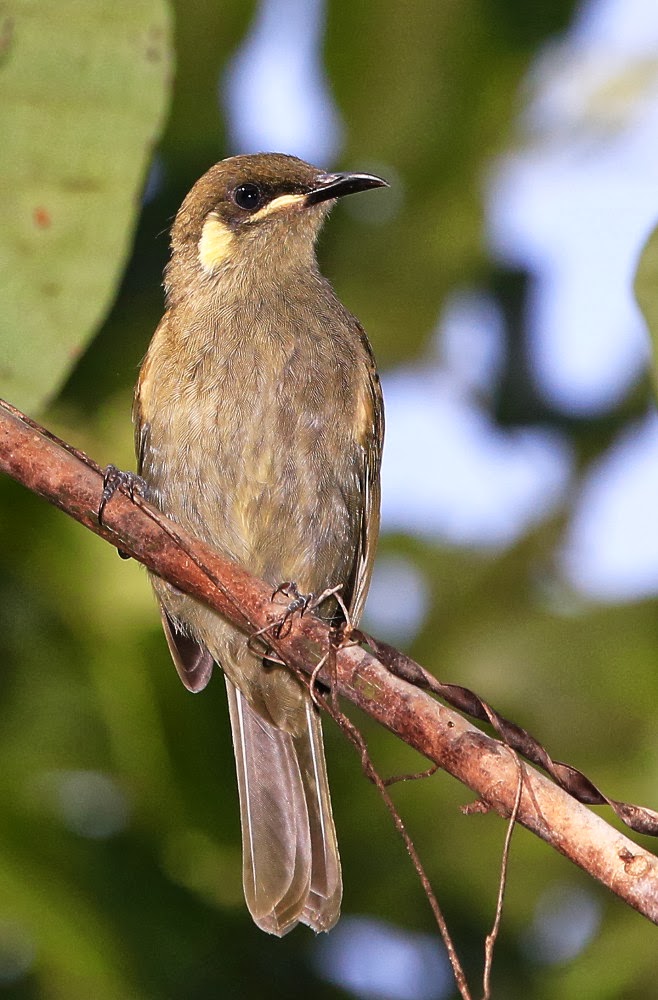
And also recently with Yellow-spotted Honeyeater (Meliphaga notata).
Making the most of latest heavy rainfall, Pied Heron (Egretta picata) ventures from typical wetland habitat to pick up prey along edge of pasture pool near Forrest Beach east of Ingham today.
Bit too far across the water but caught some distant flight action.
Long chat with small male Southern Cassowary (Casuarius casuarius) sitting quietly in the rainforest along the road to Wallaman Falls today.
Any eggs under there? - No reply (but no). Just tired, are you? - Seen any hot females lately? - Lot of rain this week, eh? - See you later, mate. - Righto Tony (in my dreams!) Others report another male with two young in the area.
Can almost see the grass growing by the minute around Ingham these warm and wet days, so plenty to hear but sometimes little to see along Orient Station fences today. Best of the morning, Golden-headed Cisticola (Cisticola exilis).
Lots of noise from many Tawny Grassbird (Megalurus timoriensis), but only one bird lingered for the camera.
Several groups of Red-backed Fairy-wren (Malurus melanocephalus). Not many sitting still however. They don't let the grass grow under their feet.
Might be last sightings of Eastern Grass-Owls (Tyto longimembris) for a while as tail end of Cyclone Dylan drenches swamp ricegrass habitat at the western end of the main Tyto Wetlands lagoon.
Male takes close look at intruder in his territory before the rains came.
Larger, more richly coloured female sets off for another ground-roosting spot.
Blustery breeze across Orient Station yesterday made things bit unpleasant but helped keep Zitting Cisticola (Cisticola juncidis) close to the ground...
... and to the fenceline.
Not an easy bird to get clear pictures of in its preferred habitat.
And when chance comes of right place and right pose (on a less blustery day), the bird's too far away!
As also, yesterday, was male Brown Songlark (Cincloramphus cruralis), my first sighting of the species at the station, and only my second in the Ingham area.
Bit of a mystery bird, the Grey Whistler (Pachycephala simplex). Two races, simplex, plainish and confined to Northern Territory, and peninsulae, with lemon underbelly and located in northeast Queensland.
But there's no hint of lemon in most Grey Whistlers around Ingham, such as the above at Jourama Falls yesterday.
As to grey, it's easy to see why alternative name - little-used, though more appropriate - is Brown Whistler.
Elsewhere at Jourama, no mystery about White-browed Robin (Poecilodryas superciliosa), which, unlike Grey Whistler, seldom stays silent for very long.
Fruitless hunt for Victoria's Riflebirds along the Wallaman Falls road at least bore some fruit with uncommon sightings of Double-eyed Fig-Parrot (Cyclopsitta diophthalma race macleayana).
Three of the tiny frugivores feasted for a few minutes on spindly, sparsely fruiting fig trees before streaking off with their squeaky 'zeet zeets'. Ten years of Wallaman drives and the first time up close to the species.
From small fruit-eaters to big: Red-tailed Black-Cockatoo (Calyptorhynchus banksii). Two flew over the Wallaman road yesterday, but more usual sightings come near the coast. The big birds love ripping into big green almonds, leaving part-eaten fruit and small branches and leaves littering the ground.
And two tidier eaters, one each just for Jarvi and Moss: Rainbow Lorikeet (Trichoglossus haematodus).
Making a change from mee-yowling from some hidden spot in the rainforest canopy, Spotted Catbird (Ailuroedus melanotis) pops into the open along the Wallaman Falls road between showers the other day. Four others showed out briefly, then all five vanished. Typical rainforest experience.
As also with shy White-headed Pigeon (Columba leucomela) along the Paluma Dam road on another showery day. Seldom seen away from the treetops, the bird touched down beside a creek and foraged among the stones for a minute or two. Then, gone and not seen or heard again.
Less wary, but another higher altitude dweller, Yellow-faced Honeyeater (Lichenostomus chrysops) calls from alongside a track to the west of Wallaman Falls. Sunnier setting on a sunnier day.