Thursday, November 27, 2008

Yellow and red on the cards

Just a fleeting glimpse of a distant Yellow Wagtail today, after another late start because of vital football duties (watching Chelsea's multimillion men struggle to 1-1 against Bourdeaux).

One of the most colourful things about the footy was the ref's six or seven yellow cards, and one red. So here's a picture or two - from the rainy-day bin - to match the colours of the day.
What could be more fitting than a Silvereye (Zosterops lateralis). Very yellow, and with a beady eye to boot?

Or an Olive-backed Oriole (Oriolus Sagittatus)? Some yellow, and with a red eye?

Last, two Noisy Pittas (Pitta versicolor), bits of buffy-yellow, red, green and black, lighting up their arena, but out of focus and unsatisfying. Bit like today's match.

Wednesday, November 26, 2008

'Zweep' for rare wagtails

The Yellow Wagtail (Motacilla flava) pops up as a summer migrant along most of the eastern coastline down to Victoria. The birds are usually of the race simillina (from E. Russia), less often taivana (Asia, Japan).

Rarer still, mostly, are Citrine, Grey, Black-backed and White Wagtails. If there be a wagtail heaven in Australia for birdwatchers it is Darwin, where almost all races of almost all species may turn up.


Want to find a rare wagtail? Do not follow the guide books to playing fields, airstrips and other mown areas. Instead, take their sometimes advice and get yourself near sewerage lagoons, spread sludge, or water treatment ponds. Not so easy in many places and cases.


Or wait till someone else finds one. Or two. Or three. Or four. Perhaps even five. You've guessed it! I am that someone else.


Took a late afternoon drive yesterday to some ponds and in the breaking gloom of distant thunder clouds heard a high, sweet 'zweep zweep'. Focussed too late on small bird ascending rapidly off muddy area of pond and climbing high before disappearing west.


But the Yellow Wagtail's 'zweep' is not too different from the Australasian Pipit's call. The area is base to two or three pairs of pipits (a bird which normally flies low when disturbed and returns to ground quickly).


After a hectic morning watching Euro soccer (lucky Arsenal!), fixing bicycle, getting in way of water blasting the caravan (oops, partly inside!) and seeing a false roof fitted (less heat, fewer leaks, reduced rain noise), I headed off hoping to confirm wagtail's presence to the east.


No joy on first patrol of pond system. Then, more 'zweeping'. Forty metres away, a rather yellow Yellow Wagtail. On the algal green surface of a drying section of pond mud. Quick pictures. Race off for tripod. Return to find Black-fronted Dotterels chasing wagtail. More quick pictures before bird quits under dotterel harassment.


Trudge off in 35C heat and tons of sun in pursuit. Criss-cross dried weed-filled pond. Chase after possible two birds. Much more 'zweeping' and see four or five birds leave ponds and go to ground in waist-high sugar cane.


Two birds then head off to nearby trees. Two return toward where the chase began. More hot trudging. No birds on the mud. But more sounds heading back toward the cane.

Trudge back and find non-yellow Yellow Wagtail calling from a mass of dried floating pond grass. Better pictures, but unable to get really close before bird lifts off and disappears west.

My experience suggests the birds will stick around so long as the mud areas continue to be uncovered. However, much of the ponds' cane grass and bulrush were dug out this year, and some ponds are also carrying high water levels. Experience must often give way to changed conditions.


But between now and the beginnings of the Wet I'll somehow sneak close to one or two of my four or five Yellow Wagtails. It's on my Xmas list!

Tuesday, November 25, 2008

Saving them from ourselves

Oh, look, the poor little bird has fallen from the nest. It's fluttered up on to that old birdo's bicycle. Isn't it cute? What shall we do?

We'd better try to put it back. Pick it up and find the nest. Let's take it home and look after it. Wrong! Wrong! Wrong!

We're so keen to do the right thing we often get it all upside down. Doctors are told (but then sometimes go on to ignore the dictum): First, do no harm.

So it should be with us and wildlife. We almost all know not to get between wild animals and their young. That's because it's dangerous for us. But our thoughts should be first for the good of the young.

So when the above fledgling Rufous Whistler lost a tenuous grip on some outer foliage at Tyto today and fell at my feet, I naturally stepped back to get a picture. And to think about its welfare.


Yes, in that order and without any thought of saving the bird. That's what parents are for. Right on cue a male whistler turned up. With food in mouth. But it didn't go near the fledgling. It ducked here and there close by. Then it swallowed the caterpillar.

What's the problem? I'm probably the problem. Whistlers are trusting birds, but instinct runs counter to heading direct to the young. I back off. Still nothing doing. So I clear right off for 10 minutes.

On return it takes me five minutes to find the 'helpless' fledgling near the top of the tree it fell from. Doesn't seem judging by its fretful calls to be getting all it demands from parents but how's that different from most hungry juveniles? It's safe and sound!

I know, not all cases match such happy outcomes. My principle, though, is always to do as little as possible to interfere - or 'help'. How do others feel?

Monday, November 24, 2008

Heading for a falls

How about some sightseeing, with striking birds thrown in - and a blue frog?

Starting at the beginning, a 20-minute, 2-hectare transect across the reed flats and through the Scleria, looking for Little Bitterns. Furtive movement high in Razor Grass. Away flies male bittern, showing typical glorious chocolate and custard yellow colouring seen from behind. Top start!


On to the pool of death. Almost all evidence of total fish kill sunk without trace. But here's a blue frog drawing the flies. Blue? Yes. It's a dead Green Treefrog (Litoria caerulea).


Scientific name is said to spring from specimens pickled in alcohol when preserving fluid ran out during Joseph Banks' collecting. Blue and yellow equals green. But the frog yellow is alcohol soluble. So the taxonomists in England poured blue frogs from the bottle.


Still early morning and bright, clear sky. Time for a change. Out west 45 kilometres to Seaview Range, rainforest, and Wallaman Falls, Australia's longest one-step drop. I'm not one for waterfalls but at least they don't hide in trees, or fly off while camera dithers.


The birds, though uncooperative, are worth a few words. First up was a Wompoo Fruit-Dove, 'wollack-a-woo-ing'. Sorry about the picture. Bird refused to leave the shadows.


Even harder to see and impossible to snap, a pair of hyperactive Spotted Catbirds. Their mewing and yowling forces smiles from the glummest birdo. Fifteen minutes with the green clowns and I'm laughing for the rest of the day. In the same patch of rainforest, a Noisy Pitta, Yellow-breasted Boatbill, and Black-faced Monarch.


Highlight still to come: on a forested track by Stony Creek (which feeds the falls). Series of one-note calls. Glimpses of biggish dark bird. Finally, some distant light - on orangey-brown breast, red bill and blue head of a migrant Buff-breasted Paradise-Kingfisher. Azures pale in comparison. But couldn't see anything of white tail streamers. And no picture.


But while chasing after a pair of Dollarbirds I did catch up with a Grey Whistler.


A final bonus. I caught sight of a leech on my leg before it put the bite on me!

Sunday, November 23, 2008

Honeyeaters help themselves

Seems innocent enough, doesn't it? Male Rufous-throated Honeyeater (Conopophila rufogularis) collects material for nesting. But thieves are ever with us.

Victims of this robbery are the Brown-backed Honeyeaters (Ramsayornis modestus) that defied my prediction of failure with a nest right in front of the Tyto hide. The pair three days ago began an even more noticeable nest outside the hide.


Progress seemed slow and work rather off and on, but that's not too unusual. Today, the nest was being deconstructed by the Rufous-throateds, busy unpicking spider webs binding the nest and carrying them to an islanded paperbark 30 metres away.


The four prominent small honeyeaters in the wetlands are the BBs, the RTs, and the Browns and (slightly larger) Yellows. BBs nests are targeted by all three other species, but I can't recall seeing the thieves' nests being raided until abandoned.


Browns and Yellows hide their nests better. But RTs, like BBs, build their dangling nests in the open, over water usually, and yet escape theft. It may be that the BBs' habit of stop-start work invites the other species to help themselves.

Saturday, November 22, 2008

Eagle-eyes needs beagle nose

Golden-headed Cisticola not so rusty when it comes to catching a feed

See the eagle-eyed birdo doing his stuff. Eyes always on the move, missing nothing. Searching for Pale-vented Bush-Hens (Amaurornis olivaceous). Listening intently for telltale murmured 'tuck tuck tucking' from the long grasses.

Pair of birds yesterday fled the drying margins of the only pool left in creek, which runs southwest-northeast in a southern semicircle around the main lagoon. Later got close to one bird but no clear views. Ditto with a pair of Buff-banded Rails (Gallirallus philippensis).

Prowl the pool area again today. Get a whiff of something unpleasant in the air. Ignore it and continue the search. No hint of hens or rails. But that smell. What is it?

Stare at shallow water. Penny drops. Those hundreds of small pale white 'leaves' patterning the yellow algal bloom are dead fish. Those three small branches are dead eels.

So busy looking for birds, I've missed the death of every fish in the 30-metre S-shaped shallows. It probably began at least two days ago. Yesterday's searing 36 Celsius would have virtually cooked the oxygen-starved fish.

So much for eagle eyes, what I need is a beagle's nose! And even the tiniest bird-brain might have pondered why the hens and rails were hanging around the margins of the pool.

Got things back on track an hour later with a Little Bittern sighting. Heard stealthy movement high in a patch of Scleria I was skirting. The bird, a female, took off low as always and plunged back down into more of the two-metre grass. Never any point in chasing once the bird has flown.

But the encounter may offer an insight worth chasing about the daytime habits of the birds. In a possible case of another penny dropping, it struck me that the birds' rare gurgles seldom come from areas that lack a small tree springing from the dense Scleria (Razor Grass). This applies particularly to two spots in front of the hide.

Today's movement came from further west, close to a small Tulip Tree. On checking under the tree I found a small raised patch of bent grass. I'm tempted to describe it as a natural cathedral, but an A-framed structure with high flattened grass floor will do.

Exploration near the hide and other areas would be much more intrusive. So I'll see if there are spots elsewhere that I might test the theory, without overly upsetting any birds - or anyone else.

One bird much easier to find was the male Leaden Flycatcher, on nest duty. The job is shared equally. Bill is open for cooling (bigger birds sometimes pant).

Thursday, November 20, 2008

Rufous Fantails, rueful birdo

Here's my bogey bird. Rufous Fantail (Rhipidura rufifrons). The bird that won't turn up most days, rarely sits still when it does turn up, and never sits still in the open anywhere near me.

Today, two turned up - an extremely rare double act in Tyto. They then took turns in teasing me, flying close by and taking up tempting positions low in trees before darting away into the upper foliage.

As a variation they'd wait till I got near and then flash across the Razor Grass in the now dry creek bed. One bird wearied of the sport after about five minutes. The other vanished more than 10 minutes later.

Got one usable picture. Lovely pose, but focus isn't great and it took some tweaking to get an image that merely hints at the most colourful of the fantails. One day ...


Wednesday, November 19, 2008

Sparrow makes rare entry

Don't laugh. This is a rare bird once you've gone more than 100 metres west from Tyto's eastern boundary and carpark. Plenty of House Sparrows (Passer domesticus) in the carpark trees and nearby suburbia.

The above female made it all the way (about 250m) to the edge of the first lagoon. Looked very out of place pottering about among the sparse weeds at the water's edge. Not for nothing are they called House Sparrows.

Further in today it was more a case of gone than out of place. Rain and wind overnight further reduced numbers on the main lagoon and reed flats. No spoonbills, ibises, egrets, and fewer ducks and Magpie Geese.

Fruitless chase at the western boundary for pictures of a busy Dollarbird. But it hawked from a series of tallish trees and the sullen grey sky made perched and in-flight pictures nigh impossible.

And no sign in the same general area of the Lovely Fairy-Wrens, which popped up again for a second yesterday and vanished just as quickly. Frustrating!

On a positive note, one for the dragonfly brigade. Casually watching these two biggies, I saw them couple in midair with an audible 'snap', weave about for a second and settle on a blade of Scleria. Channel in way, so picture from 10 metres not super sharp. ID for others - or till borrower returns 'my' library guides.

Tuesday, November 18, 2008

Brown streaks are Crimsons

Where'd he go? Do you see him? Can you see mum and dad? Do we have to go now?

Three fledgling Crimson Finches (Neochmia phaeton) peer uncertainly from their tree trunk nest hole beside the bird hide at Tyto today.

By chance (and self-imposed Little Bittern survey duty), I was in the hide for much of the morning. It soon became obvious nest departure time was nigh. The parent birds issued nonstop calls from nearby bushy weeds to encourage their young out into the world.

Answering calls from within the nest hinted at a reluctance to quit the cosy surrounds. After more than an hour without outcome, the female parent tried a new approach, perching at the nest entry and telling those inside to get outside.

Didn't work immediately. But after about 15 minutes and the fourth such command a brown streak (I'm presuming a male - sorry, but that's the way of wildlife: boys first and riskiest) launched from the nest and flew 10 metres directly across a narrow channel and landed clumsily low in the Scleria.

That left - as it turned out - three to follow. Number two a few minutes later flew straight over the channel and dropped onto the Scleria. Number three followed the same flight path after an awkward scrambled exit.

Number four proved a problem. Calls from parents and three siblings drew no response for several minutes. The siblings gave up calling and concentrated on the challenge of maintaining a sure foothold on their new habitat. This seemed more problematic than the first flights.

Finally, the last brown streak dived across the gap and joined the family. All promptly disappeared deeper into the Scleria. And not a minute too soon as the wind picked up and an hour of showers followed. A wet wide world welcome for the juveniles.

So, to wrap up the three nests around the hide and introduced as a group in an earlier post about impatient tourists:

Willie Wagtails, two young - always visible; Crimson Finches, four - never visible; Brown-backed Honeyeaters, ? perhaps two - mysteriously invisible (nest, metre from hide: awful position; incubation: no sign; feeding: seen twice; juveniles: no sight or sound).

In the interim, the male Crimson has completed another nest in a cleft immediately above the now empty hole, but with the entry facing west rather than east. They do love building! Not all such secondary nests are used as it depends on the female's approval. We'll wait and see.

And a pair of White-breasted Woodswallows have built in a deep fork of another paperbark about 10 metres to the west of the hide.

In the midst of all this procreation, two Little Bitterns gurgled briefly from deep cover, a Spotless Crake darted across a channel, two Purple Swamp-Hens gradually accepted my shadowy presence, six Comb-crested Jacanas danced on the water, four Magpie Geese squabbled about grass rights, and a Wood Sandpiper probed the water's edge.

Throw in an assortment of other birds about the place and being sheltered from the squalls and it's little wonder time flies in the hide.

Monday, November 17, 2008

Ups and downs at the beach

Day for a sea change. Don't travel out to the coast often. The waders are always too far away and without a hide there's no catching birds unawares.

But hope springs eternal. So when a dead low tide coincides with a promising dawn I head to Taylor's Beach and its wide expanse of tidal sands, channels, and patches of mud and sea grass, fringed in part by giant mangroves.

Hopes quickly unsprung! One Black Butcherbird visible in the mangroves and a few unseen Mangrove Gerygones. A Silver Gull (Larus novaehollaniae) sidles over, mistaking me for a fisher or crabber. Hangs about until it sees I'm no source of a free feed.

Squelch out on the flats thinking something will turn up. Something does. Hunched low on the sea grass, a Striated Heron (Butorides striatus). One of the wariest birds when chanced upon elsewhere unconcerned by me up to about 20 metres. No luck, however, with pictures of the bird snapping up prey.

The gull dropped in close again. But it persisted in moving as I tried for those pool reflection shots we think must be winners - and never are!

But what initially looked a lot of wet sand and almost no birds gradually showed more promise. No flocks of migrants, yet dotted here and there small numbers of resident plovers, dotterels, knots, tattlers, curlews, godwits, whimbrels. All more or less as expected.

Less expected was catching two Bar-tailed Godwits (Limosa lapponica) almost sharp as they whizzed by and finding a usable image of a far-off Grey-tailed Tattler (Heteroscelus brevipes) taking off.
Not all that's expected of a sea change, but not so dusty.

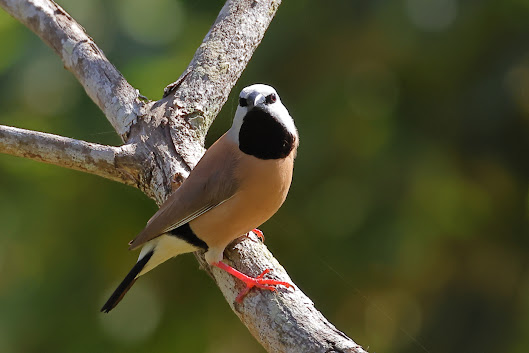
Lament for southern Black-throated Finches

Hollow logs for at risk birdies? Nature's nest boxes if you please Oh, such a clever wheeze So gather in twos and threes? Hundreds you w...