Tuesday, July 7, 2009

Macleay's Honeyeater going bananas

Up close with a Macleay's Honeyeater (Xanthotis macleayanus) today in Tyto. Three birds (sorry, Snail, only got this one) and a pair of White-gapeds were picking at bananas in a pig trap.

Two other closeup holdovers: Black-fronted Dotterell, and Magpie Lark.

Sunday, July 5, 2009

Friday, July 3, 2009

Who needs a flash new camera?

Had to trot out with old Panasonic camera today at Tyto after brain fade yesterday deleted some great pix from my Canon CF card. Will try using Media Recovery (after buying external CF card reader tomorrow) to get pix back. Anyway, today's Little Bronze Cuckoo (Chalcites minutillus - above) almost makes me wonder why I needed flash new camera and lovely 300L IS lens. Just joking, good old FZ30 seldom this sharp (because I was very close to bird!).


Here's something more like typical effort. Whistling Kite saw mature Black-necked Stork seeing off this maturing stork, and decided it also should play the bullyboy.


Earlier in week almost got a decent Fairy Gerygone shot.


Found this Northern Fantail looking up.


And chased after this Varied Triller, without getting a clean background.

Monday, June 29, 2009

Catching a few on the wing


Rufous Night-Heron

Masked Lapwing


Welcome Swallow


Little Pied Cormorant


And one that didn't fly: White Ibis

Thursday, June 25, 2009

They're asking, where's the meat?

Back,but not fully fit, so a few recent birds on the theme of 'where's the meat?', leading off with White-browed Crake.

White-browed Robin


Black-necked Stork


Here it is, with a Forest Kingfisher!

Friday, June 19, 2009

Kite flies at head of Tyto tidy-up


Going away for a few days next week, so time to tidy up some Tyto holdovers. First up, Black-shouldered Kite (Elanus axillaris) with, possibly, breakfast of juvenile Buff-banded Rail, atop the 'Osprey nest tree'. And the same kite below.


Olive-backed Oriole (Oriolus sagittatus) has a hungry look.


Mistletoebird (Dicaeum hirundinaceum) emerges from deep within preferred habitat.


White-bellied Cucko-shrike (Coracina papuensis) sits up in the morning sunlight.


And a Willie Wagtail to finish off with.

Sunday, June 14, 2009

Sunbird leads little beauties


Male Olive-backed Sunbird (Nectarinia jugularis) leads closeup looks (all shot from inside three metres) at a few little weekend beauties, from Tyto and nearby.


Little Kingfisher (Ceyx pusilla) sits tight within a water's edge guava. 


Chestnut-breasted Mannikins (Lonchura castaneothorax) just out of the nest.


Striped Skink (Ctenotus spaldingi) peers up from the Tyto lookout planking.

Thursday, June 11, 2009

Wren it all starts coming together

Blue sky backs Red-backed Fairy-wren (Malurus melanocephalus) poised on Pandanus in Tyto today. Fine, coolish start led to a few coolish pictures, cuckoos prominent.


Two Little Bronze-Cuckoos (Chalcites minutillus) 


Finally, Brush Cuckoo (Cacomantis variolosus)

Sunday, June 7, 2009

Red backs, brows and bugbears


Chasing close encounters with Red-backed Fairy-wrens (Malurus melanocephalus) and Red-browed Finches (Neochmia temporalis) calls for ready patience and prior acceptance of probable failure.


When the birds sit still briefly it's usually within a protective mass of of shrubbery (more exactly, twiggery), or hidden away in the shadows.

And when, wonder of wonders, a male wren poses unobscured the light is so harsh red plumage detail is, sadly, swamped. But, one day ... one day ...  Hope it comes soon! 

                                  Mature (above) and juvenile (below)

Friday, June 5, 2009

Sorting out the fantails


Fantails. Cheery companions for woodland walkers. But not always exactly what they seem. Grey Fantail (Rhipidura albiscapa - formerly fuliginosa) used to flit about in five races: albicauda, keasti, alisteri (above), preissi, and albiscapa. Christidis and Boles 2008 omit the first four races. But named or unnamed, they're all still where they were, north, south, east, west, high and low, cheeky as ever.


Here in Tyto, alisteri, as was, still sings sharply and sweetly. Darker keasti rarely drops in from tableland forest habitat. Mangrove Grey Fantail (Rhipidura phasiana) inhabits coastal NT and WA, but looks almost exactly like the alisteri above.


From some angles the grey Northern Fantail (Rhipidura rufiventris) can look very Grey-ish. Adding to confusion, they sound almost exactly like the one-note Graceful Honeyeater - not at all fantail-ish.(And Willie Wagtails are really fantails - but cause little confusion.)

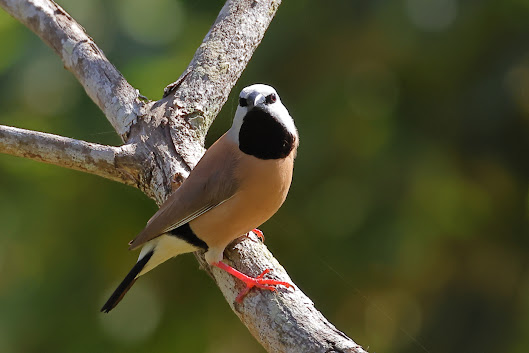
Lament for southern Black-throated Finches

Hollow logs for at risk birdies? Nature's nest boxes if you please Oh, such a clever wheeze So gather in twos and threes? Hundreds you w...