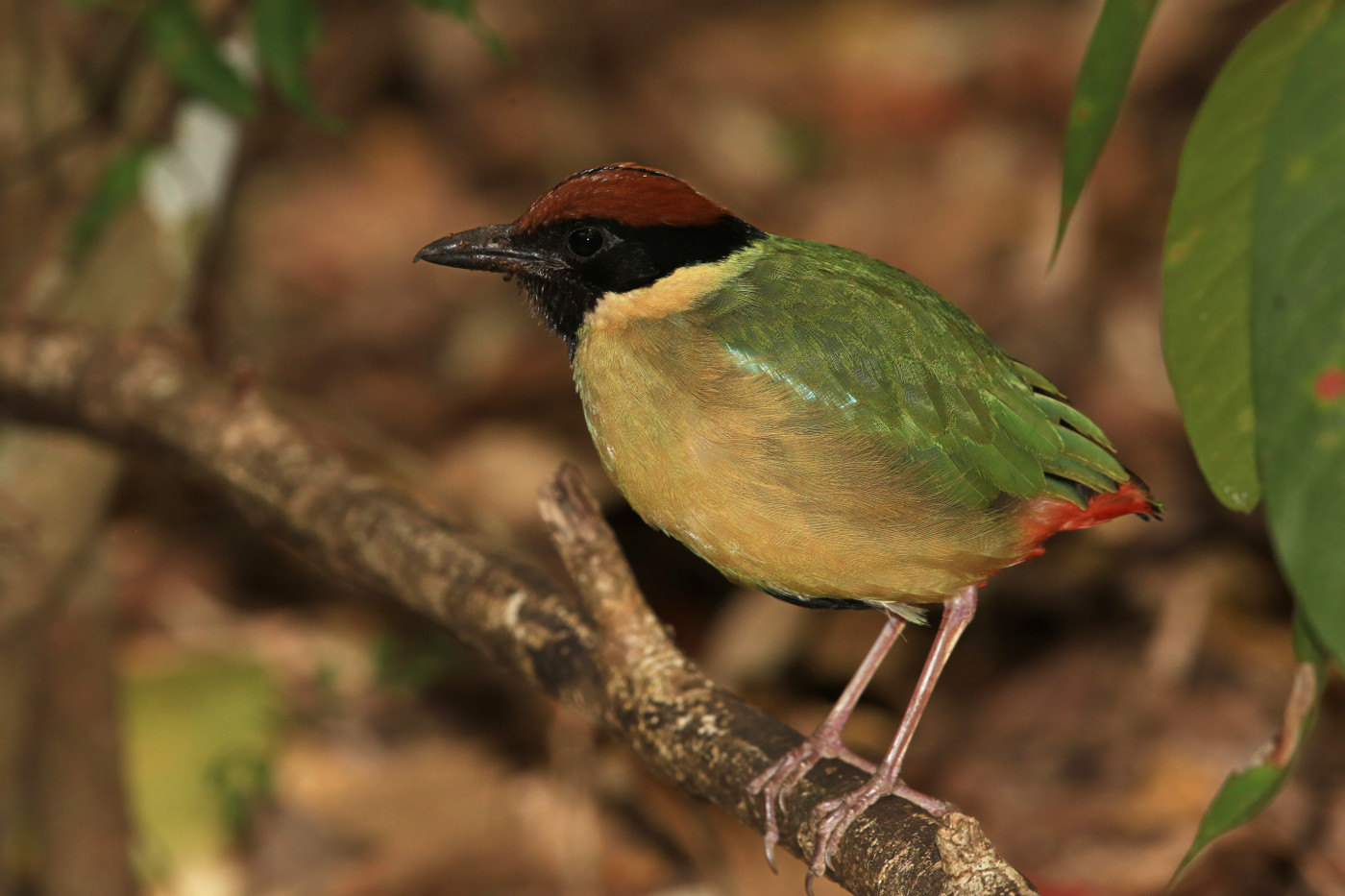
Friendship time at Jourama Falls today with Noisy Pitta (Pitta versicolor) showing remarkable lack of concern at my presence in its patch of drying rainforest. The bird was standing quietly at base of cluster fig tree as I walked along track linking the camping ground with short length of road to the falls parking area.
It paid no attention as I struggled to ground and wriggled this way and that to get a view unblocked by leaf litter and weeds. Then came an extended conversation as I circled the bird. It picked at fallen fruit, then went on to turn over leaves and litter in search of meatier fare. More than 10 minutes passed before the Pitta pattered off. At any next meeting the bird will almost certainly exhibit no such unconcern. Magical moments come on nature's terms, not ours.
Thursday, October 8, 2015
Sunday, October 4, 2015
Looking sharp before El Nino takes over
Looking sharp and nicely balanced, Sharp-tailed Sandpiper (Calidris acuminata) stands poised in the disappearing water at the western end of Tyto Wetlands.
Looks likely with deepening El Nino there'll be no rain for three months so long before Xmas the Sharpie won't be hanging around this part of the lagoon.
Nor will this Royal Spoonbill (Platalea regia) be able to stand around with wet feet in this side pool along the northern boundary of the wetlands.
And Sacred Kingfisher (Todiramphus sanctus) on branch overlooking a deeper section of the main lagoon may also be facing a dry outlook by December. Interesting times ahead ...
Looks likely with deepening El Nino there'll be no rain for three months so long before Xmas the Sharpie won't be hanging around this part of the lagoon.
Nor will this Royal Spoonbill (Platalea regia) be able to stand around with wet feet in this side pool along the northern boundary of the wetlands.
And Sacred Kingfisher (Todiramphus sanctus) on branch overlooking a deeper section of the main lagoon may also be facing a dry outlook by December. Interesting times ahead ...
Thursday, October 1, 2015
Heron sticks neck out to take prey
Sat down beside shallow pool in Tyto and won bit of trust from White-necked (Pacific) Heron (Ardea pacifica), which shows somewhat lopsided plumage on right wing (but looks fine in flight).
Bird walked towards me, feeding mostly on prey snatched from water before slowing and staring hard at insect in mud on bank.
Lightning stab and what may be young grasshopper is heron fodder. Bird then decided food is food and trust is trust but safety first is the golden rule. Slowly turned and foraged back the way it came. Typical behaviour from herons and egrets, which often commit to a particular target and allow an approach until they make their kill, after which they often unhurriedly fly off. Touch-feeders such as spoonbills don't have the sight of choice prey items tempting them to ignore intruders.
Bird walked towards me, feeding mostly on prey snatched from water before slowing and staring hard at insect in mud on bank.
Lightning stab and what may be young grasshopper is heron fodder. Bird then decided food is food and trust is trust but safety first is the golden rule. Slowly turned and foraged back the way it came. Typical behaviour from herons and egrets, which often commit to a particular target and allow an approach until they make their kill, after which they often unhurriedly fly off. Touch-feeders such as spoonbills don't have the sight of choice prey items tempting them to ignore intruders.
Saturday, September 26, 2015
What's wrong with rolling out the weedkiller?
Weeds are bad! Right? Gotta get rid of them! Right?
Round-up bad, weeds worse! Right?
So let's get the Hi-lux super spray unit out and zap all that hymenachne and pink burr and stuff out of the swamp ricegrass at Tyto. Right?
Wrong! Wrong! Wrong!
See what happens! Weeds say thanks very much and spring up all along the vehicle tracks through the ricegrass. Notice how high the dead grass is. Weeds can't get through from down below. Until the nice spray men come along and flatten the way for them.
Hymenachne and wild tobacco both benefit. So the work to kill hymenachne is now promoting its growth.
And you'll never guess what efforts to remove salvinia and pink lotus from the main lagoon system have achieved. Temporary and ugly death of lotus and the sinking of free-floating salvinia.
Plenty more of both sitting in the mud below (lotus) and at lagoon edge (salvinia). Waiting for the next rains (January, probably, if El Nino allows).
Could be worse. Well, yes and it certainly has been.
Because all that ricegrass was the roosting area for six iconic Eastern Grass Owls, parents and four matured youngsters.
They didn't like the nice spray men driving over the top of their day tunnels and ideal breeding habit. They quit the place.
I've been able to find just one female in past four months.
Bad enough that the failed Wet this year has driven most of several species away to search for wetter breeding places.
But all was made worse when the conditions allowed the nice spray men access to the ricegrass much earlier in the year than usual.
Overall, I think conservation areas are not well served by local bodies with their mindsets of tidy parks, and groundskeeping.
In extension of which, I append a letter submitted to the local bi-weekly paper, and run in it with odd deletion only of dollar figure for Tyto spending. Odd, because the figure came straight from the newspaper. Anyway here 'tis (Sept 6):
Round-up bad, weeds worse! Right?
So let's get the Hi-lux super spray unit out and zap all that hymenachne and pink burr and stuff out of the swamp ricegrass at Tyto. Right?
Wrong! Wrong! Wrong!
See what happens! Weeds say thanks very much and spring up all along the vehicle tracks through the ricegrass. Notice how high the dead grass is. Weeds can't get through from down below. Until the nice spray men come along and flatten the way for them.
Hymenachne and wild tobacco both benefit. So the work to kill hymenachne is now promoting its growth.
And you'll never guess what efforts to remove salvinia and pink lotus from the main lagoon system have achieved. Temporary and ugly death of lotus and the sinking of free-floating salvinia.
Plenty more of both sitting in the mud below (lotus) and at lagoon edge (salvinia). Waiting for the next rains (January, probably, if El Nino allows).
Could be worse. Well, yes and it certainly has been.
Because all that ricegrass was the roosting area for six iconic Eastern Grass Owls, parents and four matured youngsters.
They didn't like the nice spray men driving over the top of their day tunnels and ideal breeding habit. They quit the place.
I've been able to find just one female in past four months.
Bad enough that the failed Wet this year has driven most of several species away to search for wetter breeding places.
But all was made worse when the conditions allowed the nice spray men access to the ricegrass much earlier in the year than usual.
Overall, I think conservation areas are not well served by local bodies with their mindsets of tidy parks, and groundskeeping.
In extension of which, I append a letter submitted to the local bi-weekly paper, and run in it with odd deletion only of dollar figure for Tyto spending. Odd, because the figure came straight from the newspaper. Anyway here 'tis (Sept 6):
Just back from the 'real' Tyto, the original main lagoon wetlands. Ticked 114 bird species in four visits this month. Morning tally on Saturday was 81 species. The numbers show Tyto heads Australia's easy-walking, small public birding spots.
Saturday's Express reveals Tyto Precinct and Wetlands (whatever the combination means) cost $268,000 in financial year 2014-15. Presumably the sum covers maintenance of all grass and tracks and footbridges, hides and lookouts around the main lagoon system. There was also, I think, a farcical wooden walkway on expensive stainless steel footings to pointless wet hole in reeds and more recently an overengineered culvert, plus more plastic bollards (someone's favourite nonsense for years).
So, what's Tyto's problem? Well, there is the $18.75million of ugly steel and concrete out the front. And the silliness of expecting much return from such empire building, the purpose of which was a variation on Keynes' men digging holes and filling them in again to keep economies and communities ticking over. It's all there now. Live with it! Though it would be great if the info centre got a minor makeover to remove the dreadful angled stanchions and hide the mess of aircon atop the roof.
Back to the 'real' Tyto. It continues to draw birders from around the world. It's high among the eight North Queensland hotspots that fill the top 10 for all of Australia.
That $268,000 could be trimmed 50% by reducing track widths, slashing the mostly ineffective spraying and token weed-tree culls, and getting rid of bollard lovers, wherever they rule.
What does the real Tyto need? Decent maps and signage (promised for five years). A hide that actually hides birders and looks onto a clear (not weed-choked) channel. Without any 'help' from the shire it will continue to be a birders' paradise.
The $18.75m other Tyto? No worse than most such. Some even like the prison camp lookout and factory block library (of which I am big user) and art gallery.
Just remember, the real Tyto was there first (saw a female Grass Owl on Saturday) and is the reason for all the rest. Let's put first things first.
Wednesday, September 23, 2015
Hungry youngsters might call till blue in the face
Young Blue-faced Honeyeaters (Entomyzon cyanotis) left nest little prematurely in the caravan park lately. One needed rescuing from danger of drowning in swimming pool. It overnighted in a nice warm and dark carton before being placed outside next day in an open clear plastic container. Parents resumed feeding it and youngster scrambled up into trees over next few hours.
Brother or sister didn't ever hit the ground, though often coming close. Blue-faces are among the most raucous honeyeaters (and aggressive: will swoop people sometimes even when not nesting). Noise starts early in life and both young birds could be heard begging for days through much of the park. And are still going strong. Wondering about the 'line' above the bird? It's simply a fine portion split from a palm frond.
Saturday, September 19, 2015
Honeyeater doesn't give a fig for fruit trend
Looks like Macleay's Honeyeater (Xanthotis macleayanus) lost way and ended up in drying wetland habitat, but bird grabbed prey from planting in the Jourama Falls camping area yesterday. Seldom seen so many honeyeaters active in the area. Most were feeding on newly ripened cluster figs. Much interest also shown in boiled red capsicum cast away by departed campers. Doesn't take lot of imagination to see links between extreme dryness generally being experienced this year and a strong preference among birds for moist feed.
With preferred feeding growth not doing so well, Mistletoebird (Dicaeum hirundinaceum) takes to bottlebrush flowers hanging over parking spots at Tyto Wetlands entry. Air has been full of their sharp high calls lately. Conditions would seem against much breeding as materials for their soft woven 'baby bootee' nests have dried up.
Dry? I'll say, says Brown Honeyeater (Lichmera indistincta). More than bone dry. This is shell dry with freshwater mussel sitting beside disappearing front lagoon in Tyto. Water rats and Nankeen Herons leave the shells along the lagoon banks, neatly gathered (rats) or scattered (herons).
With preferred feeding growth not doing so well, Mistletoebird (Dicaeum hirundinaceum) takes to bottlebrush flowers hanging over parking spots at Tyto Wetlands entry. Air has been full of their sharp high calls lately. Conditions would seem against much breeding as materials for their soft woven 'baby bootee' nests have dried up.
Dry? I'll say, says Brown Honeyeater (Lichmera indistincta). More than bone dry. This is shell dry with freshwater mussel sitting beside disappearing front lagoon in Tyto. Water rats and Nankeen Herons leave the shells along the lagoon banks, neatly gathered (rats) or scattered (herons).
Tuesday, September 15, 2015
Giant Grey Huntsman flashes tiny eyes
So much hanging around trees lately probably makes others suspect I've developed a fussy-dog toilet fetish but today turned up a Giant Grey Huntsman (Holconia immanis) that wasn't peed off when its bark hide was turned inside out.
Interesting sidelight to photographing the placid spider was counting the number of flashes reflecting from all those tiny eyes. Best of all, no angry hairy 'monster' threatening to bite me.
No bite threat, no hair, fewer eyes: Gumtree Shield Beetle (Theseus modestus) stands out as attractive bark dweller. Six legs good, eight legs trickier.
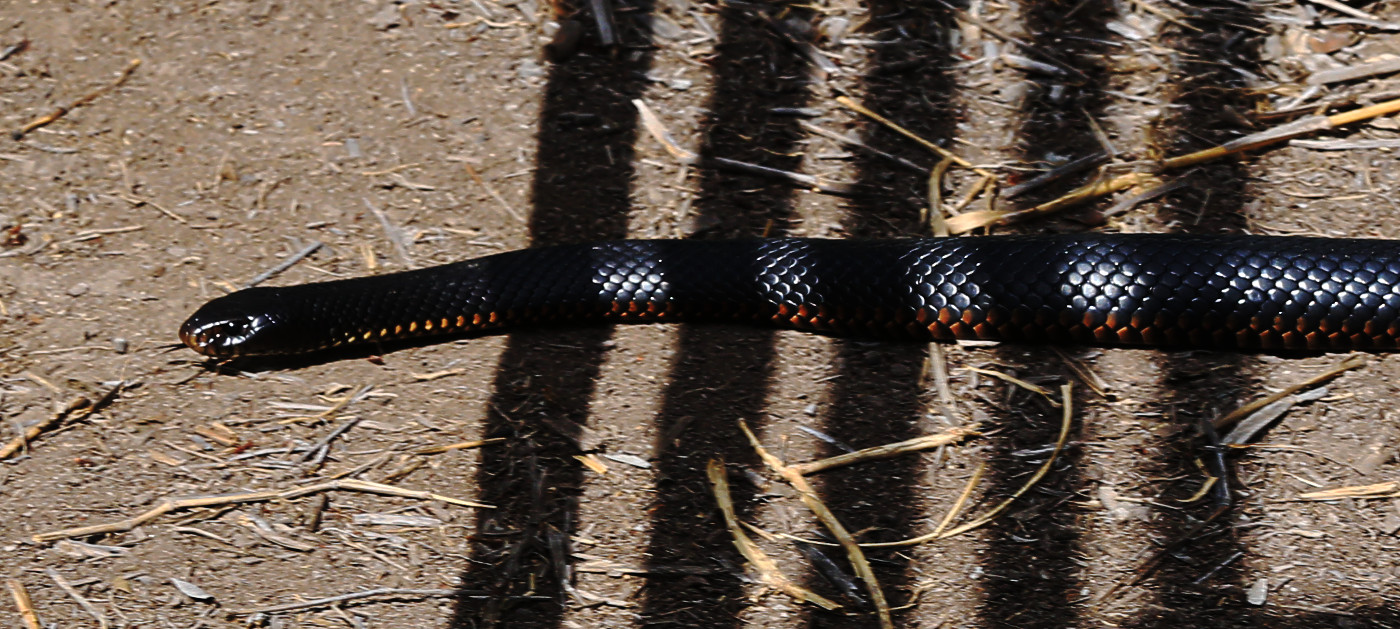
And then there's no legs at all. Couldn't get Red-bellied Black to stop for head-on shot so had to settle for harsh crop of snake speeding across gate shadows.
Interesting sidelight to photographing the placid spider was counting the number of flashes reflecting from all those tiny eyes. Best of all, no angry hairy 'monster' threatening to bite me.
No bite threat, no hair, fewer eyes: Gumtree Shield Beetle (Theseus modestus) stands out as attractive bark dweller. Six legs good, eight legs trickier.
And then there's no legs at all. Couldn't get Red-bellied Black to stop for head-on shot so had to settle for harsh crop of snake speeding across gate shadows.
Friday, September 11, 2015
Stubble Quail stumbled upon
Stumbled upon Stubble Quail (Coturnix pectoralis) in drying grasses at Mungalla Station today, some distance from usual haunts near creek track and in weedier mix of flora. No sign of any partner, but luck mainly determines sightings of the species.
Much more easily found, specially this very dry year, Horsfield's Bushlark (Mirafra javanica). The birds seem to be thriving in competition with the scores of Australian Pipits ever present on tracks and bare spots in the grasses, though the Bushlarks favour slightly greener cover.
Sunday, September 6, 2015
Poking and peering at the park's paperbarks
Bit of a poke around big paperbarks at front of the mown and park-manicured Tyto precinct this week turned up some small wildlife unnoticed by the tourists.
First, wee Black House Spider (Badumna insignis), probably closely related to the little bugger so excruciatingly met the other day (previous post). Smaller than my little fingernail and striving to look even smaller after being spilled out from behind bark onto path.
Nearby in wet, rotting tree fork, one of many Mr Bigs, Carpenter Ant (Camponotus spp.) charging out to find the agent responsible for poking around top of presumed tunnels and galleries chomped into the wood. Bigger than my thumbnail and said to pack a mean bite. Queens (not seen) said to be gigantic (for ants).
A hairy find, caterpillar of Cinnabar Moth (Tyria jacobaeae), an insect introduced to control Tansy Ragwort (Senecio jacobae). Hope that's going better than many such introductions. Hinchinbrook shire tried weevil control against Salvinia. Seems task was too big for man and insect. Spraying has achieved cosmetic and ugly partial kill of the weed. But it may have cleared the weevil.
Two for the web of one: St Andrew's Cross Spider (Argiope keyserlingi), female, lacking two legs (not so bad if one starts with eight) and tiny male mate, smaller than her head, sitting down below. He'll wait there until she consumes unwary suitors and then return to position on her back (according to web sources - wee joke there).
And one little footnote to earlier post on night screamers: happily and healthily hatched and sitting around, often under a parent, juvenile Bush Stone-curlews. Cute, eh?
First, wee Black House Spider (Badumna insignis), probably closely related to the little bugger so excruciatingly met the other day (previous post). Smaller than my little fingernail and striving to look even smaller after being spilled out from behind bark onto path.
Nearby in wet, rotting tree fork, one of many Mr Bigs, Carpenter Ant (Camponotus spp.) charging out to find the agent responsible for poking around top of presumed tunnels and galleries chomped into the wood. Bigger than my thumbnail and said to pack a mean bite. Queens (not seen) said to be gigantic (for ants).
A hairy find, caterpillar of Cinnabar Moth (Tyria jacobaeae), an insect introduced to control Tansy Ragwort (Senecio jacobae). Hope that's going better than many such introductions. Hinchinbrook shire tried weevil control against Salvinia. Seems task was too big for man and insect. Spraying has achieved cosmetic and ugly partial kill of the weed. But it may have cleared the weevil.
Two for the web of one: St Andrew's Cross Spider (Argiope keyserlingi), female, lacking two legs (not so bad if one starts with eight) and tiny male mate, smaller than her head, sitting down below. He'll wait there until she consumes unwary suitors and then return to position on her back (according to web sources - wee joke there).
And one little footnote to earlier post on night screamers: happily and healthily hatched and sitting around, often under a parent, juvenile Bush Stone-curlews. Cute, eh?
Wednesday, September 2, 2015
Tiny spider brings Cassowary walker down to Earth
Taken more than six months and about 15 trips but today finally ran into (almost literally - had to brake hard when he popped onto road near front of the Troopy) occasional Wallaman Falls walking companion, male Southern Cassowary (Casuarius casuarius).
As usual he had little to say and wouldn't look me or the camera in the eye during our 10-minute walk and talk along the road and in and out of roadside forest fringe. Seems hard to believe that no matter where one stands or how close one gets the bird simply walks on, head mostly down (that's where the food is - though there's not much falling anywhere on the ridge road these days) and unconcerned about someone walking within touching distance.
Dangerous walk? Not at all, so long as attention is paid to bird's body language. However, high on the buzz of the meeting after so long without a sighting made I the mistake soon after of picking up a tiny supposed woodlouse or similar from under some peeling bark. Oops. Twin fangs and sharp, sharp pain. For an hour or so. Sneaky little spider had rolled into ball to escape and didn't want to be picked up by a bare-handed idiot high on Cassowary encounter. Hard to read such tiny body talk. Tweezers or gloves are the key words.
As usual he had little to say and wouldn't look me or the camera in the eye during our 10-minute walk and talk along the road and in and out of roadside forest fringe. Seems hard to believe that no matter where one stands or how close one gets the bird simply walks on, head mostly down (that's where the food is - though there's not much falling anywhere on the ridge road these days) and unconcerned about someone walking within touching distance.
Dangerous walk? Not at all, so long as attention is paid to bird's body language. However, high on the buzz of the meeting after so long without a sighting made I the mistake soon after of picking up a tiny supposed woodlouse or similar from under some peeling bark. Oops. Twin fangs and sharp, sharp pain. For an hour or so. Sneaky little spider had rolled into ball to escape and didn't want to be picked up by a bare-handed idiot high on Cassowary encounter. Hard to read such tiny body talk. Tweezers or gloves are the key words.
Subscribe to:
Posts (Atom)
Lament for southern Black-throated Finches
Hollow logs for at risk birdies? Nature's nest boxes if you please Oh, such a clever wheeze So gather in twos and threes? Hundreds you w...
-
Hollow logs for at risk birdies? Nature's nest boxes if you please Oh, such a clever wheeze So gather in twos and threes? Hundreds you w...
-
Golden-headed Cisticola not so rusty when it comes to catching a feed See the eagle-eyed birdo doing his stuff. Eyes always on the move, mi...
-
Brown-backed Honeyeaters ( Ramsayornis modestus ) flourish in Tyto in spite of many nesting failures. They usually build their bulky, dangli...