
Showing posts with label Lucinda. Show all posts
Showing posts with label Lucinda. Show all posts
Sunday, January 27, 2013
Bush Thick-knee catches the eye


Sunday, December 16, 2012
Varied offering after sweet walk


Wednesday, August 15, 2012
Swallows make visitors welcome


Click pix to enlarge
Sunday, October 2, 2011
Plover poses - Pipit pauses


Click pix to enlarge
Monday, July 11, 2011
Crabbing the opportunity


Click pix to enlarge
Friday, October 31, 2008
Watch for crocs, find crakes
Ventured into crocodile country today, at the Macknade revegetation area along a major creek and billabong system close to Halifax and the Herbert River. Tyto's croc warning is mainly for show (though we did have a two-metre inhabitant for a while) and to cover the shire's behind, but things are different nearer the Herbert.
Once (as I've been) five metres away from a three-metre salty (with bit of tail missing!) hauled up on a sandy tongue leading into waist-deep water full of blue and deep red lotuses (and, sadly, Hymenachne) the size and danger is clear. Much bigger crocs have been seen in a deeper stretch of water. All this on both sides of a major Ingham-Halifax-Lucinda road and about 150 metres from the local pub.
Since the revege area is surrounded by sugar cane, the place must have its share of snakes - Browns, Taipans, Red-bellied Blacks heading the danger list - though I've seen very few. And snakes don't stalk us. Or eat us. Crocs do.
I walk through the knee-high grass with a wee tingle pinging on the senses. I want to see crocs, but not if they see me first - from up close. Only sign today was a days-old track of flattened grass on a narrow finger of land between two channels.
 So, no crocs, but did get lucky with the sighting of two young White-browed Crakes (Porzana cinerea) and a parent bird, which snatched something large, whitish and leggy out of the weeds. Though it looks like a frog, the prey refuses to resolve itself no matter how I squint at pixilated enlargements. The legs wrapped around the bird's lower bill just don't look froggy.
 The juveniles darted from cover to cover, as they always do, making it impossible to obtain any clear shots. Rather a satisfying encounter, all the same. And unexpected here at this time of year. No sign at Tyto of breeding. Two guide books offer 'most months' or 'Sept-Apr' on breeding. Dec-Mar is closer to my experience in the wetlands.
Once (as I've been) five metres away from a three-metre salty (with bit of tail missing!) hauled up on a sandy tongue leading into waist-deep water full of blue and deep red lotuses (and, sadly, Hymenachne) the size and danger is clear. Much bigger crocs have been seen in a deeper stretch of water. All this on both sides of a major Ingham-Halifax-Lucinda road and about 150 metres from the local pub.
Since the revege area is surrounded by sugar cane, the place must have its share of snakes - Browns, Taipans, Red-bellied Blacks heading the danger list - though I've seen very few. And snakes don't stalk us. Or eat us. Crocs do.
I walk through the knee-high grass with a wee tingle pinging on the senses. I want to see crocs, but not if they see me first - from up close. Only sign today was a days-old track of flattened grass on a narrow finger of land between two channels.
So, no crocs, but did get lucky with the sighting of two young White-browed Crakes (Porzana cinerea) and a parent bird, which snatched something large, whitish and leggy out of the weeds. Though it looks like a frog, the prey refuses to resolve itself no matter how I squint at pixilated enlargements. The legs wrapped around the bird's lower bill just don't look froggy.The juveniles darted from cover to cover, as they always do, making it impossible to obtain any clear shots. Rather a satisfying encounter, all the same. And unexpected here at this time of year. No sign at Tyto of breeding. Two guide books offer 'most months' or 'Sept-Apr' on breeding. Dec-Mar is closer to my experience in the wetlands.
Subscribe to:
Posts (Atom)
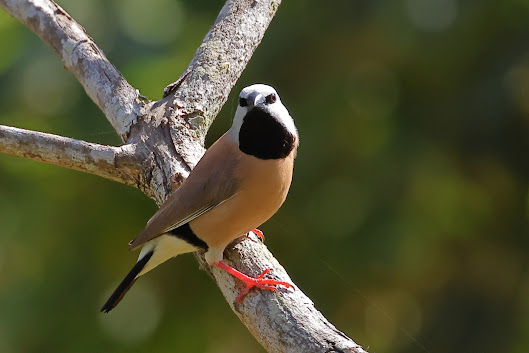
Lament for southern Black-throated Finches
Hollow logs for at risk birdies? Nature's nest boxes if you please Oh, such a clever wheeze So gather in twos and threes? Hundreds you w...
-
 Hollow logs for at risk birdies? Nature's nest boxes if you please Oh, such a clever wheeze So gather in twos and threes? Hundreds you w...
 -
 Seems Townsville will feel only the sting in Cyclone Debbie's tail. Nothing but light breeze and a rare drop of rain here yet as the c...
 -
 Golden-headed Cisticola not so rusty when it comes to catching a feed See the eagle-eyed birdo doing his stuff. Eyes always on the move, mi...