Up to Wallaman Falls to hunt for Cassowary and almost fall over big juvenile upon jumping (aged knee joke) from Troopy near known haunt of resident male. Hurriedly grab camera, five frames, junior takes off and gone, swallowed up by forest. Fading juvenile stripes showed down front of bird, which didn't look big enough to be fending for itself. But long search in all directions turned up no trace of adult male (responsible for all hatching and rearing).
Down at Jourama Falls, Topknot Pigeons out and about in scores, though seldom dropping in anywhere near me. About 60 birds coming and going, stopping mostly on native olives (no threat to any farmed olive). Two of 60 was as good as it got for me.
Nearby, Dusky Honeyeater getting stuck into insectivorial side of its diet. Most honeyeaters are happily gymnastic in the hunt for leaf-laid food.
At Mungalla Station, Tawny Grassbirds made rare showings out of their frustratingly enclosing habitat. Closed in slowly on sodden bird during morning wash. Got no closer before it flew on to barbed wire (an ugly look). Then into hiding. But its mate came out and showed off in the open (ugly background but better than on barbed wire).
Among the mangroves at the end of Orient Road found bigger targets than expected, with two of about 30 Pelicans circling low above me after quitting one of last remaining big pools of king-tide saltwater, soon to evaporate away.
At Tyto, Jacana takes in extras along with dead glasswing plucked from the muddy edge of the main lagoon. Ants foraging on the insect carcase are about to disappear into the bird, except those falling back to the surface.
Closing this quick roundup of sites, Red-capped Plover stands its ground along the Lucinda sandspit. Not my target on the day, but all the migrants stayed well clear. Not to worry, the tides are more in my favour later this week. And, who knows, maybe more tidings of Master Cassowary!
Showing posts with label Dusky Honeyeater. Show all posts
Sunday, September 11, 2016
Sunday, September 25, 2011
Dusky beauty heads honeyeater handful
Dusky Honeyeater (Myzomela obscura) in Tyto Wetlands yesterday (losing out to Brown and Yellow HEs in fight for nearby flowering bottlebrush.
Brown Honeyeater (Lichmera indistincta) on the bottlebrush.
Yellow Honeyeater ready for action (Lichenostomus flavus)
Earlier, White-throated Honeyeater (Melithreptus albogularis) also on bottlebrush.
And White-gaped Honeyeater (Lichenostomus unicolor) not so sweet-loving as it collects Cheese Tree seeds.
Click pix to enlarge
Brown Honeyeater (Lichmera indistincta) on the bottlebrush.
Yellow Honeyeater ready for action (Lichenostomus flavus)
Earlier, White-throated Honeyeater (Melithreptus albogularis) also on bottlebrush.
And White-gaped Honeyeater (Lichenostomus unicolor) not so sweet-loving as it collects Cheese Tree seeds.
Click pix to enlarge
Sunday, April 17, 2011
Sunbird feeds into scheme of things
Few Olive-backed Sunbirds (Nectarinia jugularis) seen about the wetlands lately so lucky getting close to this female today.
But, then, her mind was more on pollen and nectar than nosy photographers.
So, too, this young Dusky Honeyeater (Myzomela obscura), looking at first impression rather like a Scarlet or Red-headed Honeyeater juvenile.
And this Willie Wagtail (Rhipidura leucophrys) also didn't mind me getting close, very close, knowing I'd no designs on a dragonfly dinner.
Click pix to enlarge
But, then, her mind was more on pollen and nectar than nosy photographers.
So, too, this young Dusky Honeyeater (Myzomela obscura), looking at first impression rather like a Scarlet or Red-headed Honeyeater juvenile.
And this Willie Wagtail (Rhipidura leucophrys) also didn't mind me getting close, very close, knowing I'd no designs on a dragonfly dinner.
Click pix to enlarge
Tuesday, September 22, 2009
Honeyeaters not half tricky
Even trickier to get pictures of Dusky Honeyeaters (Myzomela obscura). They disappear for months before their somewhat squeaky high calls - often in mistletoes - announce a return. From where, I know not. 'Sedentary. Locally nomadic,' say the guide books. About now is their prime breeding time. Can't recall ever seeing signs of such in Tyto. And above bird looks immature.

And so to Mistletoebird (Dicaeum hirundinaceum), a female. Plentiful for some months, they have become harder to find recently as the dry season takes hold. It's likely the pickings are sweeter and life cooler at slightly greater altitude in the nearby ranges.
Staying faithful to its territory - and completing this set of 'birds on sticks' - Little Shrike-Thrush (Colluricincla megarhyncha). One day the trees are full of them. The next, no sight and little sound. Odd, considering they use a wider range of calls than any other species in Tyto. But it would be boring if nature became too predictable, wouldn't it?
Subscribe to:
Posts (Atom)
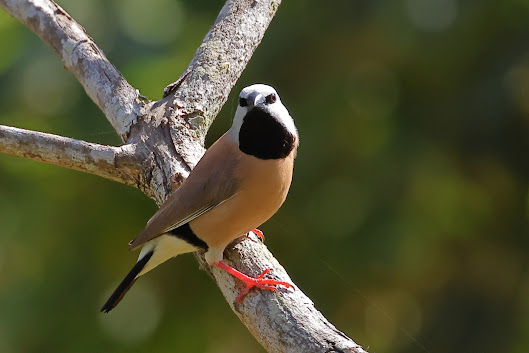
Lament for southern Black-throated Finches
Hollow logs for at risk birdies? Nature's nest boxes if you please Oh, such a clever wheeze So gather in twos and threes? Hundreds you w...
-
Hollow logs for at risk birdies? Nature's nest boxes if you please Oh, such a clever wheeze So gather in twos and threes? Hundreds you w...
-
Seems Townsville will feel only the sting in Cyclone Debbie's tail. Nothing but light breeze and a rare drop of rain here yet as the c...
-
Golden-headed Cisticola not so rusty when it comes to catching a feed See the eagle-eyed birdo doing his stuff. Eyes always on the move, mi...