Showing posts with label Tyto. Show all posts

Saturday, October 29, 2016

Crawling about to compare Crakes and measure shakes

Bit of crawling about in front of the Tyto hide today and earlier in week brought White-browed Crakes more or less eye-to-eye.

Also brought chance to compare 600mm lens (top) with old 400+1.4x (above). The birds didn't seem to mind the huge 600 or the slender 400 being pointed at them from close across a narrow channel.

But most of the 600 shots were usable, unlike those from nonstabilised 400. Two exceptions above.

Same story- even with tripod - while chasing White-browed Robin juvenile first seen on the ground yesterday. Above 600 handheld of premature nest-leaver hugging the leaf litter.

Didn't want to upset chittering, flittering parent birds too much, so quit and hunted for the group again this morning. Took some time but found youngster looking much stronger (above).

Again though, even shooting from tripod and using various means to brace everything few shots with 400+1.4x combo truly sharp. So, back into the cupboard with the 400.  

Sunday, September 11, 2016

Young Cassowary heads the week's roundup

Up to Wallaman Falls to hunt for Cassowary and almost fall over big juvenile upon jumping (aged knee joke) from Troopy near known haunt of resident male. Hurriedly grab camera, five frames, junior takes off and gone, swallowed up by forest. Fading juvenile stripes showed down front of bird, which didn't look big enough to be fending for itself. But long search in all directions turned up no trace of adult male (responsible for all hatching and rearing).

Down at Jourama Falls, Topknot Pigeons out and about in scores, though seldom dropping in anywhere near me. About 60 birds coming and going, stopping mostly on native olives (no threat to any farmed olive). Two of 60 was as good as it got for me.

Nearby, Dusky Honeyeater getting stuck into insectivorial side of its diet. Most honeyeaters are happily gymnastic in the hunt for leaf-laid food.


At Mungalla Station, Tawny Grassbirds made rare showings out of their frustratingly enclosing habitat. Closed in slowly on sodden bird during morning wash. Got no closer before it flew on to barbed wire (an ugly look). Then into hiding. But its mate came out and showed off in the open (ugly background but better than on barbed wire).

Among the mangroves at the end of Orient Road found bigger targets than expected, with two of about 30 Pelicans circling low above me after quitting one of last remaining big pools of king-tide saltwater, soon to evaporate away.

At Tyto, Jacana takes in extras along with dead glasswing plucked from the muddy edge of the main lagoon. Ants foraging on the insect carcase are about to disappear into the bird, except those falling back to the surface.

Closing this quick roundup of sites, Red-capped Plover stands its ground along the Lucinda sandspit. Not my target on the day, but all the migrants stayed well clear. Not to worry, the tides are more in my favour later this week. And, who knows, maybe more tidings of Master Cassowary!

Wednesday, July 13, 2016

Little good big but good Little comes of long lensing

Walked into Tyto yesterday jauntily carrying light 300mm lens and looking forever upward, seeking uncommon raptor seen lately at tantalising distance - and found only Little Kingfisher (Ceyx pusilla) almost beneath my feet. Wrong lens for wrong bird. Today, slogged in with 600mm lens and hefty tripod and got reverse result - no LK and high overhead Square-tailed Kite. on  which the 600 too slow to focus given need to hand-hold.

Not all lost. Did get seven extra species to go with yesterday's 70. And no walk in Tyto is ever anything less than balm for senses and soul. And it's all an excuse to run series of Little Kingfisher shots from corner of Palm Creek at Mungalla Station.

And boring stuff too. Above shots are with 600 on tripod about 20 metres from bird. Can't get closer because of intervening creek (and possible crocs).

But adding a 1.4x converters turns 600 into 840mm lens. And that makes quite a difference, does it not? Feather detail counts.

And another thing: Notice the well camouflaged camera. Stand still long enough and birds will often accept the intrusion as more natural than someone all camo'd up. Talking to them in normal voice can help. Do not whisper!


Saturday, July 11, 2015

Spoonbill shows style, Sunbird shows off

Yellow-billed Spoonbill (Platalea flavipes) steps out in style near Tyto's front lagoons.

Scruffier stuff beside water the shy and mostly solitary species' more usual surroundings.

And taking off the more usual reaction to seeing photographers and cameras.

PS: Talking of the latter, bumped in Gouldiae's mate Jim in Tyto this morn, on his way up to Cape York and Iron Range (lucky Jim).

So, bonus pic for them both: Sunbird and Troopy mirror. Sorry, angle prevented reflected selfie.

Thursday, November 20, 2014

Crocs lapping up the sunshine

Is the croc still enjoying freedom and laughing at the high-tech trap in Tyto?

Yes indeed. It's moved sunning spot slightly east and by no more than happenchance a wee bit farther away from the trap.

Meanwhile, smaller croc at Mungalla is in pool barely deep enough to dive into.

Perhaps the nearby deeper pools contain too many dangers - bigger brothers or sisters.

Friday, April 1, 2011

Rainbow Bee-eater prrps into place

Plenty of Rainbow Bee-eaters (Merops ornatus) 'prrpping' about the place these days. 


Not too many posing on low points.


Pity the pallid light in Tyto today played down bird's colours.
Click pix to enlarge

Thursday, October 16, 2008

Drifting into the shallows

As construction of a new lagoon and boardwalk motors ahead near Tyto HQ, a few seasonal regulars are drifting back to the more distant western shallows. Also noticeable, gradual additions to newcomer numbers.

A pair of Hardheads (Aythyla australis) turned up last month. Two became four, six, eight, 10, 12, 16, 18 in ensuing weeks. A similar process is building up the Royal Spoonbills (Platalea regia).


A solo Black-winged Stilt (Himantopus himantopus) was joined today by two others and the Glossy Ibis (Plegadis falcinellus) by one other. And the first Little Egret (Egretta garzetta) of the season was running about the margins.


Still no sign of sandpipers, godwits, plovers or stints. Never too many, but this year the lagoon shallows after broken weather and many showers (and rain) since May are 20cm to 30cm deeper than in a drier Dry.


It's possible the reed flats that in past years could support trucks spraying water weeds may not dry out at all in 2008. Good for crakes, rails, bitterns and many other shy species, not so good for those seeking to spot them.

Thursday, October 2, 2008

Willie's not wheelie a wagtail

Willie Wagtail (Rhipidura leaucophrys) obviously knows what the colonists chose to ignore: wagtails wag and fantails fan. They just don't do it as often as the other fantails. This bird today in Tyto shows the full tail while standing on a felled Tulip Tree much in favour as a launch platform for hungry kingfishers and bathing honeyeaters.
Another thing Willies don't do often is fly about clutching big green katydids. Fruitlessly chased after a bird yesterday carrying a huge catch in its bill. Surprisingly, the bird - between short flights away from me - speedily devoured the Leafy Katydid (Paracaedicia serrata).


Surprising, because Willies often take minutes to strip the wings off small dragon flies. To despatch a bulky insect of more than 40mm in short order would suggest the wings are considered edible, or they're easily detached. I didn't see anything discarded, but was struggling to keep up.


Thinking back (not always the most reliable source of information), I can't recall seeing big katydids taken by birds smaller than cuckoo-shrikes and orioles. Which, of course, means little to all the birds everywhere enjoying fat tasty katydids, and is no consolation to the katydids.


Talking of chasing birds, today brought a series of effortless floating flights from a Large-tailed Nightjar (Caprimulgus macrurus) and clumsy stumbling after by me. The nightjar rose from a relatively open area of shaded guava scrub, uplifted to leaf litter, fallen logs, more litter, tree buttress, shaded litter, and on to open ground, before vanishing into more guava. Given the nightjar's (aka Axe Bird) evening calls of 'chop-chop' 'chop-chop' (often for hours) it's fitting the sightings came in an area being replanted after felling of weed trees. Good fun, and a poor picture.

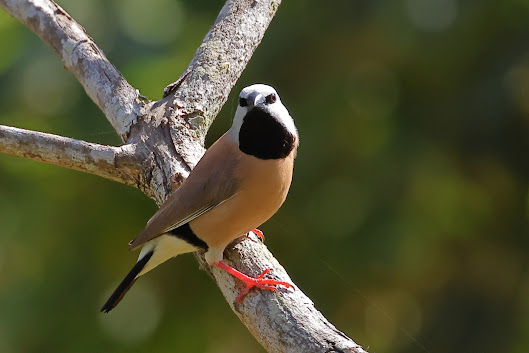
Lament for southern Black-throated Finches

Hollow logs for at risk birdies? Nature's nest boxes if you please Oh, such a clever wheeze So gather in twos and threes? Hundreds you w...