Sunday, January 7, 2018
Booboo prompts more questions of identity
Sparrowhawks stare, Goshawks glower. Easy! Except Sparrowhawks often glower a bit. And their tails (square tipped with notch, against rounded unnotched) fold inconclusively in the field. And their very long middle toes and thin legs look less impressively different in the field than in the field guides. Ditto colour, head, bill, and, specially in the north, size differences. So, no surprise if Collared Sparrowhawk ID should be challenged.
Less contentious, though commonly mislisted as Grey Shrike-thrush, Little Shrike-thrush. (above and below), previously called Rufous Shrike-thrush. Above image closely matches what birders expect to see.
Same bird taken a day earlier in less sunlight shows why Little becomes identified as Grey, which is larger, lighter grey, sounds different, and in North Queensland prefers higher and drier inland woodland.
No question about Australasian Pipit. Until it's identified as Anthus australis australis. Because across the Top (of Australia) there's another subspecies, Anthus australis rogersi, which stands very upright, is more heavily streaked down the breast, is said to have a shorter tail and longer legs than the three other Pipit ssp.
It seems rogersi may have snuck southeast hundreds of kilometres down the NQ coast without drawing field guide attention to itself. Problems: every Pipit locally stands very upright, but often without extra heavy streaking. Tail and leg lengths difficult to measure without bird in hand.
Here's to further challenges (and fewer booboos) in 2018.
Wednesday, August 27, 2014
Crimson Finch tucks into weed seed feed
Also in Mungalla, Australian Pratincole (Stiltia isabella), one of several likely to settle in for a few months' residency, and probably some breeding.
Recent migratory arrival, Latham's Snipe (Gallinago hardwickii) also appears to have settled in for a long spell, feeding in pools alongside Palm Creek.
A longterm resident, Australian Bustard (Ardeotis australis), stands out on track running above the creek. Much male posturing for months so local breeding possible, though I've never seen any younsters running about the Ingham area.
And another longtermer - always in big numbers - Australasian Pipit (Anthus novaeseelandiae) leaves the dusty ground for a brief taste of the high life.
Sunday, October 2, 2011
Plover poses - Pipit pauses
Mostly, birds faster than me. But one hopped onto driftwood and stopped briefly.
Also darting about the dunes, Australasian Pipit (Anthus novaeseelandiae).
Click pix to enlarge
Tuesday, September 28, 2010
Birds bit noisy, pictures less so
Awkwardly posed, but also sharp, a Horsfield's Bushlark (Mirafra javanica). Plenty of song from this and a few others of the species.
And from Tyto today two views of a cheery churry Brown-backed Honeyeater (Ramsayornis modestus), building, yet again, in front of the hide.
Those bored by camera details should look away now. All the above images shot at ISO 400. No noise reduction applied. Lately been told Canon uses under and over exposure tweaking to provide intermediate ISOs from the primary 100 200 400 800 etc. Pushing 200 to 250 (my previous preferred setting) creates picture noise. Helps explain high ISOs many use. Nikons don't have the problem.
Back to today's birds. Bit of takeaway food for immature Black-necked Stork (Ephippiorhynchus asiaticus).
But turtle proved too tough a nut to crack. Even mature birds try and fail to open turtles up. I suspect, on rather limited observations, that White-bellied Sea-eagles get to the meat of things by carrying turtles up and dropping them. However, I've only ever seen the pickup.
Click pix to enlarge
Friday, February 26, 2010
Pipit sits still in place of Cisticolas
Plenty of them, usually on the road. Not so common for them to allow an approach for closeups. (Brown Falcons again too fast off their fence posts as I drove up yesterday.)
Couldn't resist a few more shots of Horsfield's Bushlark (Mirafra javanica). They're so willing to sit still it seems almost rude not to stop, swap a few words (theirs much sweeter than mine) and hope for something different.
Tried without success for close shots of their fluttering flights. Light turned grey ... and then came the rain. Which has yet to really stop, 24 hours later. February's proving a wet one!
Wednesday, November 26, 2008
'Zweep' for rare wagtails
Rarer still, mostly, are Citrine, Grey, Black-backed and White Wagtails. If there be a wagtail heaven in Australia for birdwatchers it is Darwin, where almost all races of almost all species may turn up.
Want to find a rare wagtail? Do not follow the guide books to playing fields, airstrips and other mown areas. Instead, take their sometimes advice and get yourself near sewerage lagoons, spread sludge, or water treatment ponds. Not so easy in many places and cases.
Or wait till someone else finds one. Or two. Or three. Or four. Perhaps even five. You've guessed it! I am that someone else.
Took a late afternoon drive yesterday to some ponds and in the breaking gloom of distant thunder clouds heard a high, sweet 'zweep zweep'. Focussed too late on small bird ascending rapidly off muddy area of pond and climbing high before disappearing west.
But the Yellow Wagtail's 'zweep' is not too different from the Australasian Pipit's call. The area is base to two or three pairs of pipits (a bird which normally flies low when disturbed and returns to ground quickly).
After a hectic morning watching Euro soccer (lucky Arsenal!), fixing bicycle, getting in way of water blasting the caravan (oops, partly inside!) and seeing a false roof fitted (less heat, fewer leaks, reduced rain noise), I headed off hoping to confirm wagtail's presence to the east.
No joy on first patrol of pond system. Then, more 'zweeping'. Forty metres away, a rather yellow Yellow Wagtail. On the algal green surface of a drying section of pond mud. Quick pictures. Race off for tripod. Return to find Black-fronted Dotterels chasing wagtail. More quick pictures before bird quits under dotterel harassment.Trudge off in 35C heat and tons of sun in pursuit. Criss-cross dried weed-filled pond. Chase after possible two birds. Much more 'zweeping' and see four or five birds leave ponds and go to ground in waist-high sugar cane.
Two birds then head off to nearby trees. Two return toward where the chase began. More hot trudging. No birds on the mud. But more sounds heading back toward the cane.
Trudge back and find non-yellow Yellow Wagtail calling from a mass of dried floating pond grass. Better pictures, but unable to get really close before bird lifts off and disappears west.
My experience suggests the birds will stick around so long as the mud areas continue to be uncovered. However, much of the ponds' cane grass and bulrush were dug out this year, and some ponds are also carrying high water levels. Experience must often give way to changed conditions.
But between now and the beginnings of the Wet I'll somehow sneak close to one or two of my four or five Yellow Wagtails. It's on my Xmas list!
Friday, November 14, 2008
Heron makes rare showing
Even more surprising than seeing the bird has been the rarity of sightings over the years: two in five years at Tyto (a kilometre away) - to my knowledge. Today's was a rainforest first for me. But no sign of the Azure Kingfishers.
So, three pictures from the past few days:
Male Rufous-throated Honeyeater (Conopophila rufogularis) reaches under a dead pink lotus flower head in its search for small insects. The birds are seldom absent from Tyto, but often disappear high into trees through the day. Mornings and evenings, they more actively forage at and near the water's edge.
Northern Fantail (Rhipidura rufiventris) takes a spell from competing with Willie Wagtails for moths and other flying prey. The fantails can't match their more numerous rivals in open woodland. They do better in closed woodland, and stick around long after the Grey Fantails have headed off for cooler forest and higher ground.
Australasian Pipit (Anthus novaeseelandiae - formerly Richard's P.) surveys its typical mown grass territory from atop an Ingham airstrip security fence, which forms Tyto's southern boundary. I'm not too keen on manmade bits in my bird pictures, yet have to admit they do sometimes make a photgrapher's life easier.
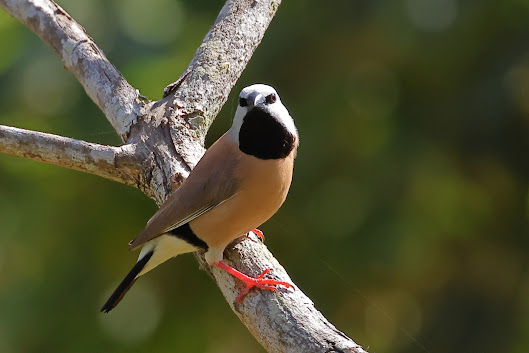
Lament for southern Black-throated Finches
Hollow logs for at risk birdies? Nature's nest boxes if you please Oh, such a clever wheeze So gather in twos and threes? Hundreds you w...
-
Hollow logs for at risk birdies? Nature's nest boxes if you please Oh, such a clever wheeze So gather in twos and threes? Hundreds you w...
-
White-faced Heron stands up and begs picture be taken at Tyto. The birds can develop some trust in people, but I've never found any aro...
-
Who gives way on footbridge, Yellow-spotted Monitor or unspotted bird watcher? Naturally, dinkum locals have right-of-way. I step aside, Spo...