Showing posts with label Spotless Crake. Show all posts

Monday, November 7, 2016

Spotless, White-browed Crakes share spoils with few tiffs

Spotless Crake finally finding mud footing firm enough to venture forth with longer-toed White-browed Crakes in front of Tyto hide these drying days.

Didn't hear or see the species for more than two months and began to wonder if some or all had done an overnight bunk. Perhaps numbers of sightings have been unusually low for a combination of reasons: strange Wet season, low breeding output, some departures.

Feeding birds ignored me over the weekend as I crawled close. Even when aching back forced me to sit up the birds stayed close across narrow channel. Added 1.4x to 600mm lens and did some shooting in raw+jpeg. For those interested, first image is jpeg with one light sharpening. Second, same image with second sharpening. Third image, raw converted to tiff, one sharpening. File size increased by about 4.5x raw over jpeg (6mb to 26mb) and another 3x tiff over raw (26mb to 72mb). Good luck trying to spot anything like such differences in images prepared for the blog. But it can matter to printers and the pros.

Another view, just for luck.

And here's the feeding partner. Mostly the two shared without tiffs.


Tuesday, June 15, 2010

Crakes come out as creek goes down

Young White-browed Crake (Amaurornis cinerea) ever present lately beside most heavily trodden area within the wetlands.

Bird's territory is 40-metre drying section of creek crossed by low footbridge leading to the main lookout.

Most of the dry season's growing numbers of visitors are unaware they're almost walking on top of the fast-maturing crake.

Which is a pity. For, as often proves the case, one bird's boldness brings others out.

No surprise to find similar-sized Spotless Crake (Porzana tabuensis) picking over the same muddy shallows. This mature bird quickly gives way if challenged by the youngster. Explains in part why the shyer species is greatly outnumbered.

Yet neither species gives way to Buff-banded Rail (Gallirallus philippensis), more than half again larger than their 20cm. Could be because crakes breed in Tyto and the rail, though local, is a mere visitor: a much sharper eyed one than most humans passing by.

Wednesday, May 12, 2010

Spotless Crake not so easy to spot

Immature Spotless Crake (Porzana tabuensis) peers from out of cover beside a Tyto track. In maturity the drab grey back will give way to chocolate brown. The eyes will glow red. Ditto the legs. Worth waiting to see.


Always worth waiting to see: Rainbow Lorikeet (Trichoglossus haematodus), scratched up from the holdover file.

Ditto this Red-tailed Black-Cockatoo (Calyptorhynchus banksii) crunching into green almond down the road from Tyto.

Updates: Male Comb-crested Jacana stays glued to surviving youngster. Three other families: four, three and two immatures. Plus two youngsters now independent.

Shining Flycatchers still feeding probably three hatchlings.

Saturday, December 26, 2009

Just the spot for Spotless spotting


Spotless Crake (Porzana tabuensis) in front of Tyto hide in patchy light yesterday. The birds were out and about again in worse light today. Increasing evaporation this month has thickened the weed mat, providing them with secure footing. But the birds remain difficult to close in on.


And the thickening growth may have discouraged this Water Rat (Hydromys chrysogaster - pictured earlier in month) from further burrowing through the water and weeds.


Another clump of weeds in another wetland near Ingham. But a very big nest builder. This Saltwater Crocodile nest is 10 metres from a well-used vehicle track and 200 metres from a busy road. No sign of the crocodile at picture time, so I'll (very) carefully keep a distant eye on things. The probability is the Wet will flush the nest and eggs away from the old river channel before the estimated 60 days left to hatching.

Saturday, October 17, 2009

Spotting more Spotless Crakes


Suddenly the Spotless Crakes (Porzana tabuensis) have become easier to find than White-browed Crakes, although probably outnumbered about 20 to one. It's perhaps because the water level has dropped markedly and provided reasonably solid footing around the margins of the scleria islands. The Spotless lacks the very long toes of the White-browed.


Totally unexpected drop-in yesterday in the channel close to the crakes' playground, a Red-backed Buttonquail (Turnix maculosus). Sorry about the rear view, but the bird splashed down, looked about as if bewildered to be sinking, and shot up and away. The species in past years turned up to feed in scruffy areas of mixed weeds. Drenched in weedicides and turned to grass, the areas now support wallabies - and ever more mowing! Don't know how long the buttonquail will stick around amid the monocultures of reeds and scleria.

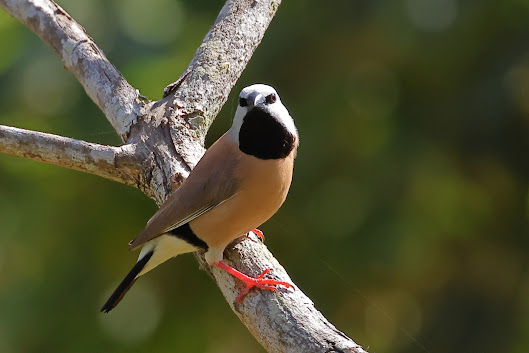
Lament for southern Black-throated Finches

Hollow logs for at risk birdies? Nature's nest boxes if you please Oh, such a clever wheeze So gather in twos and threes? Hundreds you w...