Showing posts with label nest. Show all posts

Friday, September 7, 2018

Parks and Wildlife Service burn destroys Osprey nest

Remember this?

And this?

Or this?

Now the scene is this.

Queensland Parks and Wildlife burned east of road in Town Common Conservation Park yesterday. Nest - with, possibly, hatchling/s - gone. Tree mostly gone. Only one of the three resident Ospreys close by today. Probably last year's youngster, late and yet to go off on its own, nervily calling and being harassed by Black Kites looking for after-burn pickings.

Further up the road, juvenile White-bellied Sea-eagle fared better. Base of nest tree charred and ground around it covered in ash but youngster alert and confident today. Parents not sighted: almost certainly out hunting, maybe to add to the 16 turtle shells at base of tree.

Sunday, April 5, 2009

Black Butcherbird too close

Black Butcherbirds (Cracticus quoyi) don't spend much time in Tyto and those that do often are quieter than in more usual habitats such as denser rainforest or thick belts of mangroves. Came upon two foraging through guava thickets today. Never any chance of photographing them together, but one went out of its way to get in frame. It landed on leaf litter close to my feet. Almost impossibly close for my lens, in fact, and, worse, almost totally hidden by guava trunks. Adding farce to frustration, along came a long-necked turtle on the dry litter - and scared the bird back into the understorey! Amazing that the above picture is even slightly sharp about the eye, since it was handheld at 1/30th second.


Here's another head, taken under easier circumstances, but also showing a drawback of using long lenses in relatively low light conditions. The Willie Wagtail is one of the Tyto hide resident pair, featured mouth full of dragonfly in earlier posts. Attractive enough pose, but notice the green cast where the black of the bird's outline shades into the distant background. Shorter lens, with greater depth of field, and/or fill flash would offset the effect, I think. Could use in-camera flash except it annoys birds at close range. And I keep forgetting to create a cheap slip-on diffuser. One day!


After the heads, comes a tail. Red-backed Fairy-Wren has nearly completed this nest, which it has sited atop bladey grass close to and almost facing the largely redundant Grass Owl viewing platform. It's lucky that few hopefuls any longer spend their evenings seeking the departed owls (which may only require a mouse irruption to return: or habitat change: or goodness only knows what). The female has done all the nest building. No sign of any male in area. Makes me wonder given the 'naive' placement of the nest if this might be a young bird playing house. As always, time will tell. I've resisted using the obvious heading, but can't resist having the bird ask: 'Does my bum look big in this?'  

Friday, October 3, 2008

Lovely to see you at long last!

How could it take more than four weeks for me to find a Lovely Fairy Wren (Malurus amibilis) that built a nest and today sat in it at knee height beside a fire trail?

Out in the open? Alongside the tangled lantana most likely to sustain wrens? Very close to the tree against which day after day I've propped my bike? Three metres from where I passed to and fro? Staying still long enough to melt into the background is a discipline I lack.
The female had almost to fly through my legs today to finally catch my attention. At which point I was less than five metres from the totally unobscured nest.
But it took close to a hour before another close encounter led my eye to the nest. Inside, two tiny part-speckled eggs with a faint pink hue. Thanking the wren for her help, I left and will return on most days ahead to observe from a distance.

One early thought after seeing the barely disguised nest is its vulnerability to Horsfield's Bronze-Cuckoo (Chrysococcyx basalis), the most common small cuckoo in the wetlands. Within the past fortnight I've spotted several Horsfields close by. So long as the sitting bird shows no unease at my sneak peeks I'll monitor the eggs. Could get interesting.

As a related aside, I've lately seen two pairs of Horsfield's feeding their (presumed) own singleton juveniles. First noticed such feeding twice last year. This may be a more effective strategy than absolute parasitism?

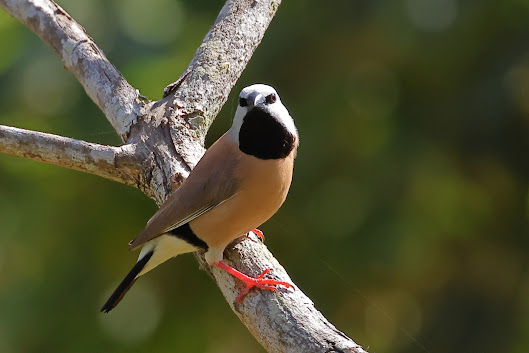
Lament for southern Black-throated Finches

Hollow logs for at risk birdies? Nature's nest boxes if you please Oh, such a clever wheeze So gather in twos and threes? Hundreds you w...