But it's brown, why's it called a Black Butcherbird? I'm glad you asked. In North Queensland - but not too far north - Cracticus quoyi race rufescens comes with either black or rufous young, in the same nest sometimes. The rufous birds change to black in their second year (note black emerging on bird's left wing. They'll also stick around and help their parents feed the next generation.
But it's brown, why's it called a Grey Teal? I'm sorry you asked, because I've no idea. Possibly because calling it brown would confuse it with Chestnut Teal. The species confuse themselves and others by hybridizing sometimes.
But it's black, why isn't it called the Yellow-streaked-necked-male Bittern? Ha! They get it right sometimes, though the female isn't really very black.
Don't ask me how the Darter managed to escape the colour determinists, though it did get saddled with the tag Snake-bird, which, I'm pleased to say, nobody has ever used in my experience. I'd much rather go for Very Twisty Neck Bird, but that's a bit colourless.
And there's obviously too much white everywhere and it's such a boring colour anyway the colour must come from a really really exciting name, such as Intermediate Egret. Not Great or Little or Reef. All too dull, dull, dull. Intermediate, now that's a name with zing. Like a Bill Shorten zinger! Talk about colourful. But actually something in this picture does bring him to mind ...
Showing posts with label Black Butcherbird. Show all posts
Sunday, January 17, 2016
Monday, September 19, 2011
Catching up in black and white
Cyclone Yasi didn't blow White-browed Robins (Poecilodryas superciliosa) away from Tyto but did change their behaviour. They now spend more time higher in trees because of stripped and sunnier undergrowth. Today's distant sighting sets black-and-white theme.
Black Butcherbird (Cracticus quoyi) caught out away from shadows at Macknade (near one of my crocodile sites).
Spangled Drongo (Dicrurus bracteatus) sparkles on pandanus stump in Tyto.
Little Pied Cormorant (Microcarba melanoleucos) in morning sunshine by roadside pool near Toobanna.
Click pix to enlarge
Black Butcherbird (Cracticus quoyi) caught out away from shadows at Macknade (near one of my crocodile sites).
Spangled Drongo (Dicrurus bracteatus) sparkles on pandanus stump in Tyto.
Little Pied Cormorant (Microcarba melanoleucos) in morning sunshine by roadside pool near Toobanna.
Click pix to enlarge
Sunday, April 5, 2009
Black Butcherbird too close

Black Butcherbirds (Cracticus quoyi) don't spend much time in Tyto and those that do often are quieter than in more usual habitats such as denser rainforest or thick belts of mangroves. Came upon two foraging through guava thickets today. Never any chance of photographing them together, but one went out of its way to get in frame. It landed on leaf litter close to my feet. Almost impossibly close for my lens, in fact, and, worse, almost totally hidden by guava trunks. Adding farce to frustration, along came a long-necked turtle on the dry litter - and scared the bird back into the understorey! Amazing that the above picture is even slightly sharp about the eye, since it was handheld at 1/30th second.

Here's another head, taken under easier circumstances, but also showing a drawback of using long lenses in relatively low light conditions. The Willie Wagtail is one of the Tyto hide resident pair, featured mouth full of dragonfly in earlier posts. Attractive enough pose, but notice the green cast where the black of the bird's outline shades into the distant background. Shorter lens, with greater depth of field, and/or fill flash would offset the effect, I think. Could use in-camera flash except it annoys birds at close range. And I keep forgetting to create a cheap slip-on diffuser. One day!

After the heads, comes a tail. Red-backed Fairy-Wren has nearly completed this nest, which it has sited atop bladey grass close to and almost facing the largely redundant Grass Owl viewing platform. It's lucky that few hopefuls any longer spend their evenings seeking the departed owls (which may only require a mouse irruption to return: or habitat change: or goodness only knows what). The female has done all the nest building. No sign of any male in area. Makes me wonder given the 'naive' placement of the nest if this might be a young bird playing house. As always, time will tell. I've resisted using the obvious heading, but can't resist having the bird ask: 'Does my bum look big in this?'
Subscribe to:
Posts (Atom)
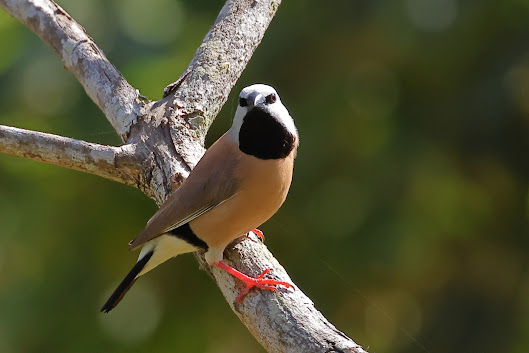
Lament for southern Black-throated Finches
Hollow logs for at risk birdies? Nature's nest boxes if you please Oh, such a clever wheeze So gather in twos and threes? Hundreds you w...
-
Hollow logs for at risk birdies? Nature's nest boxes if you please Oh, such a clever wheeze So gather in twos and threes? Hundreds you w...
-
White-faced Heron stands up and begs picture be taken at Tyto. The birds can develop some trust in people, but I've never found any aro...
-
Who gives way on footbridge, Yellow-spotted Monitor or unspotted bird watcher? Naturally, dinkum locals have right-of-way. I step aside, Spo...