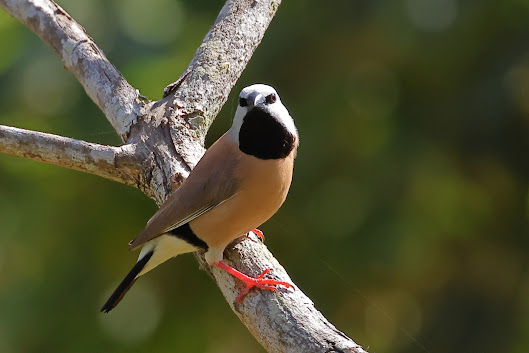
Bit of a grab bag for Santa's night. Start with the best first on Xmas Eve, shall we? Besides which, pun lodged in my grey matter and refused to be erased. So, Black-faced Woodswallow (Artamus cinereus) strikes ageless pose in the later afternoon light.
I'm repaying the species with kindness after one of their kind recently took against me. For unknown reason it began buzzing me when I neared its evening perch on a nearby road sign. Odd. (Years ago seagulls launched at me when marathon jogging. Something about the outline and black shorts, I think.)

Onwards and upwards. Garishly awful picture of Rainbow Lorikeet (Trichoglossus haematodus) serves to show why Tropical North Queensland is covered in mistakenly admired Tulip trees. Many weeds, sadly, look oh so attractive!
The profuse seed heads hold huge numbers of feather-light capsules in triple stacks. Lorikeets love them but are fussy about it, feasting for a day or so on some trees, ignoring others, then quitting the area.
The birds carry seeds away of course. But their feeding helps loosen and scatter huge numbers of seeds. The wind does the rest. Some days, tracks in Tyto are almost covered by the thumbnail-sized seed envelopes. No wonder the woodland is full of seedlings.

Onwards and inwards. The Azure Kingfishers (Ceyx azureus) have flown the burrow. Must have been two or three days ago. I suspected as much yesterday when pictured bird sat and stared unconcerned at me for about half an hour.
It had turned up without calling, and without any fish in bill. Nervy at first, it settled to an occasional head bob. Encouraged, I edged closer on hands and knees, then, clumsily, on bottom, like a rower sliding forward.
If a kingfisher can be amused, this was such a bird. I inched closer till only the pool's width separated us. It never flinched. I asked after the family and got only smug silence as answer. I looked away briefly and it was gone.

Today, I returned. No sight, sound or sign of kingfishers, apart from the tidy hole in the bank. Carefully inserted leafy branch into tunnel. Nothing to feel but the tunnel's earth. And only an earthy smell on the leaves after withdrawing the branch.
Here's the curious thing. I'm not at all downcast about missing the exit of the young birds. It was always going to be a matter of luck. And thoughts of getting good pictures met the reality that professionals would use fixed cameras, motion sensors and auto flashes.
So I count myself lucky to have had about two months off and on with two glorious and secretive little birds. I learned a tiny bit more about them. And a bit more about myself.
 Finally found a Forest Kingfisher (Todiramphus macleayii) showing a bit of patience and trust at Tyto this week. Just couldn't encourage the bird to sit on a thinner branch and get into full sunlight (click top pic to enlarge).


 So much for colour. What about sounds? I've often been struck by what appears in honeyeaters to be more curiosity about strange noises than other birds show. This White-gaped Honeyeater today seemed to react to the Canon's clattering shutter.


 This oddly coloured Grey Whistler (Pachycephala simplex) arrived at the rainforest pool today in company with two others. But they didn't seem to be getting along. The small rufous 'ear patch' may perhaps mark the bird as a juvenile. I can't recall seeing anything similar and the guide books haven't helped.
 Thought I had a sharp shot of this Azure Kingfisher carrying a fish for its nestlings (burrowlings?) yesterday, only to find shaky tripod and high ISO rendered the bird blurred and looking as if I'd gone mad with the saturation slider. On the plus side, the bird went almost straight to the burrow. The minus side? An hour's wait and no more action.
 Today, this male Red-backed Fairy Wren carrying a red enticement for females danced here and there on the Scleria. Just wouldn't stay still and unobscured long enough for anything better than this hasty effort - and many others even less successful.
 Finally, this Tawny Grassbird the other day led me a circular dance through long grass and under low trees. Round and round we went, the bird singing heartily and me muttering mightily. It might look a draw, but I think the singer more or less won the day.